Support Ops & Teams
AI & Automation
Published on
16.08.2026
Last updated on
23.09.2026
Customer service skills resume: what actually moves CSAT scores

Valentyna
VP of Customer Support

Valentyna
VP of Customer Support
TL;DR: AI now handles roughly 30% of service interactions and is projected to reach 50% by 2027. In a hybrid AI and human model, automation takes the predictable workload, and humans own everything requiring judgment, emotional intelligence, and nuance. That shifts what hiring managers should screen for. Hard skills are baseline expectations now. The skills that actually predict CSAT scores are empathy, de-escalation, ownership, multilingual ability, and tone control under pressure, and everyone should be backed by a metric. EverHelp's 83%+ CSAT across 100+ projects is built on this exact standard.
What does a strong customer service skills resume signal to a hiring manager in 2026? Proof of resolution quality, not a list of personality traits. According to Salesforce's State of Service report (2025), AI already resolves roughly 30% of service cases and is on track to handle 50% by 2027. That means the interactions reaching human agents are increasingly complex, emotionally charged, and judgment-heavy. A candidate whose resume leads with "excellent communication skills" and "team player" is presenting experience that overlaps significantly with what automation already handles.
When our HR team screens candidates, we look for evidence that a person can protect CSAT on the cases that matter most. Our excellent customer service framework defines that standard: outcomes first, descriptors second.
"Excellent communication skills" appears on roughly 9 in 10 customer service resumes, and it tells a hiring manager nothing actionable. The same applies to "problem solver," "customer-focused," and "works well under pressure." For those screening contact center outsourcing candidates at scale, these phrases describe presence, not performance. The signals worth looking for are CSAT scores, FCR rates, escalation control, and channel-specific results tied to a named tool or workflow.
When screening quickly, five indicators separate credible candidates from filler:
CRM proficiency was a differentiator two years ago. Today, it is an entry requirement. AI tools are now scoring 4.1/5 on CSAT for routine interactions, approaching the 4.3/5 average achieved by well-trained human agents. The performance gap has narrowed to emotional complexity. When screening for roles in a hybrid AI and human support model, the skills worth prioritising are those that AI handles poorly: nuance, frustration management, ambiguity, and language fluency.
Most hiring guides and job descriptions list desirable skills without explaining what they actually mean. What follows connects each skill to a specific metric, so hiring managers know what to screen for, why it matters, and how to verify it before making an offer. Recruit CRM can be used to keep those candidate details organized throughout the screening process.
Empathy is not a personality trait to note on a scorecard. It is a trust mechanism that directly predicts First Contact Resolution rates. When agents make customers feel heard, customers share the full context of their issue upfront rather than a partial version of it. That complete context is what enables FCR. According to Atlassian's service benchmarking data, every 1% improvement in FCR produces roughly a 1% improvement in CSAT. Empathy is the upstream driver of that chain. A candidate who screens as genuinely empathetic in an interview is statistically more likely to produce higher FCR scores in the role.
What to look for on a resume: Outcome-tied language such as "Maintained 87% FCR on complex billing inquiries by surfacing root issues before proposing solutions." Flag any candidate who describes themselves as "empathetic" without a supporting metric.
How to spot it in practice (interview or written communication): Ask the candidate to walk through a difficult customer interaction. Strong candidates describe the customer's emotional state before the technical problem. They explain how they gathered context, not just how they delivered a solution. In written communication samples, look for acknowledgment of the specific issue before any resolution is proposed. Generic openers like "I apologise for the inconvenience" without any personalisation are a warning sign.
In environments that run a hybrid AI-and-human model, human agents increasingly receive handoffs from AI that could not resolve the issue. The customer arriving in a human queue is often already frustrated. De-escalation is the first skill tested on every difficult ticket, and its importance grows as automation handles a larger share of routine volume. Proactive customer service habits compound the effect: agents who anticipate frustration before it escalates consistently produce better post-contact CSAT scores.
Effective de-escalation follows a consistent structure: validate the emotion, confirm the facts, propose a clear next step. "I completely understand why that's frustrating. Let me pull up your account now and walk through exactly what happened." For ecommerce teams, our team has compiled ready-to-use response templates covering exactly this kind of interaction in our ecommerce customer service email templates library, built for support managers setting tone and quality benchmarks.
What to look for on a resume: Post-escalation CSAT scores, complaint reduction rates, or retention outcomes on difficult cases.
How to spot it in practice (interview or written communication): Ask for a specific example of a difficult customer interaction. Look for the validation-first pattern. Candidates who jump to solutions without acknowledging frustration are a de-escalation risk. In written samples, warm but direct language signals competence. Generic scripted phrases signal the opposite.
Ticket bouncing (a case transferred between agents without resolution) is one of the most reliable predictors of low CSAT. Every handoff adds friction, and every friction point registers in the post-contact score. Agents who take genuine ownership of complex cases, see them through to resolution, and apply sound judgment about when escalation is actually warranted (rather than convenient) protect satisfaction scores in ways that are measurable and consistent.
Ownership also means reading customer wants versus needs with enough context to interpret policy rather than just apply it. An agent who handles a long-tenured customer's first billing dispute differently from a repeat disputer is exercising exactly the kind of judgment that reduces repeat contacts and protects long-term retention. Our customer support teams are built around this principle.
What to look for on a resume: Reduced repeat-contact rates, cross-functional case resolution without escalation, or any example showing that the candidate weighed contextual factors rather than defaulting to a policy rulebook.
How to spot it in practice (interview or written communication): Ask what the candidate does when a case falls outside standard policy. Strong candidates name the criteria they weigh. Weak candidates default immediately to "I escalate it." In written samples, look for first-person ownership language throughout: "I resolved," "I coordinated," "I followed up," rather than passive constructions that obscure individual accountability.
This is the most underrated hiring signal in customer service, and most screening processes give it far too little weight. We support customers in 30+ languages, and live chat (the channel where multilingual agents operate most often) leads all support channels at 83% Average CSAT. When an agent can handle a French or Spanish inquiry without routing to a specialist, a significant friction point disappears entirely. Every escalation triggered by a language gap represents a near-certain CSAT drop and a measurable delay in resolution.
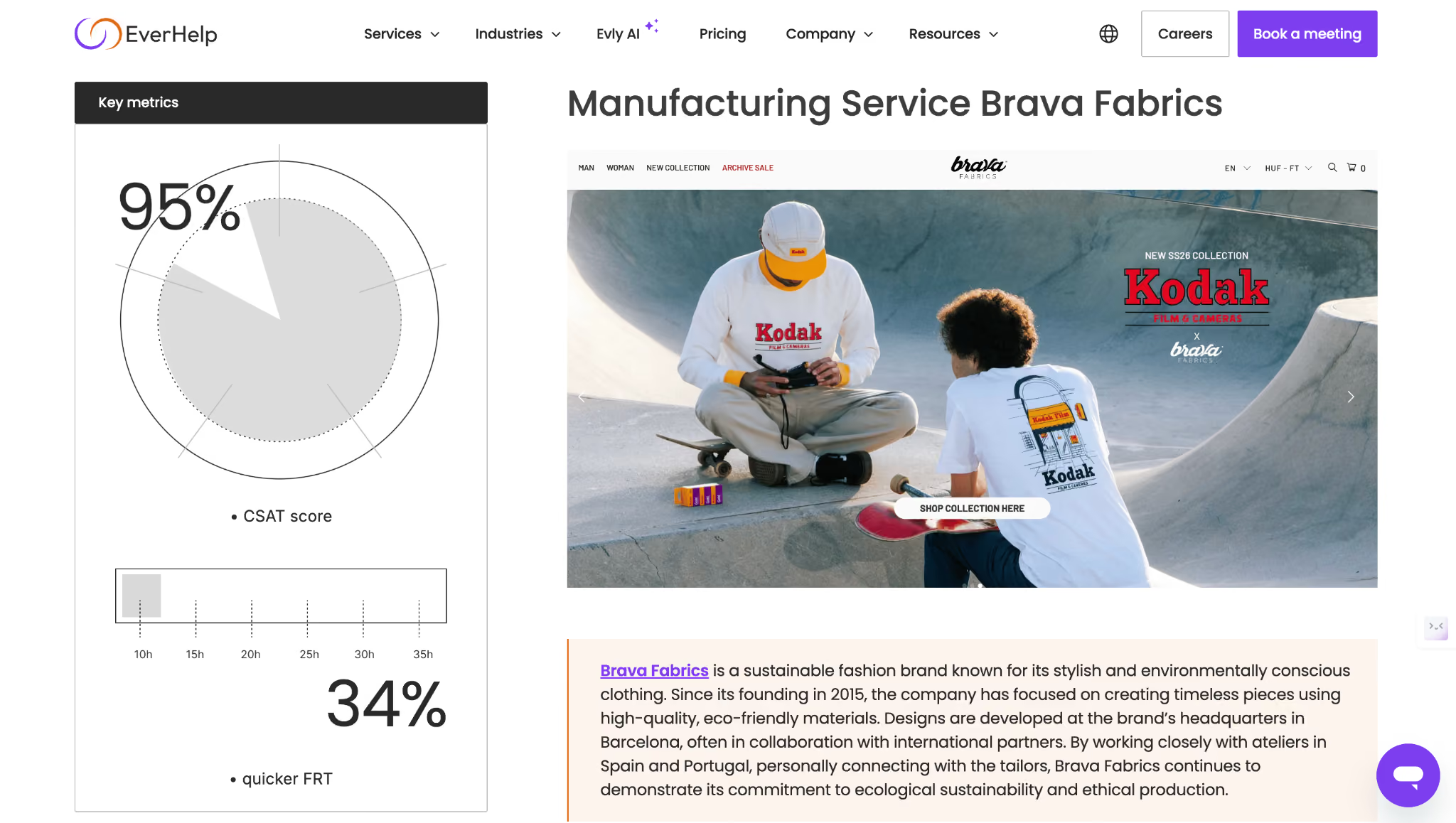
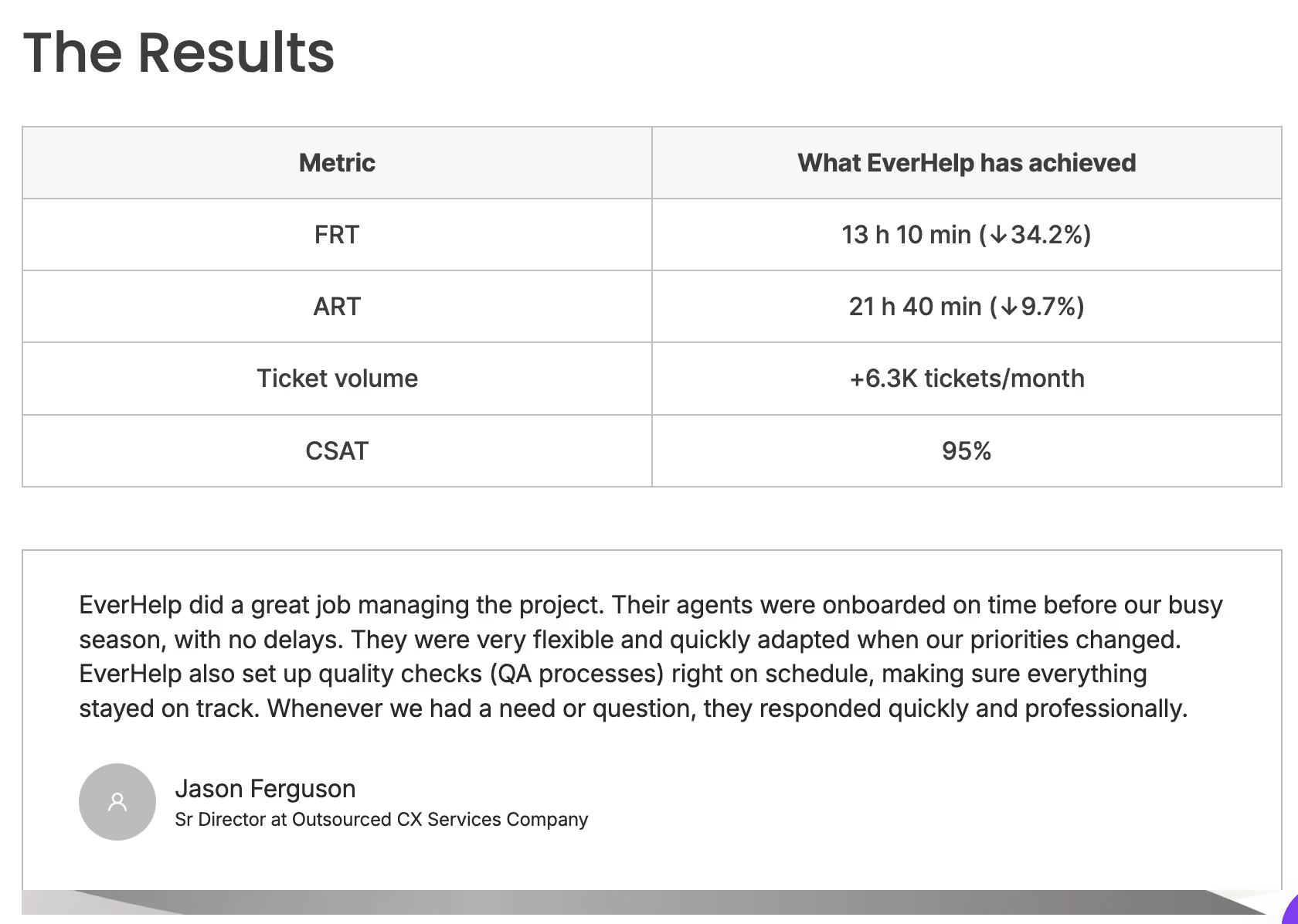
The difference in outcome is significant. Across our multilingual projects, including work with clients like Brava Fabrics, where agents handled multiple European languages natively, we consistently see above-benchmark CSAT when language coverage removes the need for escalation.
On that project, native-language agents not only resolved tickets faster but also showed noticeably higher customer engagement: customers wrote longer, more detailed responses, shared more context upfront, and left more positive post-contact ratings compared to escalated interactions handled through a language intermediary. Agents reported higher satisfaction in those conversations, too, which reinforces what our HR team already knows: engagement quality on both sides of a conversation is what sustains high CSAT over time.
Compare that to the 26-point gap between live chat CSAT (87%) and email CSAT (61%), where language friction on slower channels compounds the dissatisfaction. Meeting cultural customer service standards in a customer's own language is not a logistics preference. It is a measurable driver of satisfaction and churn reduction.
What to look for on a resume: Languages listed with real scope, including percentage of volume handled, escalation rate attributable to language gaps, and CSAT scores on those specific tickets.
How to spot it in practice (interview or written communication): If the role involves multilingual coverage, test written tone in the relevant language during screening. Fluency in customer service register matters as much as vocabulary. A candidate who translates accurately but loses warmth in the second language will produce lower CSAT on those tickets.
{{cta}}
Live chat CSAT sits at around 87%. Email CSAT averages closer to 61%. That 26-point gap is not a channel problem. It is a skills gap. Bad response times cost satisfaction points in a well-documented way, but fast responses in the wrong register (too clinical, too brief, too automated-sounding) produce equally poor scores. The skill that actually moves the number is speed combined with tone calibration. Both are trainable, both are measurable, and both are directly connected to always-on resolution quality at scale.
What to look for on a resume: Channel-specific CSAT scores alongside volume figures. High satisfaction scores on fast-paced channels like live chat indicate this skill is present and operational.
How to spot it in practice (interview or written communication): Give candidates a written scenario with a short response window. Look for replies that are clear, warm, and specific. A response that reads like an automated template is a tone-control failure regardless of how quickly it was written.
The best customer service resume skills examples are role-specific, channel-specific, and tied to ticket complexity. When screening, the framing around each skill matters as much as the skill itself. Skills for a customer service resume should reflect the environment where they were applied, because context is what makes a claim credible rather than generic.
When screening entry-level or generalist candidates, our HR team looks for demonstrated qualities of good customer service, including listening, documentation accuracy, and channel fluency, backed by measurable outcomes. Strong candidates at this level present bullets like these:
Each bullet contains a channel, a behavior or tool, a metric, and an outcome. That is the structure worth requiring.
In 2026, CRM and ticketing system proficiency are entry requirements, not differentiators. What separates a useful hard skills section from a generic one is whether each tool is paired with a demonstrated outcome. When screening for CX optimization roles, look for candidates who show operational impact from their tools, not just familiarity with them. "Used Zendesk macros to standardise responses and cut average handle time by 18%" signals operational maturity. "Proficient in Zendesk" does not.
A well-structured technical skills section tells hiring managers how quickly a candidate will reach full productivity. For our HR team, this matters beyond onboarding speed: agents who ramp slowly introduce CSAT inconsistency during their adjustment period. The technical stack worth verifying includes CRM platforms (Zendesk, Freshdesk, Salesforce Service Cloud, HubSpot), live chat tools (Intercom, LiveChat, Drift), AI-assist and chatbot handoff workflows, CSAT dashboards and SLA reporting, and collaboration platforms for cross-functional escalation management.
The benchmark our HR team applies: action verb + channel or context + tool + metric + outcome. Two to three metrics per bullet. More than that, and the credibility dilutes.
Here is the perspective no external hiring guide can replicate: 86% of our team leads were promoted from within. The people on our HR team who evaluate candidates were once agents themselves. They have seen which resume signals translate into on-the-job performance and which ones consistently disappoint, because they have lived on both sides of the hiring decision.
When reviewing candidates for contact center outsourcing roles, our HR team screens for:
Agent retention is a CSAT driver that most hiring guides ignore entirely, and it is one of the most costly blind spots in customer service hiring. According to SHRM (2024), replacing a customer service agent costs between $10,000 and $20,000 and takes 60 to 90 days to reach full productivity. New hires are not just slower: they handle nuance less reliably, escalate more frequently, and produce lower CSAT on complex cases while ramping up. The data is direct: tenured agents consistently produce higher CSAT scores on complex cases than agents still within their first 90 days, because experience is what builds the judgment and composure that satisfaction scores depend on. Team instability creates service inconsistency, and service inconsistency is what quietly damages CSAT scores at scale.
Our 89.8% agent retention rate is a direct consequence of hiring for the right traits and supporting them well. Experienced agents handle ambiguity better, maintain quality under volume pressure, and contribute to the team consistency that keeps CSAT stable across projects over time. Our 83%+ CSAT across 100+ active projects holds in large part because our teams stay, develop, and improve. You can see how these traits map to long-term outcomes in our CX optimization work.
Salesforce's 2025 State of Service report puts AI's current share of resolved service cases at roughly 30%, with a projected jump to 50% by 2027. The cost of AI resolution continues to fall, making automation the default for anything rule-based and predictable. What remains for human agents is everything that requires judgment.
Password resets and account access (est. 15% of total tickets)
Hiring managers reviewing resumes in 2026 should look for demonstrated performance in the second category. A candidate whose experience sits primarily in the first (password resets, FAQ responses, standard routing) is presenting a skill set that overlaps heavily with what automation already handles. The hires worth making are those who can demonstrate measurable performance in the interactions AI cannot close. That is where hyper-personalized CX lives, and where human skills generate their highest return.
Hard skills are the entry bar. Empathy, de-escalation, multilingual ability, and judgment are the human differentiators that predict CSAT. Those are the signals hiring managers should weigh most heavily in 2026.
The hiring criteria that worked five years ago (soft skills described, tools named, personality traits listed) no longer predict performance in an AI-supported service environment. By 2026, automation will handle the predictable half of the queue. What reaches a human agent is everything that requires real judgment, emotional intelligence, and accountability.
The strongest customer service skills resumes show proof of exactly that. Empathy tied to FCR data. De-escalation tied to churn prevention outcomes. Multilingual ability tied to zero language-triggered escalations. Ownership tied to repeat contact reduction. Every claim is чbacked by a metric.
That is the standard our HR team hires to at EverHelp. With 86% of team leads promoted from within, an 89.8% retention rate, and 83%+ CSAT sustained across 100+ projects, we know which signals on a resume predict real performance and which ones are filler. The practical checklist below captures exactly what we screen for. Download it to use directly in your next hiring round.
Download our free CS skills hiring checklist. Get the PDF
Help someone else stay in the know. Hit that share button!
.png)



.webp)

.avif)