Support Ops & Teams
Published on
26.06.2026
Last updated on
01.09.2026
Zendesk alternative in 2026: 8 tools + one option nobody mentions

Hlib
Delivery Manager

Hlib
Delivery Manager
Short on time? The best Zendesk alternative depends entirely on why you're leaving. If it's cost or setup, smaller teams do well on Help Scout or Freshdesk, while AI-first SaaS teams should compare Intercom. In the article below, we break down 8 tools by price, AI offerings, and channel fit, then give you a framework for choosing. And if your real problem is hiring, training, turnover, or 24/7 coverage rather than the software itself, no tool swap will fix it. That's where a fully managed model like EverHelp, with human agents plus our Evly AI, becomes the most beneficial alternative most comparisons never even mention.
The choice of the right Zendesk alternative has very little to do with feature checklists and almost everything to do with why you're leaving in the first place. Is it the cost that drives you away? Set up overhead? A roadmap that ignores your feature requests? Each reason points to what you need to look for in the next software.
The best Zendesk alternative for your team will depend on the problem you are trying to solve. Smaller teams might cut costs and admin load with Help Scout or Freshdesk. AI-first SaaS teams may find a better solution in Intercom. Below, we will discuss the next-best software options aside from Zendesk and provide you with a framework for making a sound decision.
Zendesk is a popular cloud-based, AI-powered service and CRM platform used by many large organizations and their support teams. This doesn’t mean it works for every business that tries it (otherwise, we wouldn’t have so many other competitors).
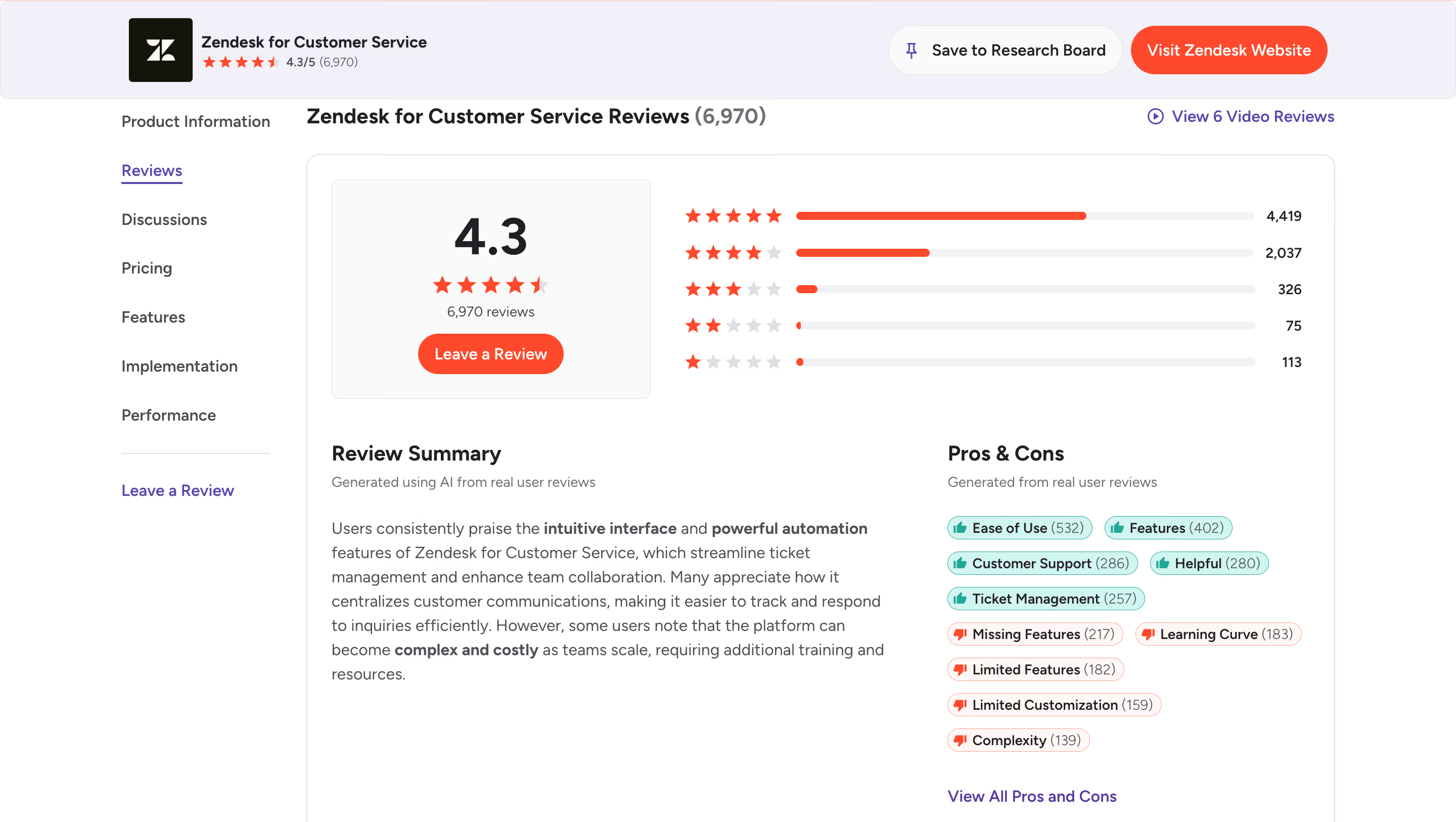
We’ve researched online sentiment and found 3 main complaints about Zendesk that recur in poor customer service breakdowns and buyer forums. G2 reviews provide a good summary of the key issues:
One of Zendesk's most popular pricing plans is Suite Professional, and it runs at $115/agent/month/. And despite covering everything that comes in the Suite Plan plus advanced automation and AI-driven insights, it still doesn’t provide teams with all the necessary features:
Now, imagine you have a 10-agent team and want them to benefit from Zendesk's AI capabilities. Well, if it’s Copilot you want, you would need to pay $ 500+ per month on top of your Suite Professional subscription of $1150. And if you want to use AI to resolve tickets, that’s an additional $1 to $2 in Zendesk bills per AI resolution.
So the seat price ends up being a small part of the bill. Zendesk implementation, agent training, and the extras you add on over the first year will eventually push the real cost well past what's advertised. And that’s exactly what online customer feedback keeps pointing to.

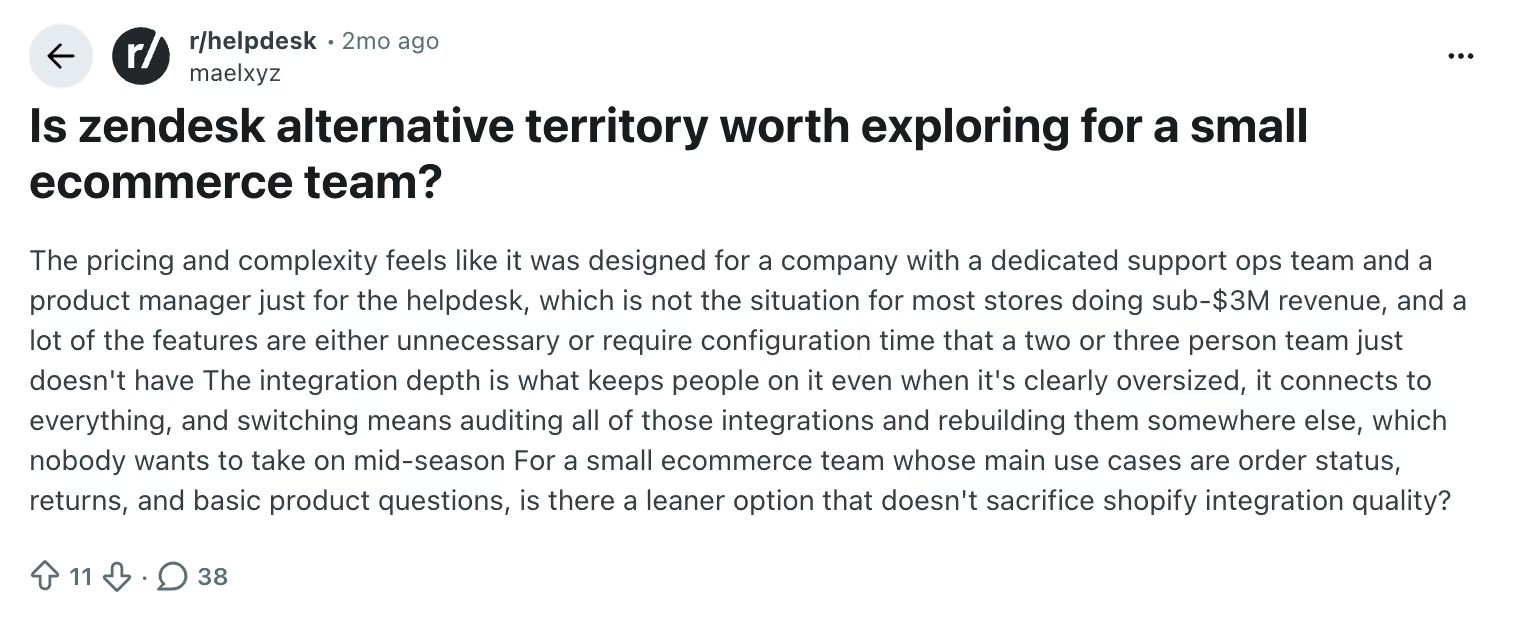
People on r/helpdesk describe Zendesk as a tool that assumes you already have a dedicated support operations function and a product manager looking after the helpdesk.
Many users on G2 also note a steep learning curve, which can be especially overwhelming for teams without the necessary technical expertise.
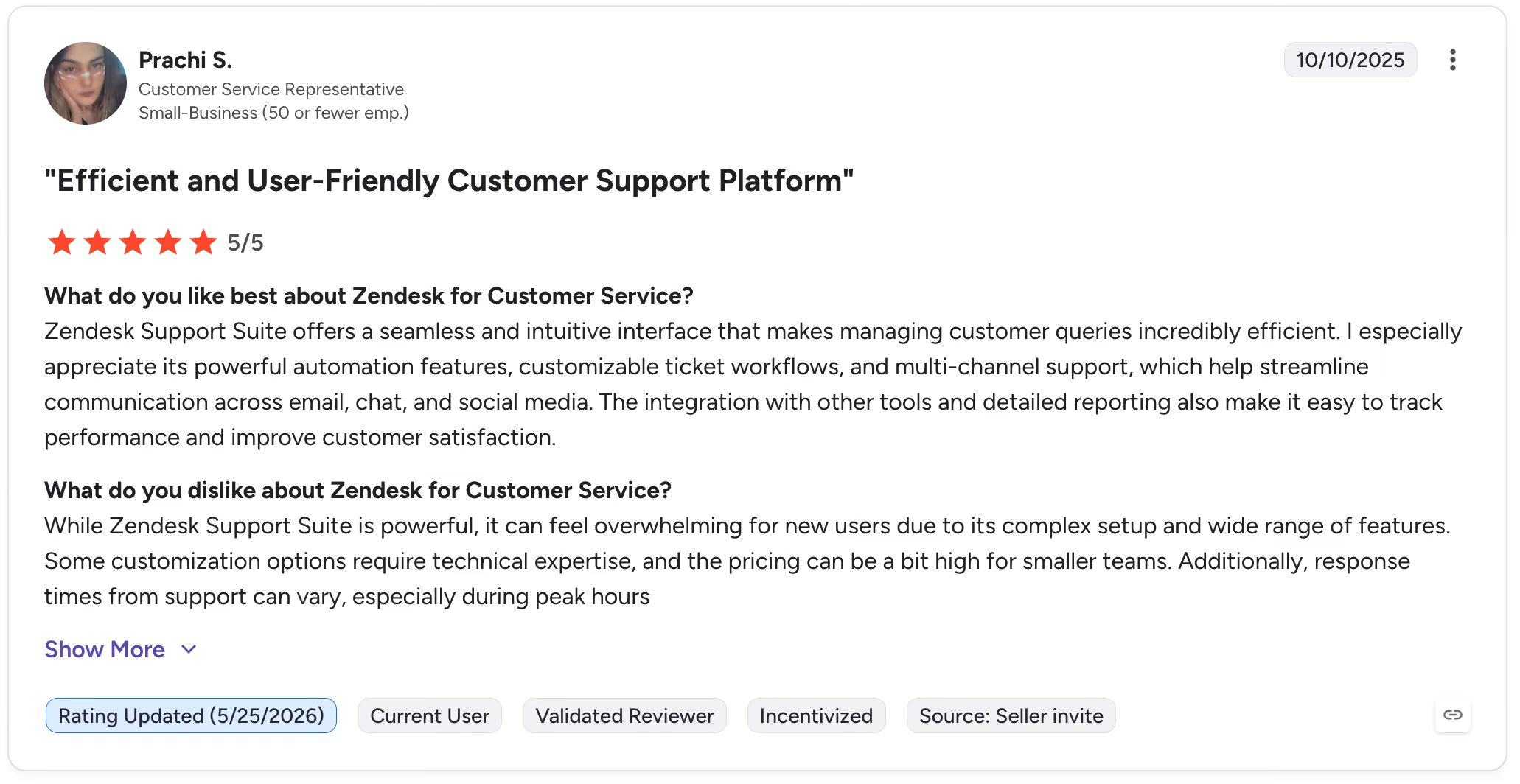
The fact that most features are behind an additional paywall makes it worse. If you want custom reporting, SLA management, customer service analytics, or skills-based routing, you'll need to upgrade the whole team's plan to unlock a feature that only a handful of your teammates need.
Some Zendesk reviews on G2 also repeatedly point out that their support team doesn’t seem to listen. Despite incentivizing users to share what they lack on the platform, Zendesk doesn’t seem to rush to implement those ideas in practice.
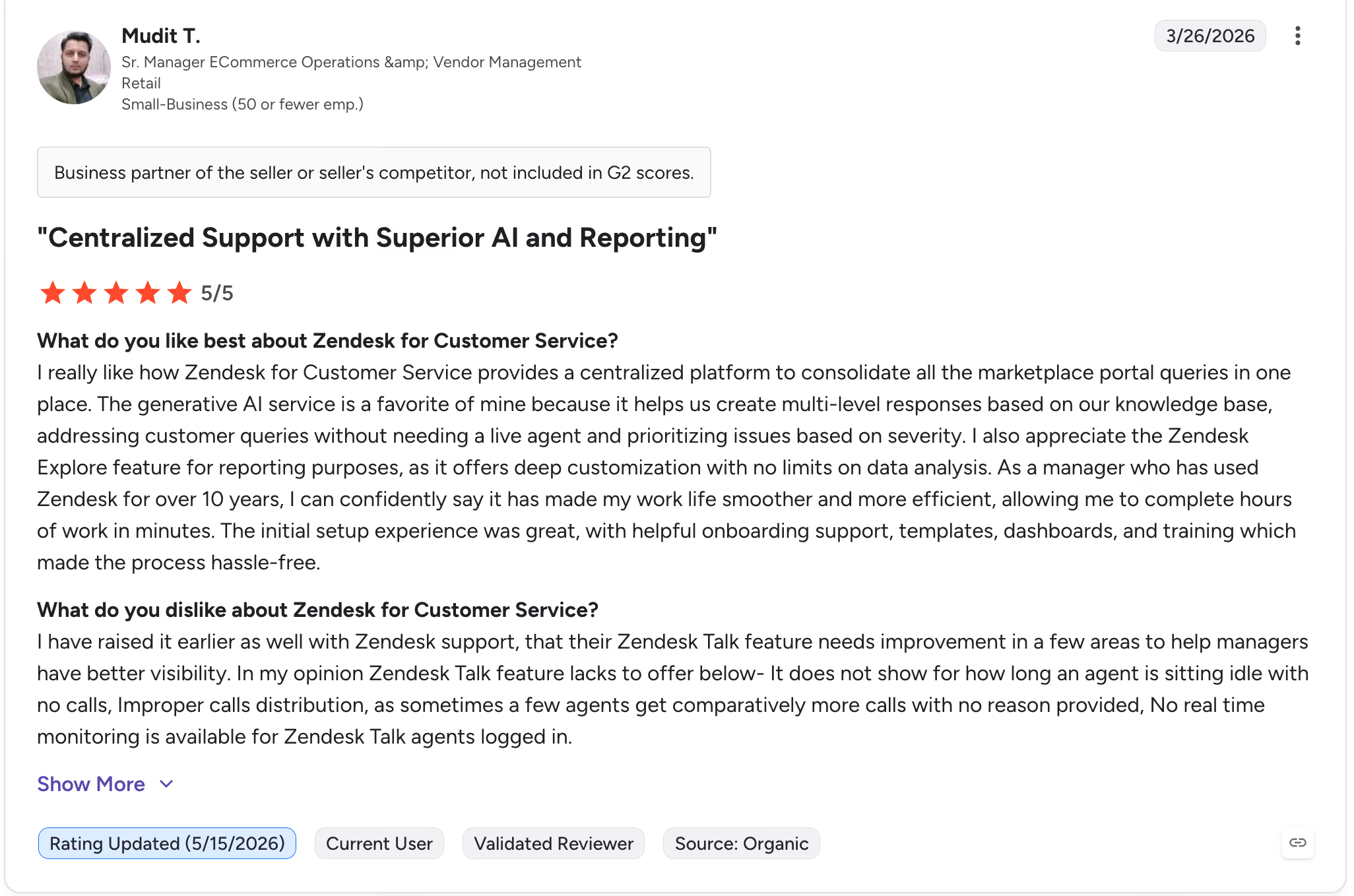
Some people believe it has a lot to do with Zendesk’s recent shift in focus towards building its AI capabilities.

So, if Zendesk doesn’t have a feature that is central to how your team works, it seems that looking at another software is a better call. Just check beforehand what your current help desk software top picks already do out of the box.
{{cta}}
Most of the time, when you look at available Zendesk competitors, you will see that each of them offers more benefits in a specific area, such as price, AI capabilities, channel fit, or ecosystem. To be completely honest, it’s hard to find a solution that will ideally cover all of your business needs. Nevertheless, you can choose an option that meets most requirements at a more reasonable price than Zendesk.
Thus, we’ve created the table below to help you select the digital customer service tools that best match your criteria.
Note: Treat the starting prices as annual-billing entry points. The actual end costs depend on add-ons and volume.
This is the cleanest alternative to Zendesk chat for small teams, bundling:
Its AI Answers feature bills at $0.75 per resolution, cheaper per interaction than Intercom. It will be a perfect fit for a customer support team of about 20 agents or fewer with email-first volume. Yet, note that it lacks SLA management, so structured queues aren't its game.
The solution offers the strongest price-to-value ratio for SMBs, especially because it includes Freddy Assist features across its plans. However, the autonomous Freddy AI Agent isn't free; it's sold in session packs at around $49 per 100 sessions. Full omnichannel customer support (chat plus voice) also requires separate Freshchat and Freshcaller subscriptions. If you're weighing Zendesk vs Freshdesk head-to-head, you might want to create a list of top-priority features for your business and base your decision on it.
This option is especially prominent for SaaS teams seeking proactive messaging, product tours, and conversational AI to drive customer support automation. Its Fin AI Agent is widely regarded as a category leader on G2, and it costs $0.99 per Fin resolution, in addition to your actual plan seats. It also has a minimum requirement of 50 outcomes per month, which makes the minimum total price for Fin AI $49.50/month. So, if you are planning to have over 2,000 AI resolutions a month, you might want to rethink Intercom as an option, as your bill will likely grow fast.
Where this one diverges from the rest of the list is scope: Konnect Insights isn't just a helpdesk, but a customer experience management platform built for teams whose customer conversations originate as often from social channels as from email. It combines omnichannel ticketing, social listening, AI-powered routing, sentiment analysis, and customer intelligence in a single platform. Its proprietary KRC engine enables cross-channel sentiment analysis and intelligent routing, while built-in BI dashboards provide actionable reporting without requiring a separate analytics tool. With pricing starting at $39/user/month and adoption across 500+ enterprise brands in 30+ countries, Konnect Insights is well suited for organizations managing complex, multi-channel customer experiences at scale.
Thanks to free tiers and trials, Tidio and Help Scout have become the obvious alternatives to Zendesk helpdesk software. For funded startups that scale quickly, Intercom, with its product-led approach, or Freshdesk with bundled AI, would be a better choice, as both give more room to grow.
Sometimes, switching to another software can indeed help you improve your support operations. If the problem, for instance, was a huge ticket backlog and long wait times due to an unorganized queue, then a solution that organizes and properly routes your tickets is enough to help you improve FRTs and finally close incoming tickets. Most of the time, however, the underlying software is not the sole reason for failing operations or declining customer satisfaction metrics.
The bigger problem is usually operational. You hire agents and wait weeks for them to ramp. Someone quits in month four, and you reset the clock. An admin spends part of every week keeping macros, routing, and integrations up to date, all while the product is constantly changing. None of that goes away when you switch platforms.
Generally speaking, a new tool won't fix the real problem if you are currently dealing with one of these issues:
Every one of those problems is about people and coverage, not insufficient features. And bringing in a specialized vendor with a team trained up to global customer service standards fixes those issues. A high-quality service provider can:
Usually, the thought of outsourcing does cause some objections. The classic fear is that an outside team will sound generic and dilute your brand. Valid concern, especially considering that 58% of enterprises say they struggle to keep a consistent brand voice across outsourced teams.
Yet, the caliber of outsourcing vendors has changed. Now, the partners that offer excellent customer service experience train their agents on your product and your tone until the replies are hard to tell apart from your own team's. Besides, many also offer customizable AI-powered solutions, trained on your product information and knowledge base.
None of this means outsourcing is right for every company. If your support is deeply technical or requires deep product understanding, you're probably better off keeping it in-house on something like Intercom. But when support is mostly just a workload you don’t want or don’t have the capacity to manage, then delegating it to a customer service outsourcing partner is a better option than simply switching from Zendesk.
Comparing a software platform to an outsourced support provider may sound erroneous. Yet both solve the same problem from opposite ends: providing support that your customers don't complain about. Zendesk hands you the controls and expects you to staff, configure, and operate everything yourself. EverHelp runs the operation for you. But how do you choose the option that will be the most beneficial for the business?
As a customer service outsourcing provider, we offer a managed support operation: trained human agents working alongside Evly, our proprietary AI agent, plugged into the stack you already use. Our goal is to provide you with a flexible support operation and your audience with personalized customer service.
So, when opting for outsourcing with EverHelp, you can be sure that the parts of support that usually eat up your week are handled for you:
We also cover any specialized needs you, as a client, may have:
Having worked with 100+ clients and noticed the industry leaning heavily towards automation, we have also launched our own AI product, Evly. It allows our clients to automate processing up to 85% of standard tickets without human intervention.
With Zendesk, AI is something you pay for in layers. You start with the Suite Professional seat, add the Copilot agent on top, and then pay a separate fee every time the AI closes a ticket on its own. The first two are fixed costs; the third varies with your ticket volume, making the monthly bill hard to predict. Here’s what a cost breakdown could look like for a 20-agent team.
As you can see, following Zendesk’s model, you would end up paying for tickets resolved by the AI agent as well as for agents’ seats and their salaries. Needless to say, this significantly bloats your support budget.
With Evly, the pricing is a bit different. First, there’s a monthly integration fee that covers:
Then go to the per-ticket resolution fees. These depend on which mode you are using:
As such, with our approach, you pay only for what you actually use, and the price reflects the extent of your use of the provided technology.
One thing to note here is that you will still probably need some human agents handling what AI structurally can't. In our recent AI for customer support webinar, Tidio's Chief Customer Officer, Marius Laza, shared a number that makes the point well: roughly 60% of customers who ask to be passed to a human do so because the AI could have resolved it on its own. Such a request usually has less to do with complexity than with comfort, which is why a real person needs to be ready to step in, rather than the bot pushing back with another help article.
And that’s exactly how we run support at EverHelp. Evly handles the routine, repetitive tickets, while our agents pick up the harder cases and the customers who just want to talk to a person.
Of course, liking the model and actually moving to it are two different things. What holds most teams back is the headache of pulling everything from Zendesk. That's a fair worry, and one we will try answering head-on.
Plenty of teams stay on Zendesk far longer than they should, simply because migrating feels risky. And honestly, it can be. Enterprise migrations usually take four to eight weeks, and the hidden costs tend to land 60–80% above the original quote once you factor in data mapping, rebuilt automations, and validation testing.
This is where working with us takes the pressure off, because:
We've already guided over dozens of clients through this process. For instance, we integrated Zendesk and set up an automated ticket-tagging system for our SaaS client, Skyfluence.
The point is, you don’t have to handle migration alone. You can delegate the process entirely to the support outsourcing provider, which can move your team to new software while maintaining high customer service standards.
{{cta}}
If you're still weighing your options, it helps to sort them by your own constraints rather than by feature lists. The quickest way to land on the right answer is to outline your:
Then you can match that with one of the possible solutions below and double-check your pick against the matrix that follows.
Choose a software alternative if…
Choose an alternative to Zendesk chat and live messaging if…
Choose EverHelp if…
Once you have a shortlist, run it through a quick cost-and-fit check. The matrix below sums up where each option lands.
If you've already made up your mind to leave, below is a scope document of the work your team will need to do to switch software.
If your shortlist keeps cycling through dashboards and per-seat math, the harder question is probably whether running your own support infrastructure is still worth it. Every software option here works for the right team, and we've tried to point you toward the one that fits.
But if the real drain is hiring, training, turnover, and 24/7 coverage you can't staff around, that's exactly what we built EverHelp to take off your hands. So before you change anything, book a call with our team, and we'll scope your current setup and needs and see which software or support model would benefit your business the most.
Honestly, there's no single best one. It comes down to your team. If you're small and email-first, Help Scout is a strong option. If you're an AI-first SaaS company, take a close look at Intercom. Budget-conscious SMBs usually do well with Freshdesk. And if your real headache is staffing and platform admin rather than the software itself, that's when outsourcing makes the most sense.
If you want something free to start with:
The cheapest paid option is Zoho Desk at $7 per user per month. However, keep an eye on usage-based AI fees and conversation caps. That's usually where the "free" and "cheap" tools start costing you more.
For AI-first teams and SaaS projects, yes. Its Fin AI agent is recognized as one of the most effective solutions. Just keep in mind it charges $0.99 per resolution, so the more volume you push through it, the faster your bill grows. It's a great fit if you have a small operation that can benefit from a conversational AI rather than traditional ticketing, and less so if your volume is steadily high.
For the right operation, absolutely. A help desk, whether it's Zendesk or any of its competitors, is just a tool your team operates. When you migrate to a new one, you change the interface, but everything around it stays on your plate: hiring agents, training them, covering nights and weekends, keeping the platform configured as your product changes. So if those are the things actually wearing your team down, a new tool won't help. An expert outsourcing provider, on the other hand, helps you restructure your support processes and takes responsibility for running them to improve your service and keep customers happy.
Help someone else stay in the know. Hit that share button!
.webp)

.webp)

.avif)
.avif)
.webp)
.webp)