Security & compliance at the core of customer service
Not all outsourcing vendors take compliance seriously. But we do. Here's exactly how we protect your data, your customers, and your reputation.
Book a meeting

Not all outsourcing vendors take compliance seriously. But we do. Here's exactly how we protect your data, your customers, and your reputation.
When a customer contacts your support team, they're sharing private information and expecting it to stay that way. And a single breach can be enough to lose them permanently.
The global average cost of a data breach in 2025, according to IBM
Consumers won’t buy from organizations they don’t trust with their personal data, Cisco reports
Is the average non-compliance cost 2.65× higher than the total compliance costs, as per Cisco
Organizations report that customers, investors & suppliers are increasingly requiring proof of compliance, according to Vanta



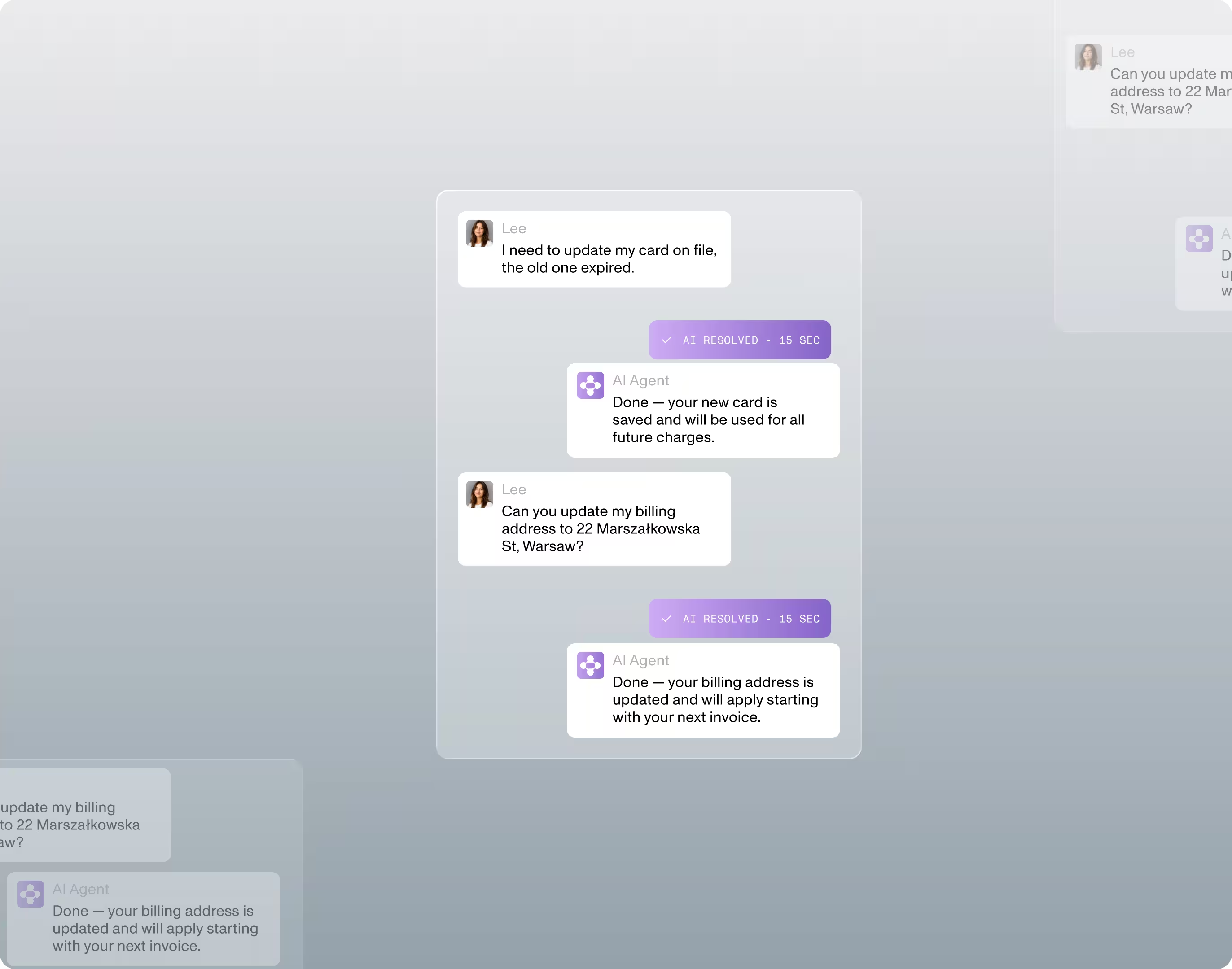
From chat to voice to social, EverHelp’s 1000+ global agents deliver 24/7 outsourced contact centre services and personalized customer care
Having certifications is not enough to protect your support system. So we built a framework for day-to-day operations that maintains security through every interaction.
Within our approach, access to customer data follows a role-based model (RBAC), where each agent operates strictly within their functional scope. Payment data is the most tightly restricted, and access permissions are reviewed regularly, so exposure doesn't expand as roles change.
At EverHelp, security training is an ongoing practice. Every agent signs an NDA and Acceptable Use Policy before going live, covering data handling and disclosure restrictions, because security hygiene works best when it feels like second nature.

In our partnerships, MFA is enforced across every internal tool. All work devices run specialized security software, and any processed data is encrypted in transit and at rest to minimize exposure at every stage.

Our agents follow clearly defined SOPs for every data-sensitive task, so nothing relies on individual judgment in the moment. All actions are logged, changes go through a controlled process, with incident response procedures in place for handling any arising issues.
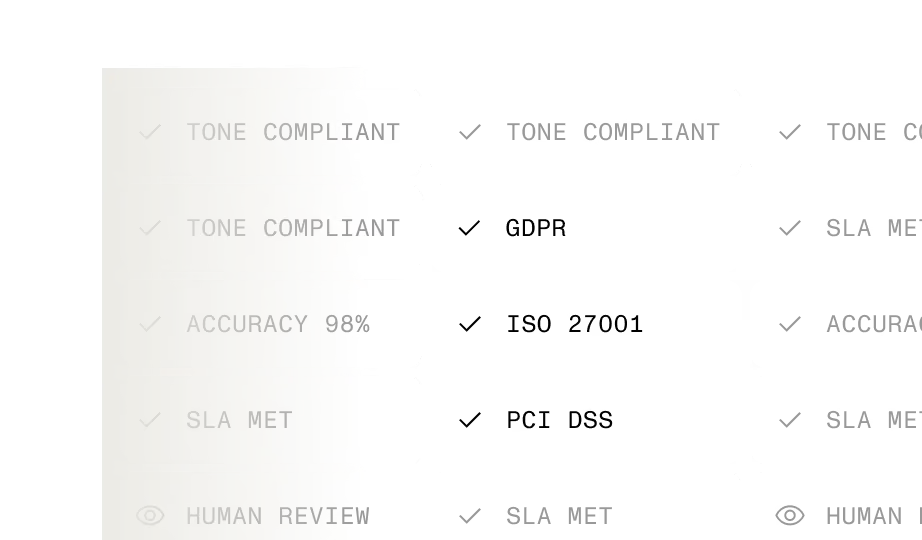
Our compliance is built around the GDPR, ISO 27001, and PCI DSS frameworks, backed by regular risk assessments. Data minimization is our working principle: if it isn't needed for the task, it isn't collected. The same standards extend to all third-party tools and suppliers.
Every agent is required to secure sensitive information whenever they step away – locking screens, storing physical documents in locked drawers, and keeping no passwords visible near their workstation. Unattended data, in any form, is a risk we don't leave to chance.

Security and performance only mean something when you can see them working, and we make sure you never have to chase us for an update.
.svg)
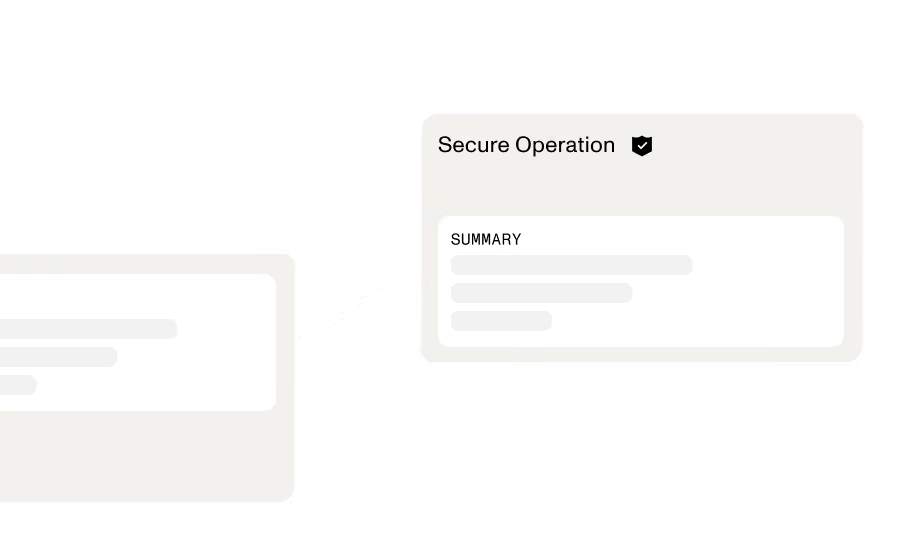
When a security anomaly is detected, we notify the affected client within 24 hours. From that point, status updates go out through agreed channels until the issue is fully closed. And once it is, you receive a summary report covering the outcome, the root cause, and any follow-up actions we recommend.
.svg)
Our partners receive structured reports at intervals that work for their team – weekly, bi-weekly, monthly, or quarterly. On top of that, quarterly business reviews give us a dedicated space to assess SLA attainment together, address any workflow gaps, and align on priorities for the period ahead
.svg)
Our Delivery Managers and QA teams monitor SLA adherence, first-response times, resolution rates, CSAT, and quality scores. When something needs fixing, we update it right away without waiting for a scheduled review to flag it. Additionally, our quarterly reviews audit inquiry structure.
Yes, EverHelp holds PCI DSS certification. This means every support interaction involving payment data runs inside a controlled, audited environment where cardholder information is protected at every stage of the customer journey. When working with us, you can rest assured that your customers' payment details are handled under the same security standards that govern the most sensitive operations in the payment card industry.
ISO 27001 is an ongoing commitment to secure data management, which means that:
No certification guarantees zero incidents. What ISO 27001 does is ensure that risk is identified, managed, and documented to a globally recognized standard.
We treat any request to delete personal data as a time-sensitive operational task. We:
Where legal retention obligations exist – for example, financial records required under applicable law – we'll identify those exceptions clearly rather than applying a blanket deletion that creates compliance gaps elsewhere.
Our approach to internal threats monitoring combines technical controls with people-level accountability. Every agent signs a confidentiality agreement covering data handling, disclosure restrictions, and obligations upon leaving. Mandatory security training is completed before going live, and MFA covers access to every internal tool. From there:
When a suspected security anomaly is detected, we notify the affected client within 24 hours. From that point, our team maintains regular status updates through agreed-upon channels until the issue is fully resolved.
Every incident gets classified by severity the moment it's detected, with clear ownership assigned and containment measures applied in parallel with a root cause investigation.
For anything mission-critical, the right people are pulled in immediately, and it becomes the team's top priority until it's closed.
It depends on your setup, but security integration is included in our onboarding process from the very start. For standard tooling (ticketing platforms like Zendesk, MFA systems, and cloud-based environments), we work directly within your existing infrastructure, keeping control firmly on your side.
Where your security requirements go beyond our standard controls, we review them in detail before engagement begins, identify any gaps, and agree on a resolution timeline. We don't go live until both sides are satisfied with the setup.
In most cases, yes. Every client engagement is governed by a Data Processing Agreement that defines roles, processing boundaries, and data management obligations specific to your partnership.
If your policies call for specific access restrictions, data residency requirements, or custom escalation procedures, we can review them and see if we can align with them before launching the support operation. For EU-based clients or those serving European end-users, this includes Standard Contractual Clauses for any data moving outside the EEA. If your requirements go beyond what we can feasibly deliver, we'll tell you right away, as agreeing to standards we can't meet is simply not our policy.
.avif)

.avif)
.avif)
.avif)
.avif)