Support Ops & Teams
Published on
05.07.2026
Last updated on
01.09.2026
ShyftOff review 2026: is this agentic GigCX platform worth it?
.avif)
Andrew
Chief Commercial Officer

Andrew
Chief Commercial Officer

TL;DR: ShyftOff is a Tampa-based Agentic Workforce Delivery Platform that deploys US-based 1099 contractors in 30-minute intervals, claims 35-55% cost savings over legacy BPOs, and automates QA across 100% of interactions. The model is genuinely strong for high-volume, variable-demand contact centers with an existing CCaaS stack. The drawbacks are real: contractor reviews on Indeed and Glassdoor flag hour scarcity, platform instability, and poor support responsiveness. For teams needing a full-service CX partner with embedded AI and dedicated agents, the gig model has clear limitations.
What if you could staff your contact center the way streaming platforms staff servers: perfectly matched to demand, billed only for what you use, scaled in under an hour? That is the premise behind ShyftOff, and for certain contact centers in 2026, it is a compelling one.
The ShyftOff outsourcing provider review question is not whether the model is innovative. It clearly is. The more useful question is whether it solves your problem, at your scale, for your customers. According to ShyftOff's homepage, partners reduce operating costs by 35% or more while sustaining 98%+ quality scores. Those numbers deserve examination, as do the contractor reviews that tell a more complicated story.
ShyftOff launched in 2020 and is headquartered in Tampa, Florida. It bills itself as the world's first Agentic Workforce Delivery Platform, distinguishing itself from both traditional BPOs and workforce management (WFM) software.
Where a legacy BPO supplies dedicated teams on fixed contracts, and WFM software organizes teams you already employ, ShyftOff sources, certifies, schedules, and manages a flexible 1099 contractor workforce around your existing W2 agents and AI automation. Agents are independent contractors who self-select shifts, work remotely, and are paid only for productive time. The platform automates every stage of the workforce lifecycle:
According to ShyftOff, about 80% of contractor agents are college-educated professionals, including nurses, contact center managers, and QA analysts who take gig shifts alongside other roles. The claim is that higher agent quality supports premium CX outcomes even within a flexible model.
For a broader look at what to weigh before selecting any provider, the guide to reviewing answering services covers the evaluation criteria in detail.
ShyftOff's platform is built on three proprietary capabilities that set it apart from generic gig staffing models. Each is worth understanding on its own terms.
ShyftOff uses AI algorithms to parse agent profiles against specific brand requirements before any contractor is approved to work on a campaign. The system evaluates experience, prior performance scores, campaign-specific certifications, and availability windows to match the best available agents to each client program.
This goes beyond a basic marketplace model. Brands do not browse a directory of available agents and select candidates. The platform executes the match automatically, using the defined parameters the brand sets during onboarding. According to ShyftOff, the proprietary matching logic is one of the primary drivers of the quality consistency they claim, since agents are pre-qualified rather than generically assigned.
Priority Boarding is ShyftOff's performance-linked scheduling system. High-performing agents, ranked by quality scores, customer satisfaction outcomes, and consistency metrics, earn first-access rights to available shift schedules before lower-ranked contractors.
The practical effect is that 90% of shifts on a given campaign are covered by the same elite-tier agents, according to ShyftOff. This addresses one of the central criticisms of gig CX models: that rotating workforces means inconsistent quality. By making schedule access a performance-based reward rather than a first-come, first-served allocation, the platform creates a structural incentive for agents to maintain high standards. It also gives brands continuity without requiring fixed employment contracts.
Traditional contact center QA evaluates a random sample of interactions, typically between 1% and 3% of total volume, according to Verint, and flags issues retrospectively. ShyftOff's platform applies automated quality monitoring to 100% of interactions in real time.
The system evaluates interaction scripts continuously, scoring agents against predefined criteria including brand tone, compliance language, and resolution quality. Insights from QA are fed back into the workforce orchestration layer automatically, informing agent ranking, shift allocation, and campaign eligibility. Rather than a quarterly QA review triggering a coaching session, the loop runs constantly and acts on data without manual intervention.
For teams evaluating technical support outsourcing options, real-time QA at full interaction coverage is a meaningful capability gap compared to most traditional outsourcing models.
Understanding both sides clearly is essential before any evaluation goes further.
Cost structure
ShyftOff bills only for productive hours: no idle time, no shrinkage, no charges for training beyond the certification phase. According to ShyftOff's GigCX research, this model delivers approximately 35% savings compared to traditional BPO models by eliminating overhead and paying only for active work. The company claims 35-55% savings against traditional contract rates.
Deployment speed
Most programs go live within 30 days of asset delivery. Compared to legacy enterprise outsourcers, where implementation timelines run three to six months, that is a significant advantage for teams facing sudden volume spikes or rapid market entry.
Elastic staffing
The on-demand call center scheduling model allows brands to flex agent coverage within hours once fully onboarded. During surges, open enrollment periods, or outage-driven volume spikes, ShyftOff deploys elastic staffing pools without requiring advance headcount commitments.
Integration without displacement
ShyftOff connects to 50+ CCaaS and CX tools, including Genesys, Five9, Talkdesk, NICE, and Zendesk, without replacing your existing infrastructure. For operators who have invested in their CX stack, this matters.
Compliance coverage
PCI-DSS, HIPAA, SOC II, HITRUST, and GDPR are supported, with agents required to pass campaign-specific certifications before accessing any regulated environment.
Hour availability for contractors is inconsistent
The single most common complaint across ShyftOff reviews software and platform feedback is insufficient hours, particularly for agents new to the platform. Contractors frequently need to certify across multiple campaigns to build meaningful income. Low hour availability drives contractor churn, which undermines the consistency the Priority Boarding model is designed to create.
Platform stability issues
Multiple contractor reviews from 2024 and 2025 describe technical problems with ShyftOff's software, including system errors that result in agents being removed from campaigns for issues originating in the platform itself. Resolution times for support tickets are consistently reported as slow.
Limited dedicated account management
ShyftOff is a platform, and its support model reflects that. Brands do not receive a dedicated client success manager in the way a traditional managed outsourcing partner provides. For companies that want strategic CX oversight or hands-on program optimization, that absence is a genuine gap.
Brand depth limitations
Gig contractors working across multiple campaigns simultaneously carry shallower product knowledge than dedicated agents trained on one brand. For interactions requiring deep contextual familiarity, the gig model creates a ceiling on agent performance that certification alone cannot close.
English-first focus
ShyftOff sources from the US, LATAM, and the Philippines, but the platform is built primarily for English-language programs. Companies requiring robust multilingual coverage will find the current agent pool limiting.
Compliance is one area where ShyftOff competes directly with legacy enterprise BPOs. The platform covers the most common regulatory requirements across healthcare, financial services, and global data privacy:
Agents on regulated campaigns are background-checked, ID-verified, and required to pass campaign-specific certification at 100% proficiency before accessing any client program. ShyftOff uses an island browser approach to contain agent access to only the tools and data required for each interaction.
On the integration side, the platform connects with 50+ enterprise CCaaS, WFM, QA, and CRM systems, including Genesys, Five9, Talkdesk, NICE, Verint, and Zendesk. It functions as a workforce execution layer on top of your existing stack rather than replacing it.
{{cta}}
ShyftOff publishes several performance claims, and it is worth separating what the numbers mean operationally from how they are presented. Independently verified client case studies with named brands and audited metrics are limited in public documentation, so the table below contextualizes each figure against what it means in practice rather than simply repeating the claim.
The benchmarks are directionally credible and consistent with what GigCX models produce at the category level. The gap is third-party validation: ShyftOff's public case studies reference outcomes without naming clients or providing audited data. For procurement teams that require independently verified performance evidence before signing, that is a genuine due diligence limitation to flag.
The workforce behind the platform has its own perspective, and it matters for an honest ShyftOff reviews software evaluation.
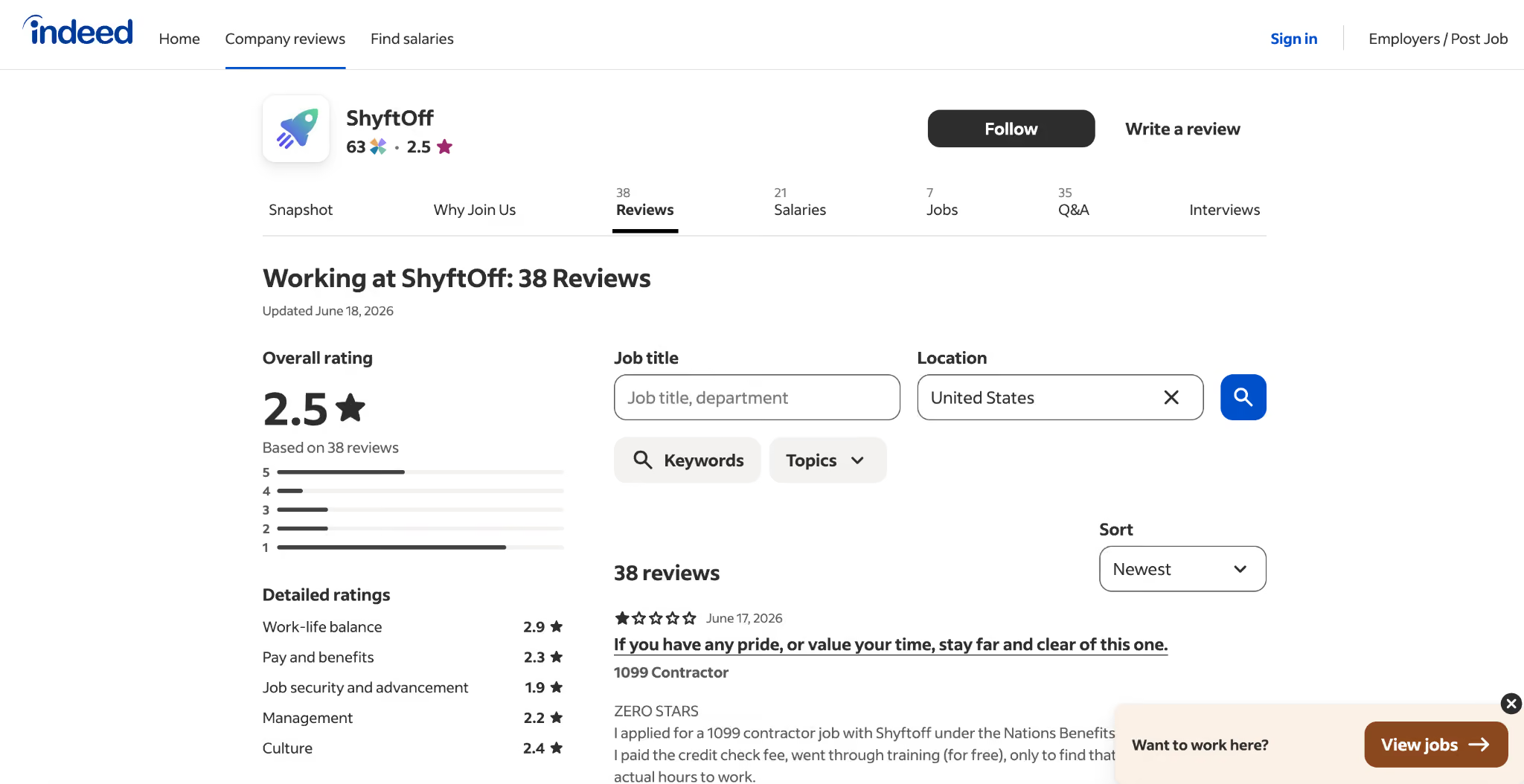
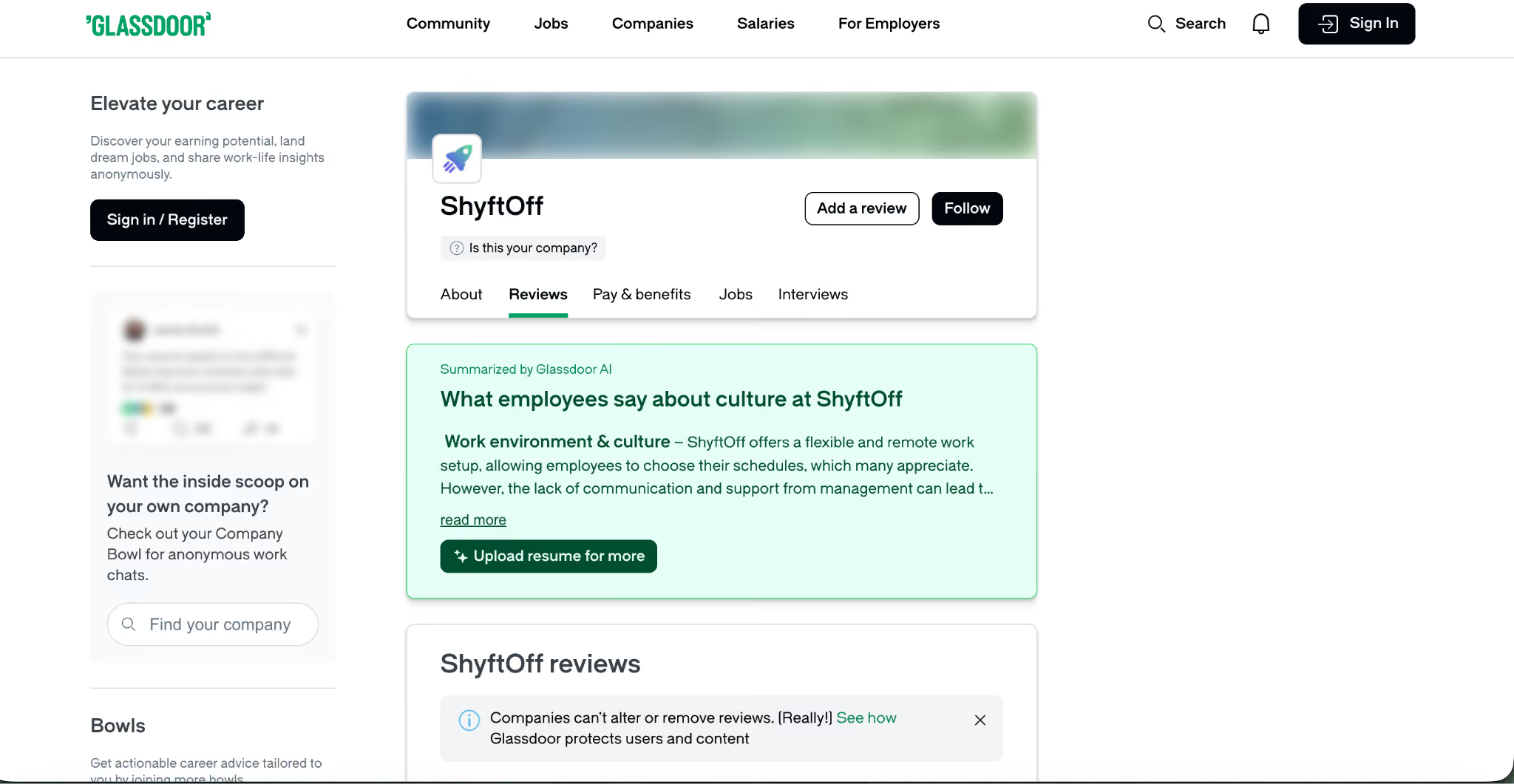
On Indeed, ShyftOff carries a 2.6 out of 5 rating based on 34 reviews (as of late 2025), with management at 2.3 and pay and benefits at 2.4. Glassdoor reviews from 2025 present a split picture.
Consistent positives across contractor feedback:
Consistent negatives that appear repeatedly:
One Glassdoor review from July 2025 noted that agents are "held responsible when there are issues with their systems." An April 2026 review described training as only a few days before agents are expected to go live, which sits in contrast to ShyftOff's published 100% proficiency certification standards.
These are not just worker experience issues. High turnover, insufficient hours, and unresolved platform problems can undermine the quality and consistency that the Priority Boarding model is designed to deliver. For any team reviewing help desk outsourcing providers, contractor satisfaction metrics are a useful proxy for service stability that rarely appears in vendor pitch decks.
ShyftOff occupies a distinct position in the outsourcing landscape. It is not a traditional BPO, not a WFM tool, and not a managed services partner in the conventional sense. Understanding how it sits against EverHelp and legacy enterprise outsourcers helps clarify which type of company benefits most from the platform.
ShyftOff's primary advantage is workforce flexibility. The 30-minute interval scheduling, usage-based pricing, and elastic contractor pool work well for contact centers facing unpredictable or highly seasonal inbound volumes. If your team runs a lean W2-based and needs to flex 3-5x capacity for specific windows without long-term headcount commitments, ShyftOff was built for that.
The platform also integrates non-invasively into your existing stack. No new telephony, no rip-and-replace, no extended implementation. For operators who have already invested in Genesys or Five9, automating just the workforce execution layer is a legitimate differentiator.
Where ShyftOff delivers workforce elasticity, we deliver end-to-end outsourced support with AI embedded at every layer. Our Evly AI agent, trained on 100,000+ real support tickets, handles tier-1 automation and routes complex issues to dedicated human agents, achieving an 85% automation rate with a 45-second average first response time.
Our model is built around dedicated teams. Every client gets agents trained exclusively on their product, backed by a 96% quality score across an 850,000+ monthly ticket volume. That depth of brand alignment is difficult to replicate with a rotating contractor pool, particularly in fintech, SaaS, or healthcare, where context and continuity matter in every interaction.
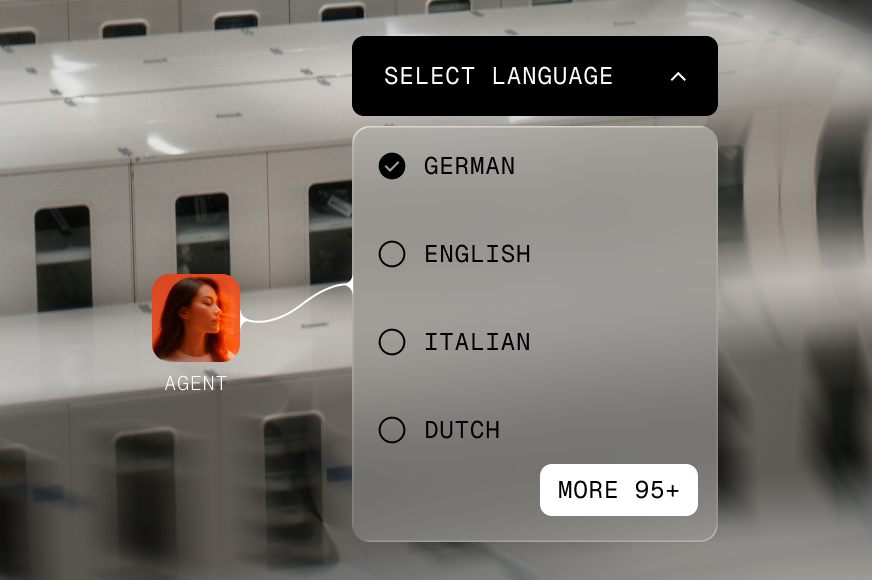
For companies evaluating multilingual support and AI strategy, our Evly AI handles 95+ languages instantly, while our human agents cover 30+ languages across four continents. ShyftOff's contractor base is primarily English-speaking with LATAM coverage available, but multilingual depth is more limited. Where ShyftOff focuses on workforce delivery, we focus on business outcomes: reducing churn, improving CSAT, and building a support operation a brand can scale into.
{{cta}}
The comparison with legacy enterprise BPOs is where ShyftOff's positioning becomes clearest, because the two models are solving fundamentally different problems at fundamentally different scales.
Foundever was formed in 2023 through the merger of Sitel Group and Sykes Enterprises, the latter acquired for $2.2 billion in 2021. It operates 130,000+ associates across 45 countries, handles 3.3 billion customer conversations annually in 60+ languages, and serves 800+ brands, including Fortune 500 enterprises. Its EXP+ platform combines operations, analytics, learning, and digital delivery in a hybrid Work from Anywhere model. Offshore delivery runs approximately $8-$14 per agent hour for standard voice programs. Implementation timelines are measured in months, and minimum commitments typically apply. Foundever has ranked on Everest Group's CXM PEAK Matrix for 13 consecutive years, a track record built on program consistency and long-term client relationships rather than deployment speed.
Teleperformance (now operating as TP following a 2025 rebrand) is the world's largest BPO by scale. Founded in Paris in 1978, it employs 446,000 people across 100+ countries, generated $11.5 billion in revenue in 2025, and supports clients in 300+ languages across 170 markets. Its 2024 acquisition of Majorel further expanded its European multilingual footprint. TP's proprietary TP.ai FAB orchestration platform and a real-time accent neutralization partnership with Sanas signal serious AI investment. For multinational enterprises running coordinated support across 20+ countries simultaneously, TP's infrastructure is essentially unmatched. For mid-market buyers, however, the sales cycle length and coordination complexity that come with that scale can be as much a barrier as an advantage.
The practical takeaway is straightforward:
What the legacy giants cannot offer is what ShyftOff does best: elastic staffing in 30-minute intervals, billing only for productive hours, and a deployment timeline measured in weeks. For contact centers where volume is genuinely unpredictable and overhead cost is a pressure point, that trade-off is worth taking seriously.
ShyftOff delivers on its core promise for the right buyer. If you run a mid-to-enterprise contact center with genuine volume volatility, an existing CCaaS stack you want to keep, and a primarily English-language operation, the Agentic Workforce Delivery Platform solves a real problem. Elastic staffing in 30-minute intervals, automated QA at 100% interaction coverage, and usage-based billing are meaningful improvements over the traditional ShyftOff call center BPO model on all three dimensions.
The harder question is fit. ShyftOff is a workforce delivery platform. It does not come with a dedicated account team, a multilingual support infrastructure, or a hybrid AI-plus-human delivery model built into the product. The contractor review data on Indeed and Glassdoor also signals that agent experience, which underpins quality consistency, has meaningful room for improvement.
For contact centers needing a flexible, lower-overhead staffing layer to complement an existing operation, ShyftOff is a credible option. For companies that want an outsourcing partner to take full ownership of customer experience across channels and scale AI alongside human agents, the model is not the full picture.
{{cta}}
Neither exactly. ShyftOff describes itself as an Agentic Workforce Delivery Platform: it sources and manages a real contractor workforce for you (unlike WFM software) but does not supply a dedicated team or program management structure (unlike a traditional BPO). It automates the full workforce lifecycle, including recruiting, certification, scheduling, QA, and payroll, which is the core distinction.
For companies evaluating what type of support model they need, a virtual telephone answering service and a platform like ShyftOff solve very different problems. ShyftOff is best suited for contact centers managing inbound volume at scale.
Brands pay only for agents' productive time: the period agents spend queued for interactions, actively handling calls or chats, or completing after-call work. There are no charges for idle time, shrinkage, or post-certification training. The company claims 35-55% savings against traditional BPO contracts. Specific rate cards are not published; pricing is structured per engagement based on volume, coverage hours, and campaign requirements.
The platform supports PCI-DSS, HIPAA, SOC II, HITRUST, and GDPR. Agents on regulated campaigns must complete campaign-specific certifications and pass background checks before accessing any client environment.
The key risks to evaluate before adopting any gigCX outsourcing solutions model:
ShyftOff delivers workforce execution automation. A full-service partner like EverHelp delivers CX outcomes: dedicated teams, embedded AI, multilingual coverage, QA frameworks, and strategic account management. ShyftOff suits operations that already have a CX strategy in place and need a flexible staffing layer. EverHelp suits companies that want an external partner to own and optimize the entire support function.
Help someone else stay in the know. Hit that share button!



.webp)

.avif)
.webp)