Support Ops & Teams
Published on
02.04.2026
Last updated on
01.09.2026
How EverHelp Integrates With Your eCommerce Stack: A Complete Guide for Store Owners

Victoria
QC Team Lead

Victoria
QC Team Lead
Most eCommerce brands that outsource customer support hit the same wall eventually — a problematic integration process. What usually happens is that the two systems start running in parallel, which, without a proper process structure, confuses internal teams and disrupts services.
As a result, businesses begin to believe that outsourcing customer support always entails a lengthy integration process. With this article, we want to show you that there’s another possible way for eCommerce support outsourcing to unfold.
The typical outsourced support model was designed to help companies cover large ticket volumes right away. So the core problem is not that BPOs are bad at support. Many of them are fine at handling tickets.
The problem is what they build support for: to cover headcount and average handle time, not lifetime value, brand consistency, or the operational feedback your product and logistics teams actually need.
In practice, this looks like:
At EverHelp, we build operations that specifically fix the integration and ownership gaps that make traditional BPO support so frustrating for eCommerce teams.
First of all, we immediately connect our Integration Manager to your project, and their first job is to map your existing tools:
Everything your customers touch, they need to understand.
From there, we recruit and train agents to match your brand's unique communication style and tone of voice. Performance is tracked through brand-aligned KPIs: CSAT, FRT, resolution quality, and, where relevant, upsell conversion.
To ensure processes run smoothly, we establish:
When a macro stops performing, or a new order status starts confusing customers, the team adjusts. They proactively surface suggestions: new routing rules, self-service content ideas, macro updates.
This is what we believe a real CX optimization partnership looks like: a vendor that actively works with the business to help reduce ticket volume, rather than just respond to it.
For our support system to run successfully, we need to gain a deep understanding of both your products/services and the platforms you use to interact with the audience. Thus, a week-long onboarding call and a shared Google Doc won’t cut it. Partnering with EverHelp, you can expect a structured integration process built around three distinct stages.
Before anything is built, we look at what you already have. Our dedicated Integration Manager reviews your current helpdesk configuration, eCommerce platform, CRM, shipping and returns tools, and any automation or routing rules already in place.
What we look at:
What we don't touch: anything that works. If your tagging structure is clean, we build on it. If your views are already well-organized, we slot agents into them. Our goal is to seamlessly integrate into your system rather than reinvent it.
Providing generic training is where most BPOs go wrong. At EverHelp, training is built specifically for your brand, accounting for your Shopify setup, your return window, your escalation tree, and your edge cases.
The training program covers:
Before going live, every agent passes an assessment. This matters because personalization at the individual customer level is only possible when agents genuinely understand your product and can adapt their responses to context.
After the launch, our agents start working within your existing environment. We configure roles, permissions, and collision detection so your in-house team always knows who's handling what, and so agents never miss a ticket or process the same one twice.
What gets set up at the “go-live” stage:
One day before launch and one day after, EverHelp's team is on full monitoring, watching for issues, clearing any backlog, and fine-tuning tool configurations based on real traffic patterns.
{{cta}}
Of course, the scope of work an EverHelp agent fulfills can differ depending on which platform your store runs on. Each platform has its own data model, order logic, and connector ecosystem, and that’s why we train our agents to work within those specifics.
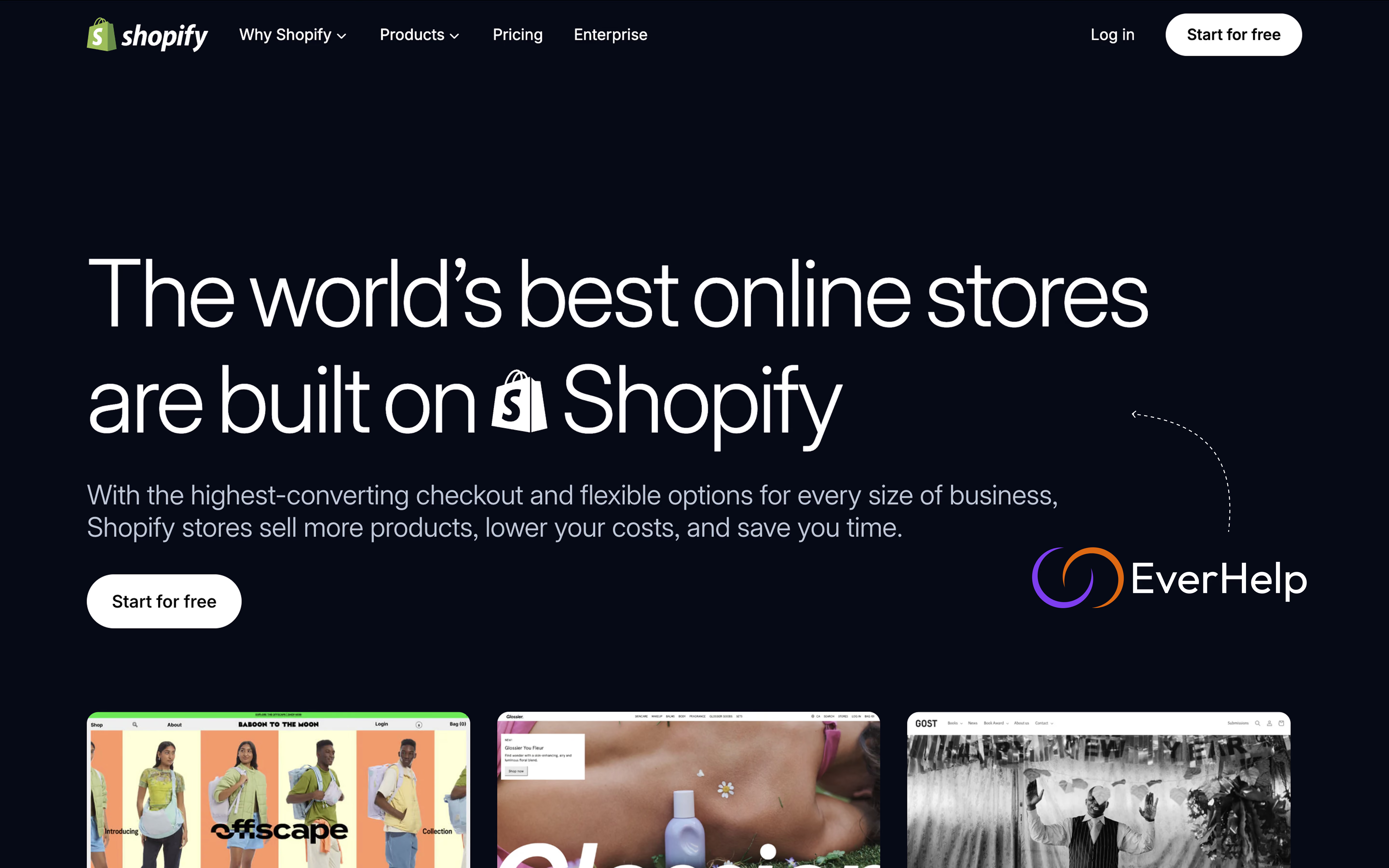
WISMO queries — "Where is my order?" — account for roughly 30–40% of inbound eCommerce tickets. EverHelp agents can resolve these without escalation as they have direct access to order and shipment details inside Gorgias or Zendesk via Shopify's native apps.
From the helpdesk, agents can:
In practice: A customer messages asking where their order is. The EverHelp agent opens the ticket, pulls the Shopify timeline alongside the carrier tracking status, applies the WISMO macro in your brand's tone, and, if needed, updates the order directly. The whole interaction takes under two minutes.
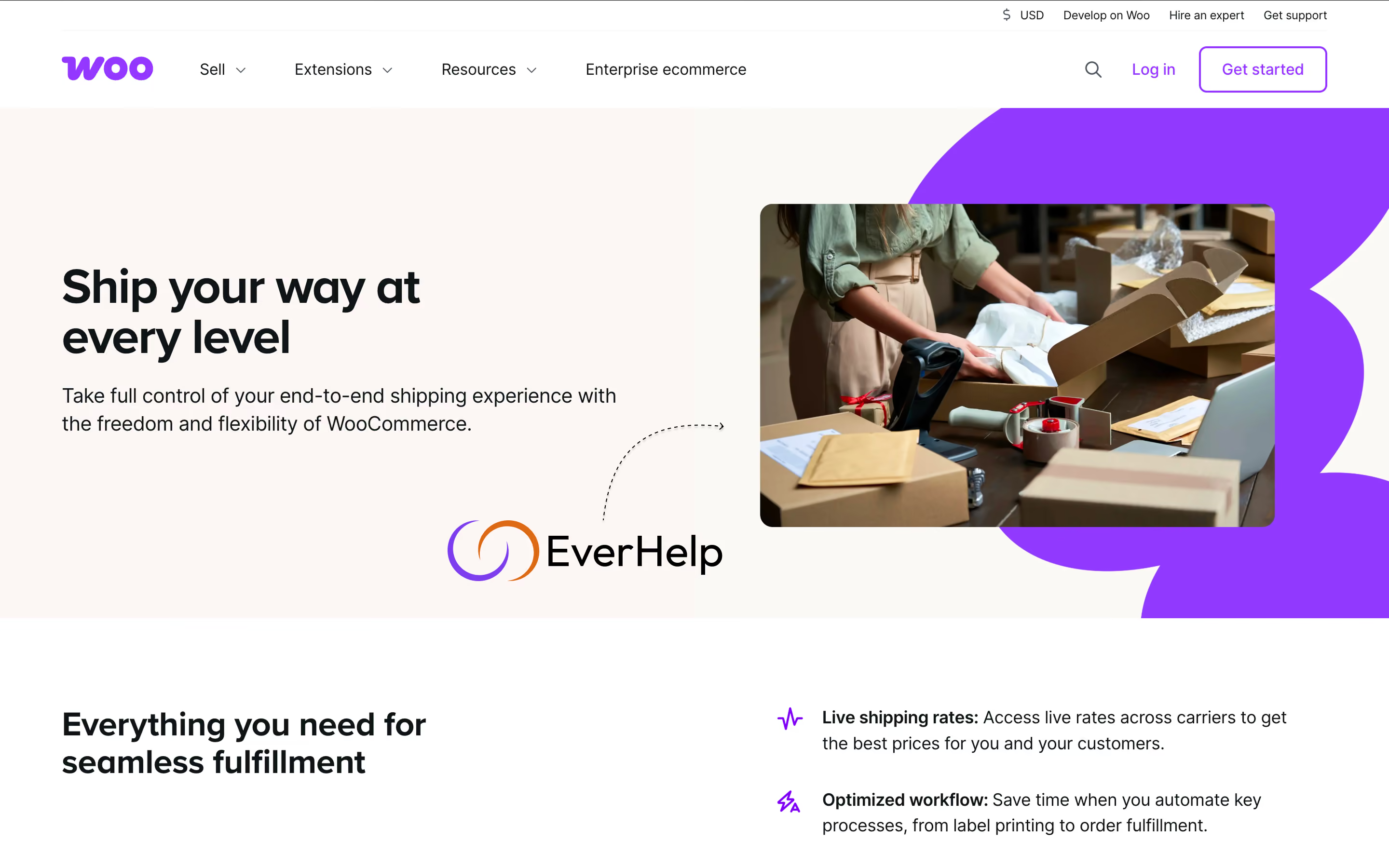
WooCommerce stores often run on a patchwork of payment gateways, shipping plugins, and custom order statuses, which makes a clean support operation harder to build, but not impossible.
EverHelp connects your WooCommerce store and associated shipping tools into the helpdesk so agents see full order history and customer data without logging directly into WordPress. We also map custom order statuses, mixed payment-gateway states, and subscription logic into clear agent workflows, so there's no ambiguity about which action applies in which situation.
We can easily work with WooCommerce-compatible helpdesks and plugins, meaning brands don't need to change what's already working.
For Magento and Adobe Commerce brands managing multiple storefronts, markets, or B2B catalogs, EverHelp can create special role-based access points for agents. After all, data sprawl in enterprise environments is a real risk, and we take it seriously.
Our agents are trained on complex catalog scenarios:
We design playbooks and macros to explicitly account for these edge cases.
During peak periods, EverHelp can scale up with pre-trained agents who already understand Magento workflows, to avoid breaking established processes and launching a new onboarding cycle.
Marketplace support is a different beast. Amazon's and eBay's messaging systems, SLAs, and policy requirements don't succumb to the rules of direct-to-consumer support. Yet, building a separate flow for them would create even more delays, order errors, and missed response windows.
That’s why we try to connect to your Amazon and eBay messaging directly, so agents can see and manage every channel. Typical marketplace cases our team handles in these environments include:
Marketplace tickets are tagged and reported separately, so your analytics stay clean, and you can track marketplace-specific performance independently.
As we handle your ticketing platforms, we also integrate with your helpdesk infrastructure. Our agents are trained to work with all the tools you implement in day-to-day operations.
Gorgias is the helpdesk built specifically for eCommerce, and it's the natural home for EverHelp agents. The deep integration it offers — order views, refund actions, discount generation, shipping data — means agents can resolve the majority of tickets without leaving Gorgias.
We can also help build and refine Gorgias rules, views, and macros for eCommerce stores. Usually, we introduce such features as:
After all, we want our support setup to work for you in the long run, and that’s why we don’t shy away from refining and correcting pre-established processes.
Zendesk is a platform most well-known to our agents. We can both integrate with the client's existing Zendesk profile and provide a new one for those companies that don’t yet have the setup.
When we integrate, we pay special attention to queue segmentation: in-house queues, EverHelp queues, and shared queues are configured so leadership always has a clear view of who's handling what. We also always set up collision detection to avoid duplicate work.
All the roles and permissions within the Zendesk ecosystem are established by EverHelp’s Integration Manager during onboarding. And yes, we do account for data privacy and access controls as a part of our broader service security commitments.
To make sure our agents can work effectively with your existing Freshdesk configuration (e.g., ticket statuses, priority tiers, tags, and routing logic), we cover all the flows in the agent training. From their first shift, EverHelp’s team behaves like a natural extension of your in-house team. And as we integrate into your system via your admin access, our agents can handle both DTC and marketplace tickets from the same interface, just as your in-house team.
Though we work well with both platforms, it’s understandable why one would prefer either one.
Freshdesk is especially suitable for lean teams that need to move fast. It provides:
Zendesk has its honorable place in larger, more complex environments where advanced routing logic, custom workflows, and enterprise-grade analytics justify the steeper price and learning curve.
Still, ticket volume and how much configuration you can actually manage internally tend to be the deciding factors. For a full breakdown of pricing, AI features, and user feedback, read the Freshdesk vs. Zendesk comparison.
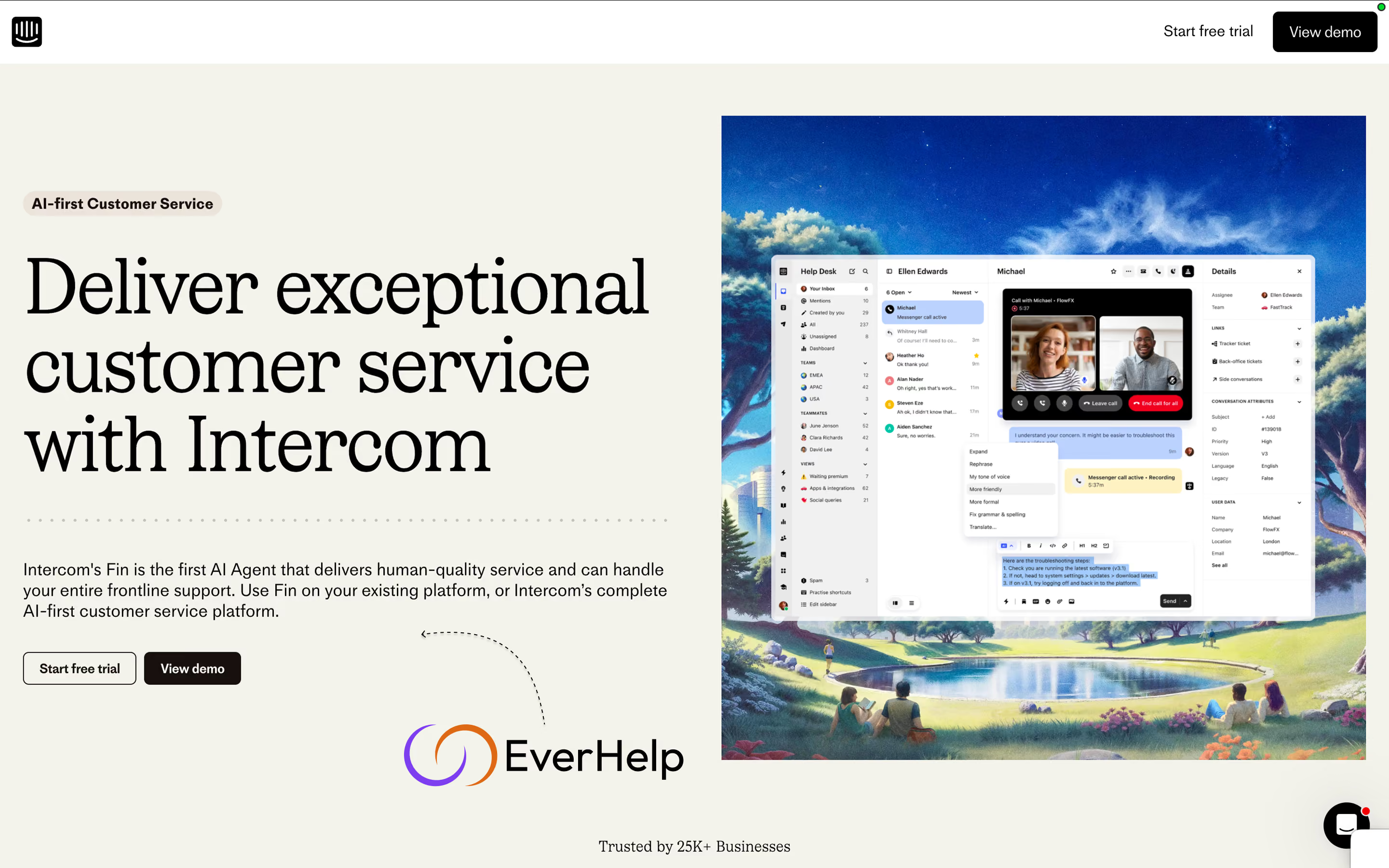
Conversational support requires a different operating mode — faster, more fluid, and much more sensitive to brand tone. EverHelp agents working in Intercom or Re: amaze are trained specifically for this, to maintain short response times and initiate proactive outreach where necessary.
We always respect existing routing rules and SLAs from the very start of our partnership. That said, our agents are on a constant lookout for improvement possibilities and are ready to adapt to improving workflows.
Having dealt with numerous support hiccups and operational obstacles, the EverHelp team built an AI assistant of our own to help our agents resolve day-to-day issues.
For us, jumping on the AI bandwagon wasn’t just blindly following trends. Because we initially designed Evly to help reps address the biggest productivity blocker we’ve encountered in our work: a flood of repetitive customer queries. It first launches in 14 days, scales fast, and responds 24/7.
However, as we incorporated our AI agent into various projects, we found that it can complement the service team’s work across many other tasks.
What can you typically notice when we add Evly to your eCommerce stack?
Additionally, Evly helps businesses scale globally much faster, as it can provide Tier 1 and Tier 2 support in over 95 languages, reducing the need to hire additional agents as you enter new markets.
{{cta-lm}}
As we built our AI assistant to work similarly to our agents, it connects seamlessly with your knowledge base, CRM, and eCommerce platform via API as well. This allows the system to draw on real order data and current product information to learn how to handle the tickets within your infrastructure and according to your rules.
It continuously learns from resolved tickets, meaning its accuracy improves the longer it runs. And when a case genuinely needs human judgment, empathy, or escalation, it hands off with a full conversation summary so the agent never asks the customer to start over. Besides, we handle the setup end-to-end.
Over the past year, we have noticed that the combination of Evly and human agents provides brands with the speed of automation they so desperately seek, while still ensuring the quality of specialized human support.
When EverHelp is fully integrated, your team stops managing the following:
Your team's key job becomes reviewing what's working, providing direction on brand updates and policy changes, and staying focused on growth, while EverHelp runs the everyday operation.
Shopify, WooCommerce, Magento, Amazon, and eBay cover the majority of eCommerce setups. But if your platform isn't among them, we can still connect with your custom-built stack or a niche marketplace via API using your administration controls.
The integration approach is the same: map the tools you have, build the workflows your agents need, and connect everything into a unified helpdesk view. If you're evaluating your shipping toolchain alongside your support setup, the eСommerce shipping software comparison is worth a look.
There's no minimum platform requirement to work with EverHelp. The starting point is always an open conversation about what you're running and what you need.
Most of the e-commerce brands that struggle with outsourced support have a single problem: poor integration.
At EverHelp, we solve the issue through a structured 28-day launch model, which allows us to provide a fully trained, deeply integrated support team in a short period of time.
If you're ready to see what that looks like for your store, book a meeting with the EverHelp team. We'll map the integration to your specific stack and walk you through exactly what the first 28 days look like for your business.
Help someone else stay in the know. Hit that share button!
.webp)

.webp)

.avif)
.avif)
.webp)
.webp)