Growth & Metrics
Omnichannel Support
Published on
12.02.2026
Last updated on
01.09.2026
5 Strategies for Effective Contact Center Workforce Optimization

Oleksandr
AI Integrations Lead

Oleksandr
AI Integrations Lead
.avif)
Picture this: it's Monday morning, and your contact center is already behind. Three agents called in sick, you're scrambling to fill shifts, and customers are waiting 15 minutes for someone to pick up. Sound familiar? Too many contact centers operate in this reactive "survival mode" – firefighting quality issues, patching together schedules at the last minute, and burning through agents faster than they can hire replacements.
Contact center workforce optimization (WFO) is a unified approach that combines technology, people management, and data intelligence to ensure this doesn’t happen, so the right agents with the right skills are available at the right time. Instead of constantly reacting to crises, optimized centers build a customer support team based on needs anticipation, proactive agent support, and smart resource allocation.
We’ve decided to dedicate this article to five strategies that have been proven to help businesses support WFO, improve agent performance, organize and distribute workloads, and optimize costs. The stakes couldn't be higher: centers stuck in survival mode can face higher turnover rates, inconsistent service quality, and ballooning operational costs. Let's break that cycle.
The reactive cycle feeds on itself:
This chaos devastates agents first. They show up unprepared, feel undervalued, and burn out quickly. When your people don't know if they're working weekends until Thursday afternoon, morale drops. As a result, contact centers experience an average annual turnover rate of 30-45%, with some reaching as high as 60% in particularly stressful environments.
Customer experience suffers next. Rushed, burned-out agents take longer to resolve issues, provide inconsistent service, and escalate problems they could have handled themselves, leading to poor customer service. Meanwhile, the business actually loses money:
There's never time for strategic planning because everyone's too busy plugging holes.
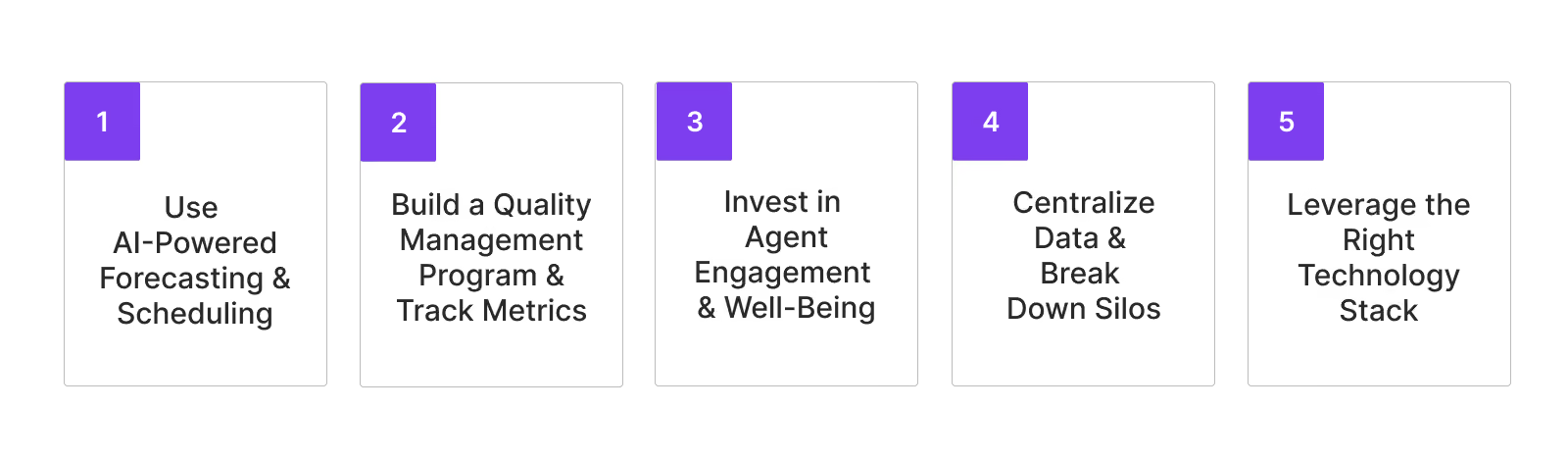
These problems aren't inevitable, though. They're symptoms of a lack of a deliberate optimization framework. And that’s why, below, we have outlined 5 steps your company can take to move from simply reacting to issues to avoiding them altogether through proactive planning and forecasting.
Manual forecasting is like driving by looking in the rearview mirror. Legacy systems rely on static averages from last year and are blind to real-time demand shifts or the complexity of managing voice, chat, email, and social customer support channels simultaneously. No wonder your schedules never match reality.
AI-powered forecasting has become a game-changer for strategic planning. Machine learning models are now analyzing years of historical data, identifying seasonal patterns, and incorporating real-time signals (e.g., social media trends or weather events) to predict contact center volumes across all channels. And it’s a trend that’s not dying out: the call center workforce management software market was estimated at $5 billion in 2025 and projected to grow at a 12% CAGR through 2033, driven heavily by AI/ML integration for predictive scheduling and real-time performance monitoring.
You can then apply automated schedule generation (e.g., tools such as Assembled AI, CloudTalk, or RingCentral), which takes those forecasts and builds optimized rosters that match agents' skills and availability and respond to predicted demand. The system accounts for multiple variables, including:
When unexpected volume spikes hit or agents call in sick, intraday management tools (e.g., Nice or Peopleware) automatically adjust schedules mid-shift. As automated planning and scheduling account for more variables, they reduce overstaffing and understaffing and lower overtime costs.
{{cta}}
Traditional quality programs built on random call sampling and punitive scorecards don’t inspire growth but create anxiety. Modern teams are moving in a different direction, using AI-driven call recording and analytics to evaluate 100% of interactions, surface sentiment changes, and highlight coaching opportunities in real time. And it seems like agents prefer things this way, as employees trust software to deliver fair evaluation far more than their managers.
As such, a strong quality program should power coaching that sharpens empathy, tone, and problem-solving skills. Your agents need to feel supported to be able to deliver their service confidently. Here’s how you can do it:
Of course, automated scoring works best when it’s paired with consistent one-on-one coaching focused on development. And don’t forget to celebrate wins. Agents who handle tough de-escalations with professionalism or consistently exceed customer satisfaction targets deserve visible recognition, not just a quiet note buried in a spreadsheet.
No, this approach isn’t “soft.” It’s a contact center workforce optimization strategy that actually works for people. When agents trust (and understand) the quality process, they’re more engaged, more capable of handling complex situations, and far better ambassadors for your brand.
Still, without aligned KPIs, optimization efforts quickly lose focus. Many centers track dozens of customer satisfaction metrics without understanding which ones truly reflect success. We advise defining a "north star metric" (usually First Call Resolution or CSAT) and mapping supporting KPIs that ladder up to it.
Below is a table of key metrics that matter for contact center workforce optimization:
Agent engagement has long proven to directly impact performance, retention, and customer experience. Organizations with best-practice engagement have more engaged employees, delivering a measurable competitive advantage compared to their peers struggling with disengaged teams. In fact, Gallup's 2025 Exceptional Workplace Award winners reported engagement rates of 70%, more than triple the 21% global average, and those organizations consistently outperform peers with 23% higher profitability, 18% more productivity, and up to 59% less turnover.
Practical tactics matter:
Publicly celebrate achievements, whether it's a difficult de-escalation or hitting quality targets five days straight. Recognition fuels motivation far more effectively than generic "team meeting" shout-outs.
It’s also important to actively monitor workloads and encourage actual breaks, so agents have actual time to recover mentally in between calls. Recognize agents for quality and problem-solving, not just speed. When centers obsess over Average Handle Time alone, they incentivize rushing customers off calls rather than solving problems, damaging your customer loyalty.
It seems like a lot of work for you as an employer. Well, there’s something in it for you too – cost savings! Reducing turnover alone saves massive hiring and training expenses. Think about it: replacing a single agent costs $10,000-$20,000 when you account for recruiting, onboarding, training, and lost productivity during ramp-up. Improving agent well-being, on the other hand, delivers immediate ROI, with studies showing that employee wellness programs can return up to $6 in healthcare savings for each $1 invested.
Interesting Case Study: Chapman Institute have introduced a wellness program for a 500-eemployee call center in Ohio. The program included wellness webinars, a pilot of flexible scheduling, and “Wellness Champions” appointed across teams. After 12 months, the company saw:→ turnover reduction from 45% to 28%→ AHT improvement by 15%
→ Employee NPS increase by 44%
→ Absenteeism drop of 21%
If you are currently looking at all these strategies, thinking “well, we have that, but nothing changes,” then maybe it’s disconnected systems that are killing your workforce optimization efforts:
Research reports that nearly 79% of employees report their company not taken any steps to consolidate platforms. This fragmentation leads to inaccurate forecasts, slow decision-making, and supervisors spending half their day wrangling spreadsheets instead of coaching agents.
Your solution is:
Unified data creates a single source of truth for operations. Supervisors stop playing detective, trying to reconcile conflicting reports, and start acting on insights.
This allows true omnichannel consistency: the same data quality whether customers reach out via phone, chat, email, or social media. And with 68% of CIOs planning on consolidating their vendor engagements, there’s no reason for you not to try too.
{{cta}}
Technology should simplify operations, not complicate them. Thus, when evaluating platforms for workforce optimization in a contact center, prioritize:
Beware of the "tool overload." Gartner reports 49% of B2B sellers feel overwhelmed by the number of tools they're expected to use, which directly impacts performance. The same principle applies to contact centers, with every additional login, dashboard, and process delaying your agents’ responses to customers. So, look for platforms that consolidate capabilities rather than forcing agents to toggle between twelve different applications.
Practical advice:
A platform with 500 features you'll never configure is less valuable than one with 50 features your team actually uses daily.
Look for solutions offering continuous learning capabilities. You don’t want to manually tune it every time you make any changes to your product or services. The best platforms adapt to your unique patterns instead of forcing you to adapt to their rigid assumptions.
Now, if you are serious about your contact center workforce optimization, you need a clear way to evaluate the tools and partners you rely on. One widely used starting point is Gartner’s Magic Quadrant, which helps businesses compare Workforce Optimization (WFO), Workforce Engagement Management (WEM), and CCaaS vendors using a consistent industry framework.
The Magic Quadrant looks at providers through two practical lenses:
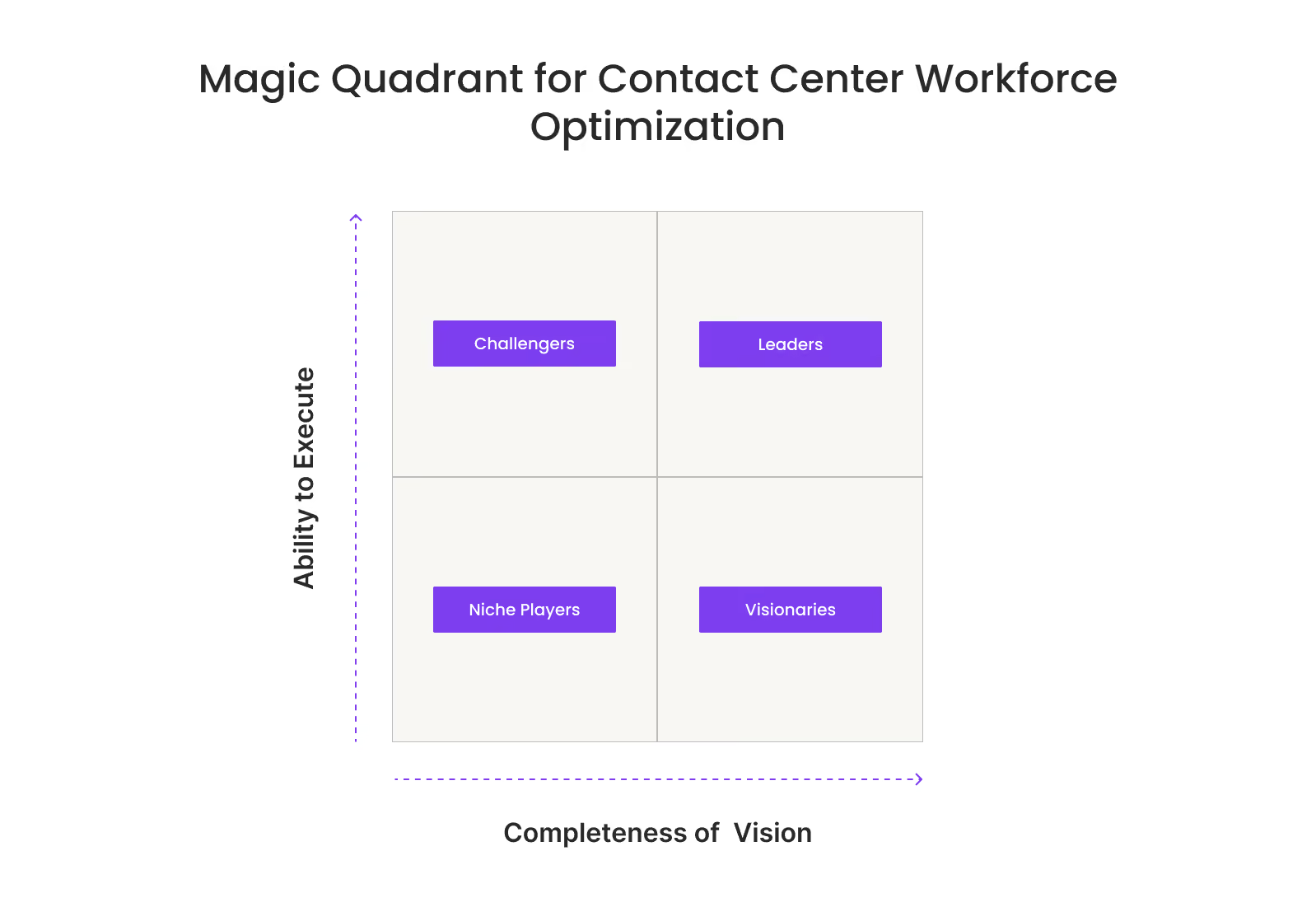
Who are the providers that would score well against the Magic Quadrant? Think leaders like NICE, Genesys, and Verint. Year after year, these companies tend to show up as leaders thanks to strong AI-driven forecasting, real-time scheduling, and advanced analytics that help teams make smarter staffing decisions. They also invest heavily in machine learning, omnichannel capabilities, and agent-friendly interfaces – features that directly impact productivity, engagement, and customer experience.
For businesses evaluating workforce optimization technology, the Magic Quadrantcan be a valuable first filter. Use it to create a shortlist, compare strengths and gaps, and guide deeper conversations with vendors about your specific needs. When paired with well-established internal goals and real-world testing, it can help you choose solutions that genuinely improve how your contact center operates.
At EverHelp, we always strive to teach what we preach. So we always try to put in special effort in our workforce optimization processes, too. And the biggest part of it is working with our agents. Our VP of Customer Support, Valentyna Dimova, shared exactly what we do to properly organize and manage our support teams:
This allows us to calculate exactly how many agents we will need for any given part of the day and for which channels. Additionally, our customer service analytics extend to monitoring Agent Utilisation Rate to see where the support team is either understaffed or overloaded. As such, we avoid agent overload and get a chance to keep our SLAs on track.
This way, we reduce the number of clicks agents need to resolve tickets, enabling faster case resolution for customers and significant savings on outsourced customer service costs for our clients.
Our QC team leads organize special scorecards to track agent performance, with everyone on the team having open access to these materials. Based on the results, the QC team then works with customer representatives to deepen their knowledge of both the client’s products and processes. Speaking from experience, the more agents know and understand, the faster they can process tickets.
Whenever possible, we offer flexible scheduling, allowing team members to choose shifts that support a healthy work–life balance. Our team leads also foster deeper connections through peer-to-peer onboarding, where experienced agents guide newcomers through client processes. Beyond onboarding, these agents help shape and improve workflows by gathering feedback from both agents and customers and contributing to product trend analysis.
Moving from reactive to proactive support organization is a huge cultural shift. And it needs to be powered by smarter forecasting, coaching-first quality management, engaged agents, unified data, and the right toolkit.
And, as AI continues maturing, the gap between optimized and unoptimized contact centers will only widen. The centers investing in workforce optimization now will dominate their markets, becoming one of the many modern-day customer service standards. Those clinging to old reactive habits, on the other hand, will struggle to compete on service quality or operational efficiency. The time to act is now.
Ready to transform your contact center? Book a meeting, and our experts will help you discover where to start your workforce optimization contact center efforts.
Help someone else stay in the know. Hit that share button!
.webp)

.webp)
.avif)
.avif)
.webp)
.webp)