Growth & Metrics
Published on
11.01.2026
Last updated on
01.09.2026
Customer Service Tips for Scaling Quality Without Burning Out Your Team

Dmytro
QC Delivery Manager

Dmytro
QC Delivery Manager

Scaling support doesn't have to mean sacrificing your team's sanity. The most successful businesses demonstrate that you can handle growing customer volumes while maintaining service excellence and team wellbeing.
According to Salesforce research, 89% of customers are more likely to make another purchase after a positive customer service experience, and many companies try to reach these results by pushing agents harder rather than building smarter systems. We want to show that there’s another way.
We’ve reviewed various research, studies, and customer service books and identified the real customer service tips that drive sustainable growth. They focus on designing processes, tools, and culture that support long-term performance rather than short-term gains. At EverHelp, we firmly believe that when leaders thoughtfully structure their support model, teams can deliver consistently high-quality service without the emotional and physical toll of constant firefighting.
Let’s start by understanding what scaling actually means. When we talk about scaling customer service, we're referring to handling increased customer volumes, managing multiple communication channels simultaneously, and navigating growing product or service complexity. The challenge intensifies as businesses grow because most teams respond reactively:
Such an approach does work, but not for long, as it quickly leads to burnout.
Burnout in support manifests as emotional exhaustion, depersonalization (treating customers as problems rather than people), and declining performance across all metrics. The root causes are mostly quite predictable:
Gallup's workplace research shows that burned-out employees are 63% more likely to take a sick day and 2.6 times more likely to actively seek a different job. For support teams, this translates directly into talent loss, training costs, and a deterioration in service quality at the exact moment your business needs consistency most.
{{cta}}
Recognizing burnout early should be a top priority for any company. Doing so allows teams to intervene sooner, re-engage employees, and ultimately reduce agent attrition.
The behavioral signs appear first, and they mostly show up in performance data:
You'll notice more short-tempered responses, disengagement during team meetings, and the quiet resignation from usual responsibilities.
The emotional and physical symptoms agents report tell a more complex story. Support professionals describe constant fatigue that can’t be fixed by sleep, genuine dread before shifts start, and an inability to mentally recover after work ends. According to research from Toister Performance Solutions, 74% of call center agents are at risk of burnout, with over 50% reporting they feel emotionally drained from their work daily. This exhaustion stems largely from the emotional labor required to maintain professionalism while managing difficult interactions. Burnout agents also report feeling detached from customers they once cared about helping, a psychological defense mechanism against the daily emotional drain. This detachment shows up in ticket quality, poor customer service, and ultimately in retention rates for both customers and employees.
Some burnout drivers lie outside your immediate control, but many don't. Structural issues create the foundation for burnout: insufficient staffing during predictable peak periods, rigid schedules that prevent agents from managing their energy, inadequate break policies, and the perpetual "backlog crisis" mode that makes every day feel urgent. When teams are constantly behind, the psychological weight of their labor accumulates.
KPI and process problems compound the structural issues. Dashboards that reward speed over quality send clear signals about what leadership values, even when public messaging says otherwise. Excessive pressure on average handle time (AHT) forces rushed conversations, eliminates room for empathy, and actively works against first contact resolution. Tools that require too many clicks, multiple system logins, and extensive manual after-call work make agents' jobs unnecessarily harder.
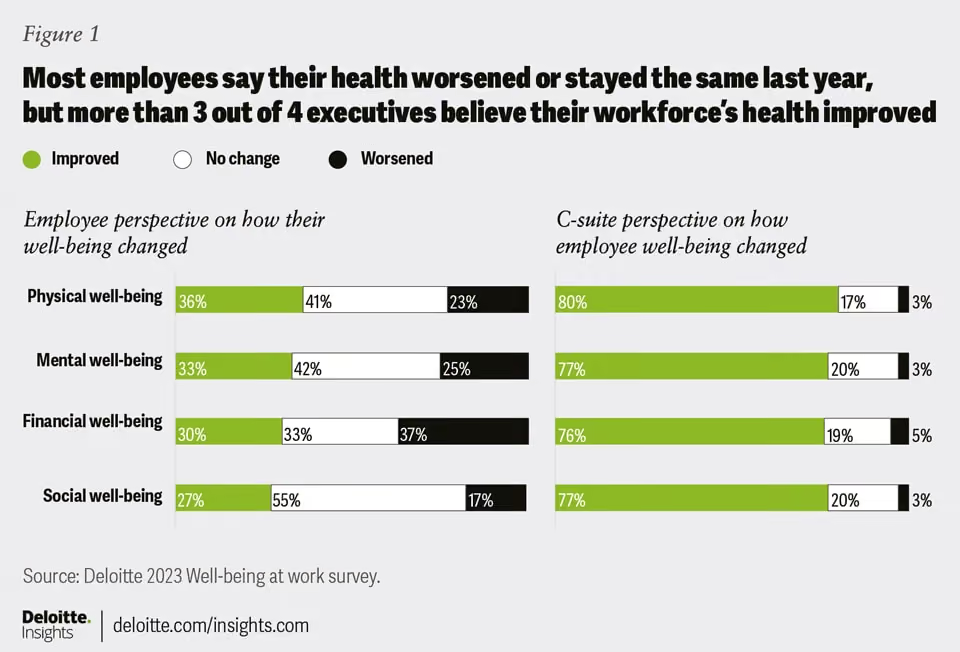
Cultural drivers often prove the most insidious, however, because they're harder to measure. When managers normalize overtime, fail to create psychological safety for raising concerns, or provide no real mechanism for agents to influence process or policy decisions, they signal that individual well-being matters less than hitting numbers. Deloitte's research on workforce wellbeing reveals that only 58% of employees rate their wellbeing as “good,” while 25% report a decline in their mental health over the past year. Notably, even as many (80%) employees actively strive to improve their well-being, they continue to face barriers, most of which are rooted in their work environment.
{{cta-lm}}
These findings tell us a simple thing: to scale your support processes without putting pressure on employees, businesses need to restructure their operations. Preventing burnout as your support operation grows requires deliberate design choices at the foundation of your model. The following strategies focus on building systems that become stronger and more resilient (rather than more fragile) as volume increases.
Tiered support models and pod-based structures were proven to reduce cognitive overload as they allow routing different issues to specialized groups rather than expecting every agent to handle and know everything. Frontline agents focus on common issues they can resolve confidently, while specialized teams handle technical problems, escalations, and edge cases.
Role rotation across omnichannel channels and tasks can also be helpful. Such work organization helps prevent the repetition fatigue that kills motivation. Agents who spend two days on email, two on chat, and one on quality review tasks or project work can maintain higher engagement and build broader skills. A service culture that promotes cross-functional exposure may increase agent retention compared to teams stuck in single-channel roles, as it offers more diversity and new work opportunities for employees.
Sustainable scaling also depends on clearly defined ownership of critical support functions. Knowledge management, quality assurance, coaching, and even multilingual customer support should not be “extra” responsibilities loaded onto regular agents. Instead, assign dedicated roles or structured rotations to ensure these tasks are consistently executed. This prevents the decline in service quality that often happens when growth outpaces your systems. Together, these customer service tips form the structural foundation for sustainable growth.
Anticipating seasonal peaks and marketing campaigns through volume forecasting eliminates the reactive scramble once queues explode. Using customer service data analytics of historical ticket data, product release calendars, and marketing plans to model staffing needs reduces chronic overtime and the emotional toll of constantly playing catch-up.
Setting "red line" thresholds also provides operational clarity about what triggers contingency plans. Define the maximum overtime limit and acceptable queue backlog levels. You might also want to introduce specific operational changes that activate when thresholds are hit, such as:
Overall, companies implementing predictive scheduling report: 18% reduction in absenteeism and 30% improvement in perceived work-life balance. The key is to set all necessary parameters during calm periods rather than during peak seasons. Because proactive customer service strategies that prevent issues provide even more value than efficient reactive handling.
Technology should make the job of your customer support team easier, not burden them with more interfaces and manual work. When selecting tools for your agents, focus on solutions that streamline their work:
Invest in tools that reduce repetitive contacts and post-call work instead of "shiny" features agents rarely use. A knowledge base that surfaces relevant articles during conversations is far more valuable than advanced analytics dashboards locked behind separate logins. And note that smooth integration matters more than features: constantly switching between systems adds cognitive load, and over hundreds of daily interactions, this quickly leads to fatigue and mistakes.
You might like: 8 Ways Digital Customer Service Tools Deliver ROI + Free Calculator
{{cta}}
If you were a support agent facing the hundredth “Where’s my order?” or “I forgot my password” ticket of the day, how would you feel? Drained, slowed down, apathetic even, maybe? Now, what if those daily routine requests were handled automatically? Modern technology provides a variety of ways to organize that:
With these tasks covered, agents could be free to focus on the complex, human interactions that actually require empathy and judgment. And that would safeguard them from burnout.
Reducing cognitive load and constant context switching allows agents to engage fully where it matters most. According to current studies, when AI handles routine interactions, companies see a 43% improvement in employee job satisfaction and a 52% reduction in turnover. Data proves that strategic automation powered by AI not only helps ensure consistent service quality but also improves agent well-being.
The rule is simple: if customer support automation reduces empathy or creates confusion, it’s not working. But if it removes busywork and gives agents more time to focus on complex, human conversations, it improves both support processes and agent morale. Now, let’s talk more about how different automation approaches can help you to protect your employees’ welfare.
Self-service can be considered an introductory step to automation. Effective self-service, however, requires more than publishing a knowledge base and hoping customers find it. The most successful implementations include FAQs, searchable knowledge bases, AI chatbots, and in-app contextual help that resolve the top repeat issues without forcing a contact. The key is tying content strategy directly to volume drivers.
You can use ticket tags and search logs to prioritize self-service topics that meaningfully reduce inbound load and escalations. If password resets generate 200 tickets monthly and your self-service article gets 50 views, either the article is poorly written, hard to find, or customers don't trust it. Creating a customer support knowledge base that can actually be helpful requires ongoing refinement based on real usage data.
And that’s when feedback loops might come in handy to keep self-service accurate and trustworthy, protecting customer service quality. When articles become outdated or product changes make instructions incorrect, customers lose trust in self-service entirely and default to contacting support even for simple issues. Regular content audits based on ticket trends and customer feedback maintain the effectiveness that reduces agent workload.
Even with automation in place, human oversight is still much needed. After you rollout any automated processes, track metrics to catch quality issues early, such as:
Additionally, provide clear “escape hatches” from bots to humans, so customers never feel trapped in a script. Nothing frustrates a customer more, or weighs on an agent, than resolving a problem that escalated after repeated automated failures. Thoughtful automation paired with self-service and guardrails doesn’t just reduce workload, but protects customer service standards, boosts morale, and allows agents to focus on the interactions that matter most.
Metrics drive behavior, so the ones you choose matter. When agents are measured primarily on speed (handle time or contacts-per-hour) they naturally rush conversations, skip empathy, and move quickly to the next ticket. Over time, this creates a treadmill effect: volume goes up, but customer satisfaction and agent morale decline.
A better approach is a balanced scorecard that values both efficiency and quality. Combine traditional metrics like AHT and first response time with indicators that capture customer experience:
This signals to agents that speed matters, but delivering thoughtful, empathetic, and personalized customer service matters just as much.
Wellbeing metrics should be part of the picture too, not an afterthought. Tracking turnover, absenteeism, overtime, and pulse survey results alongside operational KPIs lets you spot trends before they become crises. When team health metrics dip, it’s often a leading indicator of future performance issues. Gallup’s research shows that organizations treating wellbeing as a core business metric achieve 23% higher profitability and 18% higher productivity than those that don’t. By measuring both quality and wellbeing, you create a system that rewards sustainable performance, not just fast outputs.
Once you start measuring what matters, the next step is listening. Regular pulse surveys and team retrospectives give agents space to share what drains their energy and what would make their work more sustainable. These shouldn’t be annual engagement surveys that vanish into an HR system. Instead, introduce weekly or bi-weekly check-ins to keep the conversation alive and surface issues while they’re still manageable.
Customer feedback plays an equally important role. QA reviews, CSAT comments, and follow-up questions reveal where macros, workflows, or self-service fall short. When agents notice customers repeatedly asking for clarification after a specific response, that’s a clear signal the process needs adjustment. Using a customer feedback system that actually drives operational changes shows agents their input matters, and that your support model evolves based on real experience, not assumptions.
Even with the right metrics and feedback loops in place, support work remains emotionally demanding. Recovery has to be built into daily operations, not treated as a perk. Scheduling micro breaks and encouraging time off after intense interactions (angry customers, complex incidents, or difficult conversations) gives agents space to reset before moving on.
Policies that normalize recovery, such as mental health days, flexible scheduling, and protected no-meeting blocks, help teams perform sustainably over time. When taking a break requires justification or feels risky, agents push through until burnout hits. Weaving recovery into your processes prevents that cycle and supports a healthier, more resilient team as you grow.
As your support team grows, protecting employee well-being becomes critical to your success. And your company culture is another way for you to create an environment where agents thrive. Below, we’ve collected a few aspects that can help you build that type of culture.
Customer service training that truly prevents burnout goes far past product knowledge or script compliance. It combines technical skills with soft skills, such as de-escalation, showing genuine empathy, and setting healthy boundaries. Giving agents these tools helps them handle challenging situations with confidence, reducing stress and making their work feel more rewarding.
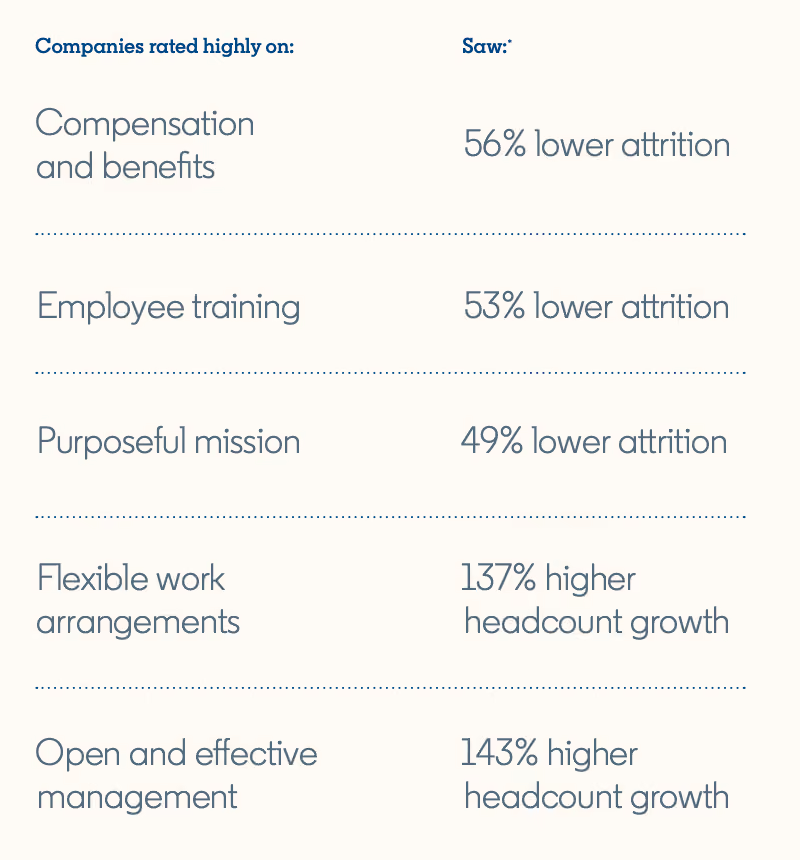
Research shows that well-designed training programs pay off: 92% of employees report higher engagement, and companies with intense coaching see 53% lower attrition rates. At EverHelp, for instance, we have specifically designed a separate platform to facilitate knowledge sharing and agent development – EverHelp Academy. It offers specialized learning modules and lectures, as well as creates a community within our company, driven by constant improvement.
Coaching works best when it focuses on strengths and solutions rather than just spotting errors. When sessions feel like audits, agents become defensive. Starting with questions like “What went well?” and “What did you learn?” before addressing areas for improvement builds both confidence and resilience. Incorporating authentic empathy statements, customer service agents can adapt to their natural communication style, which is far more effective than rigid scripts, helping interactions feel genuine rather than robotic.
One thing every support training needs to include is de-escalation practices. For some, it may seem unreasonable, but many agents get frustrated by unproductive conversations with customers who are frustrated (and sometimes even aggressive). Following these, it’s important to teach your employees to:
Imagine a customer reaching out with a simple request, like a refund or a replacement. In a traditional setup, the agent must pause, seek approval, and navigate a chain of permissions. The customer waits, frustration grows, and the agent feels stuck in a role that’s more about following orders than solving problems.
Now picture a different scenario: the same agent, working within clear policies and guardrails, has the authority to make decisions on the spot. They offer the refund immediately, explain the solution confidently, and leave the customer feeling genuinely cared for.
Studies show, that 70% of agents want more autonomy in resolving customer issues. They also show that nearly half (48%) of contact center leaders rank empowerment as a top-three factor for improving agent performance, with 18% ranking it #1, ahead of training, technology, and pay Empowering agents with autonomy doesn’t just improve their service. It can give them a sense of impact, reduce frustration, and lower the risk of burnout.
When agents can say, “I can help you with that right now” instead of “Let me check with my manager,” it changes everything. Customers feel taken care of and agents feel capable. This confidence prevents the learned helplessness that comes from being an order-taker, turning your team into problem-solvers. Building excellent customer service requires trusting your agents to make the right decisions and giving them the tools to succeed.
Even the most empowered agents face pressure: back-to-back calls, frustrated customers, and the emotional weight of solving problems all day. In this environment, mental health can’t be a taboo topic. Teams that encourage open conversations about stress, provide access to psychological support, and train leaders to spot early warning signs create a safety net before small issues turn into crises.
When agents feel safe saying, “This workflow is unnecessarily stressful” or “We need help during peak hours,” it’s not complaining, but an early signal that lets managers act proactively. Addressing these concerns early prevents burnout, keeps attrition low, and shows your team that their wellbeing matters.
The stakes are real. The World Health Organization estimates that depression and anxiety cost the global economy $1 trillion annually in lost productivity, with customer-facing roles showing higher rates than other professions. Companies that normalize mental health support and make it easy to use see a 4:1 return through lower absenteeism and turnover. By creating psychological safety around wellbeing, you protect your team. And as a result, your customers benefit from agents who are alert, engaged, and less worn down by their workload.
{{cta}}
Understanding what doesn't work helps as much as knowing what does. Some popular tips might seem efficient in the short term, but create long-term damage to both team wellness and customer relationships.
Sustainable scaling depends on building support teams that thrive under growth rather than crack under pressure. A people-first culture isn't soft or inefficient. It's a strategy. Organizations that prioritize thoughtful work environments, manage workload intelligently, and promote healthy work-life balance see higher employee retention and productivity. They’re also more likely to improve customer experience and customer loyalty.
When you protect your team's well-being, you create a competitive advantage that's difficult to replicate. At EverHelp we know it firsthand. We pride ourselves in building a people-first work environment, where agents can openly discuss their issues and concerns, find development opportunities, and take on more responsibilities as they grow professionally. So, if you were looking to build a team like that of your own, book a meeting with us. Who knows, maybe our experience will be useful.
Help someone else stay in the know. Hit that share button!



.webp)

.avif)
.avif)
.webp)