Growth & Metrics
Support Ops & Teams
Published on
05.02.2026
Last updated on
01.09.2026
What’s Up With Customer Service Analytics & Why You Need Them

Oleksandr
AI Integrations Lead

Oleksandr
AI Integrations Lead
Slow response times, unresolved issues, and impersonal service can make your customers look for another provider. According to PwC’s 2025 Customer Experience Survey, 29% of consumers stopped interacting with a brand after a poor customer service experience. It seems like now, after years of rising costs and a global crisis, even minor frustrations can cause your customers to churn.
Yet, there’s a chance it may not. If you actually use what you know to improve. With a proper customer service analytics strategy, your team can win every time, turning customer challenges into opportunities for growth and customer loyalty.
In this article, we’ll show you how adopting a data-driven approach to customer support positions your business to thrive and what you need to do to truly delight your customers.
Data analytics has, over the years, become an integral part of any business set to grow and succeed. According to HubSpot’s 2025 customer service data, over 55% of service and support leaders were planning to invest in customer journey analytics to drive more sales. 70% of customer service managers worldwide admitted to already using generative AI to assess sentiment across a broad range of customers.
The reliance on data has become more than a trend, and we will tell you exactly why. Academic research on data‑driven CX shows that companies implementing AI‑driven experience management strategies gained a 15% increase in customer retention and around 84% satisfaction, specifically from personalized, data‑led interactions. However, these are not the only benefits that customer service analytics bring to the table.
Your support tickets are basically free market research – if you know how to read them. Every complaint about a missing feature, every workaround a customer describes, and every "can your product do X?" question are signals of unmet demand. This is voice-of-customer (VoC) analytics in action: systematically mining support conversations, reviews, and NPS comments to understand not just what's broken, but what customers are actually trying to find.
When clustering tickets by segment, industry, or use case, you can also see certain behavioral patterns. Maybe your SaaS customers keep asking for API documentation, while e-commerce clients want better mobile support. Maybe enterprise users are essentially "hacking" your product to solve problems you didn’t think of. And trust us, this is a clear sign that you're sitting on an untapped vertical. These clusters tell you where demand is growing fastest and what to build next.
The data also shows you how big each opportunity actually is. If 300 tickets mention a feature request versus 12, you know where to invest. This way, you can size problems, prioritize roadmap items, and forecast agent workload based on real patterns rather than gut feeling. Companies leveraging big data this way see an average profit increase of 8%, according to Zippia – proof that listening systematically pays off.
Over time, that collected data will translate into a more seamless and personalized experience, which, in our world, leads to increased customer loyalty. Conversely, 53% of bad experiences lead to customers reducing their spending, particularly in industries where switching providers is easy (e.g., eCommerce, SaaS).
By leveraging customer service analytics (e.g., NPS and CSAT) and tracking benchmarks such as purchase frequency, browsing behavior, and engagement patterns, businesses can better anticipate emerging customer needs and create experiences that encourage longer customer stays.
The better you understand your customers (and the longer they stay), the more opportunities you create for upselling and cross-selling. For some businesses, this can boost total revenue by 10–30%. And companies that use customer data to personalize experiences also see a 25–30% increase in average order value (AOV).
Earlier, we mentioned that through data analytics, you can predict agent capacity and workload. That, plus the process optimization opportunities analytics offer, helps significantly reduce operational costs. For instance, reports show that predictive speech analytics in contact centers can improve workforce efficiency by up to 30%.
Yet, other mechanisms contribute to cost savings. By analyzing historical support data, businesses can:
To stay ahead of evolving customer needs, 48% of support teams prioritize addressing issues proactively by predicting and resolving concerns via targeted outbound messages. How? Through trend spotting and anticipation of potential issues, before tickets escalate into costly refunds or customer churn. For instance, you can:
This does wonders for customer satisfaction metrics. Microsoft‑referenced data shows 68% of consumers have a more favorable view of brands that contact them with proactive service notifications, backing up the fact that proactive outreach directly boosts satisfaction and brand favorability.
Insights from customer service should ultimately serve the whole business. McKinsey reports that end‑to‑end customer‑experience transformations, which include cross‑functional CX teams and integrated technology, typically deliver 10–20% improvements in customer satisfaction.
Example: When your product team sees that 400 tickets mention "confusing checkout flow" in the past month, they know exactly what to fix next.
Marketing benefits too. Instead of brainstorming campaign angles in a vacuum, they can use support transcripts to capture the exact language customers use when describing problems, then build messaging around those real concerns.
Example: If returns anxiety keeps surfacing in tickets, run a campaign that showcases your hassle-free return process. Simple.
The magic happens when support data becomes a shared source of truth. Sales learns which objections actually matter. Product prioritizes features customers are begging for, not the ones that sounded cool in a planning session. An Emarsys summary cites research where 97% of executives say data silos are negatively impacting their business, and 47% of digital CX executives say data silos are the biggest obstacle to providing an excellent customer experience. Centralized support analytics turn feedback into coordinated action across the entire organization.
{{cta}}
Predictive analytics is the practice of using data to uncover patterns that may anticipate future behavior. This type of customer service analytics is useful not just for you but also for your audience. Below, you will find 5 most helpful and popular ways you can work with predictive analytics to center your business around its customers.
From what we previously mentioned, it is clear that data analytics is basically a gateway to trend spotting and behavioral predictions. Having customers’ historical data helps businesses see where they struggle most and (hopefully) fix those issues as soon as possible, before complaints start flooding in.
To make it easier for you to understand what exactly to do with predictive analytics, we have created a simple 4-step framework.

No matter which report on customer trends you read, you will notice that personalized customer service has already become a must for most audiences. What research has proven in particular is that:
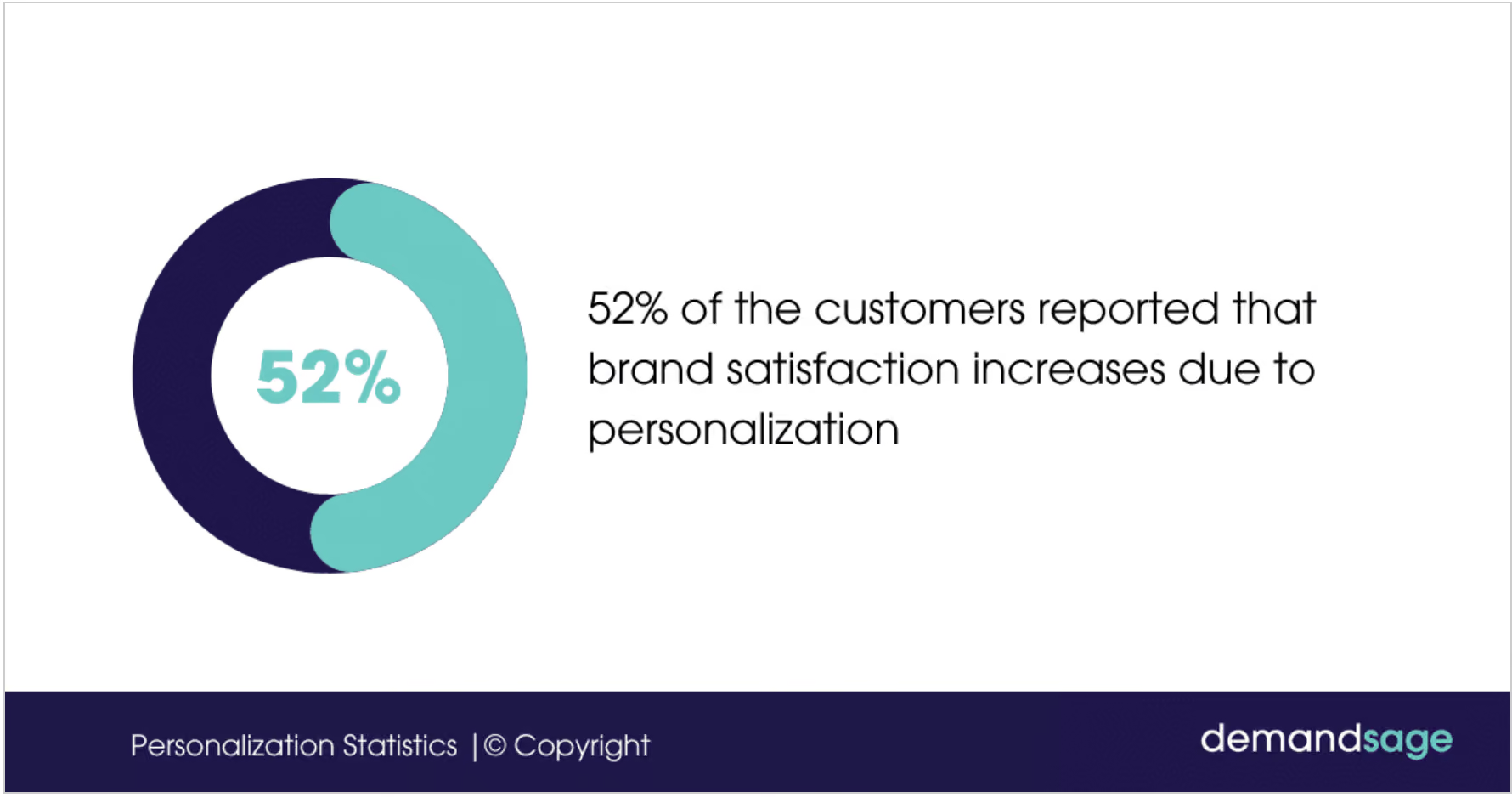
As such, personalization is closely tied to business success. In fact, according to McKinsey, companies that excel at personalization can generate up to 40% more revenue compared to average players on the market.
Personalization is about tailoring communication, channels, recommendations, and even complaint handling to each customer. When customers feel understood and valued, they’re more likely to stay loyal and buy more over time.
So, if you were wondering how to reduce customer churn, personalization is the answer. Still, it needs to be done right, and that’s where customer data comes in. Here are a few approaches you can use to facilitate personalized experiences:
{{cta-lm}}
Speed matters. Customers are 2.4 times more likely to stay loyal when their problems are solved quickly, and real-time analytics makes that speed possible. Instead of agents hunting through disconnected systems or escalating tickets they could handle themselves, they get instant access to the context they need:
Achieving such a smooth interaction between agents and data demands a few things:
Your knowledge base should answer the questions customers actually ask, not the ones you think they'll ask. Ticket and chat analytics show you exactly what's driving contact volume:
Example: When one SaaS company analyzed its tickets, 40% were about billing confusion. They created targeted help articles and cut related tickets by 60%.
Analytics also tells you which existing content isn't working. Track search queries that return no results, articles with high bounce rates, and low helpfulness scores. If customers land on your "How to Reset Your Password" article but still open tickets, the article isn't clear enough – rewrite it.
High-performing organizations using analytics-driven self-service reach deflection rates of over 50%, meaning half their support volume never touches an agent. As such, monitor your deflection rate closely, as it's a direct line to lower costs and faster resolutions. The data shows you what to build, what to fix, and whether it's actually working.
{{cta}}
The implementation of digital customer service tools has already become a new normal. Technology has become the primary way for companies to better understand customers, streamline support, and deliver faster, more personalized experiences. As organizations look for smarter ways to turn growing volumes of customer data into actionable insights, artificial intelligence is becoming a central part of modern customer service strategies.
A 2024–2025 Statista survey of 10,000 decision makers found that around 50% use AI in CX to analyze feedback, create content, and power chatbots, and over 25% use it specifically to analyze data and predict future behaviors or outcomes. The simple truth is that nowadays, if you are not into AI-led customer support automation, you are more likely to stay behind your competitors. Like Harvard Business School Professor, Karim R. Lakhani, said:
“AI won’t replace humans, but humans with AI will replace humans without AI.”
However, not all customer service analytics AI tools will set you up for success. To find software that works for you, consider the following aspects.
Are you trying to deflect tickets, boost CSAT, drive upsells, or extract insights from conversation data? A chatbot built for deflection won't give you the deep sentiment analysis or churn prediction you need to offer high customer service standards.
If your AI tool doesn't plug directly into your help desk, CRM, and data stack – Zendesk, Salesforce, Shopify, whatever you use – you'll spend more time wrangling data than analyzing it. The best platforms unify AI and human workflows.
You want conversation analytics, real-time dashboards, sentiment tracking, and predictive insights about CLV or churn risk. Our CEO, Nataliia Onyshkevych, noted on Forbes Business Council that the most successful deployments automate up to 80% of routine queries, helping humans learn what to act on.
AI hallucinates. It invents policies, makes up discounts, and confidently states things that aren't true. As our CEO said:
“Adding humans to the workflow will allow for controlling AI’s behavior and intervening in complex and high-stakes situations.”
-Nataliia Onyshkevych, CEO at EverHelp
Fact-validation controls and human-in-the-loop workflows are non-negotiable. You need tools that let you review AI responses, set accuracy thresholds, and escalate edge cases to humans before they reach customers.
Your AI should adapt to your brand voice, follow your workflows, and be customizable without requiring an engineering team. If changing a response template takes a developer sprint, you've bought the wrong tool.
Absolutely. Data-driven customer support can give you a real competitive edge. After all, a data-led approach helps teams deliver better service, create happier customers, and drive stronger business results.
But it’s not a quick fix. Building a strategy around customer service analytics takes time, the right tools, and strong alignment across teams. You’ll need to analyze feedback, set clear processes, and continuously refine your approach to keep improving the customer experience.
You can structure and optimize a support strategy on your own, but consider the trade-offs first.
If you think you can do it and get the results that you want, then great. But if you aren’t sure, our EverHelp experts will be more than happy to jump in and build the data-driven customer support you want. Book a meeting with us to discuss what would be a good fit for your business.
Help someone else stay in the know. Hit that share button!



.webp)
.avif)
.avif)