AI & Automation
Live Chat
Technology
Published on
02.01.2026
Last updated on
01.10.2026
Best AI live chat software for customer service 2026: compared & reviewed

Olha
Support Operations Manager

Olha
Support Operations Manager

TL;DR: This guide answers the five critical questions leadership teams ask before signing contracts, compares platforms by vertical (ecommerce, SaaS, finance, healthcare, hospitality), and reveals hidden implementation costs vendors don't disclose upfront. We examine representative solutions, Evly AI, Zendesk, Intercom, Gorgias, Tidio, and adding AI layers, with practical deployment blueprints and future-proofing strategies.
The AI landscape has shifted dramatically. What separated platforms in 2024 was speed and basic automation. In 2026, the differentiators run deeper:
According to Zendesk, 61% of customers now expect personalized service and AI to understand their emotional state. Businesses face mounting pressure to meet that expectation while staying compliant across jurisdictions.
Hence, choosing the best AI live chat software for customer service that fits your industry means moving past feature checklists. The platforms that deliver measurable ROI in 2026 balance industry-specific workflows with flexible architecture, giving you automation today and adaptability tomorrow.
This guide compares options by industry and highlights the real costs of implementation, including the ones vendors don’t talk about. We’ve added an extra section, going over popular questions business owners usually ask when looking for AI live chat software.
Most leadership teams circle back to the same five questions before committing to an AI live chat software contract. These aren't technical deep-dives; they're alignment questions that determine whether your investment supports strategic goals or becomes another underused SaaS subscription.
So here are the five most common questions answered to help you make the right choice before selecting a platform.
Quick answer: Most companies may see 3–12 month payback through deflected tickets, reduced handle time, higher conversion rates, and contained headcount growth.
ROI hinges on four levers:
Research from McKinsey indicates that AI-powered customer service can reduce handling time by up to 40%, which directly impacts labor costs and customer satisfaction scores.
Quick answer: You can do it via the provided granular tone settings, prompt configuration, restricted knowledge sources, and human approval workflows.
Modern platforms offer granular controls: tone settings that shift between formal and conversational, prompt configuration that embeds your brand guidelines, restricted knowledge sources that prevent the AI from inventing answers, and human approval workflows for sensitive topics like refunds or account changes.
Guardrails matter. Set escalation rules that route uncertain queries to human agents rather than letting the AI guess. Define forbidden topics: medical advice for non-healthcare brands, financial guidance for non-licensed entities, and legal interpretations. Then, enforce them at the platform level.
Brand voice isn't a one-time configuration. Plan to review a sample of AI conversations weekly during the first quarter, then monthly. Look for tone drift, factual errors, and missed escalation opportunities. The best platforms let you tune responses without retraining models.
Quick answer: Choose between all-in-one CX suites (full migration), standalone chat tools (medium integration work), or AI layers (minimal disruption), depending on your needs.
Map your core systems before evaluating platforms:
Prioritize solutions with native integrations to these tools. Generic "we integrate via API" claims don't count; ask for proof of production deployments at similar companies.
You might like: Freshdesk vs Zendesk. Who wins?
Quick answer: Every provider should adhere to both general and industry-specific standards (like PCI-DSS for payments), as well as provide encryption and other security measures.
This is the base that each platform should provide:
Quick answer: It depends on what you’re looking for: big suites offer broad integrations and stability but come with complexity; niche specialists provide faster time-to-value and deeper vertical workflows.
Big suites offer broad integrations, established ecosystems, and predictable roadmaps. Niche specialists bring deeper vertical workflows, faster time-to-value, and teams that speak your industry's language. Neither is inherently better.
Ask yourself three questions:
Recommended Approach: Shortlist one suite, one AI layer, and one niche tool for pilot comparison. Run parallel tests on identical use cases with consistent success metrics.
{{cta}}
Generic “top 10” lists ignore what actually matters: how well a platform handles your industry’s unique workflows. They focus on a one-size-fits-all approach, forgetting those with specific needs. We don’t!
Top platforms: Gorgias, Tidio, and EverHelp’s Evly AI.
Order tracking, returns processing, product recommendations, abandoned cart recovery, and multilingual customer support define success in eCommerce. Customers expect instant answers about shipments and simple self-service for exchanges.
Prioritize these integrations:
Gorgias and Tidio excel here with pre-built eCommerce templates. Evly AI adds fast vertical onboarding and consistently high automation rates on repetitive queries, letting you cost-effectively scale during peak seasons. These strong candidates also support the eCommerce customer experience trends driving 2026 expectations.
Related articles: 10 eCommerce Support Challenges With Solutions
Top platforms: Fin AI, Zendesk AI, EverHelp’s Evly AI, and AI layers for existing stacks.
In-app support, onboarding guidance, account-based routing, and tight CRM integration separate strong platforms from generic chat widgets. SaaS customers expect contextual help tied to their product usage, not disconnected FAQ bots.
Prioritize these integrations:
Intercom, Zendesk with AI, and Evly AI lead here. On the other hand, AI layers that sit atop existing ServiceNow or Jira Service Management deployments work well for technical teams with complex toolchains. Focus on solutions that support both reactive support and proactive customer service interventions.
Top platforms: EverHelp’s Evly AI, Zendesk AI.
Strict compliance, identity verification, transaction status queries, and high trust thresholds define this vertical. A single data breach or regulatory violation outweighs any automation benefits.
Require these compliance criteria:
Top platforms: Zendesk AI, Evly AI, adding AI Layer.
Appointment scheduling, eligibility checks, coverage questions, and sensitive personal health information handling require specialized approaches. Favor platforms with proven healthcare deployments. Their AI should route any health-related questions to qualified staff rather than attempting answers.
Require these compliance criteria:
Top platforms: EverHelp’s Evly AI.
Bookings, cancellations, itinerary changes, local recommendations, and real-time disruption updates (weather delays, overbookings) drive support volume. Mobile support matters more here than in other verticals.
Prioritize these integrations:
Evly AI’s background in service-heavy industries and 24/7 multilingual coverage positions it well for global hospitality operations, maintaining consistent customer satisfaction metrics.
Disclaimer: This article was written by Everhelp, which is one of the providers featured in this comparison. All trademarks and brand names belong to their respective owners and are used for identification purposes only. Everhelp has partnerships with some of the providers listed here. Competitor information is based on publicly available sources and is accurate as of September 23, 2026. Providers may update their offerings at any time, so we recommend confirming current details directly with each company before making a decision.
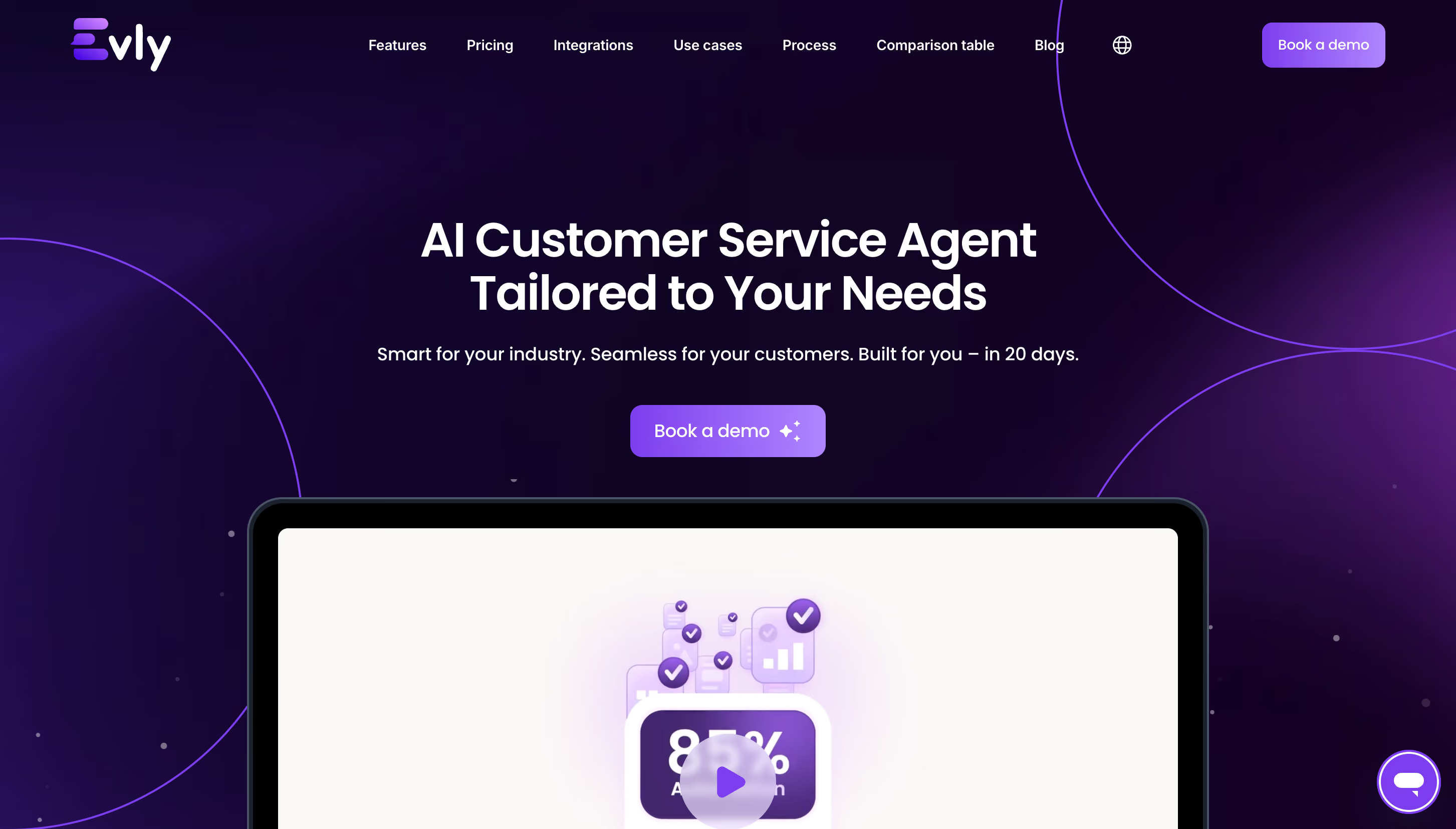
Built by customer support specialists who have worked across various industries rather than pure software engineers. Evly AI adapts quickly across verticals: eCommerce, hospitality, professional services, healthcare, and others.
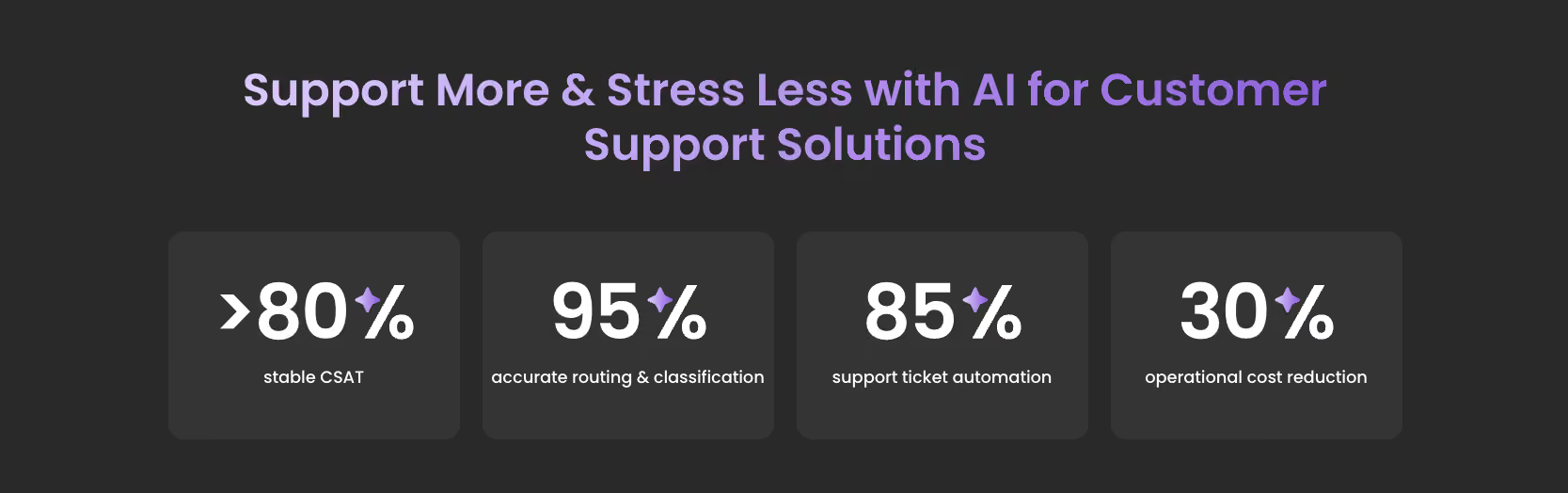
User reviews on G2 consistently highlight:
Best Fit: Companies of all sizes wanting an AI partner that understands live chat support benefits and can adapt implementation to operational realities rather than forcing generic playbooks.
{{cta}}
Zendesk unifies ticketing, knowledge bases, voice, messaging, and now native AI under one roof.
Best Fit: Mid-market and enterprise teams already invested in the suite, seeking incremental AI upgrades without migration risk. Excels for true omnichannel customer service.
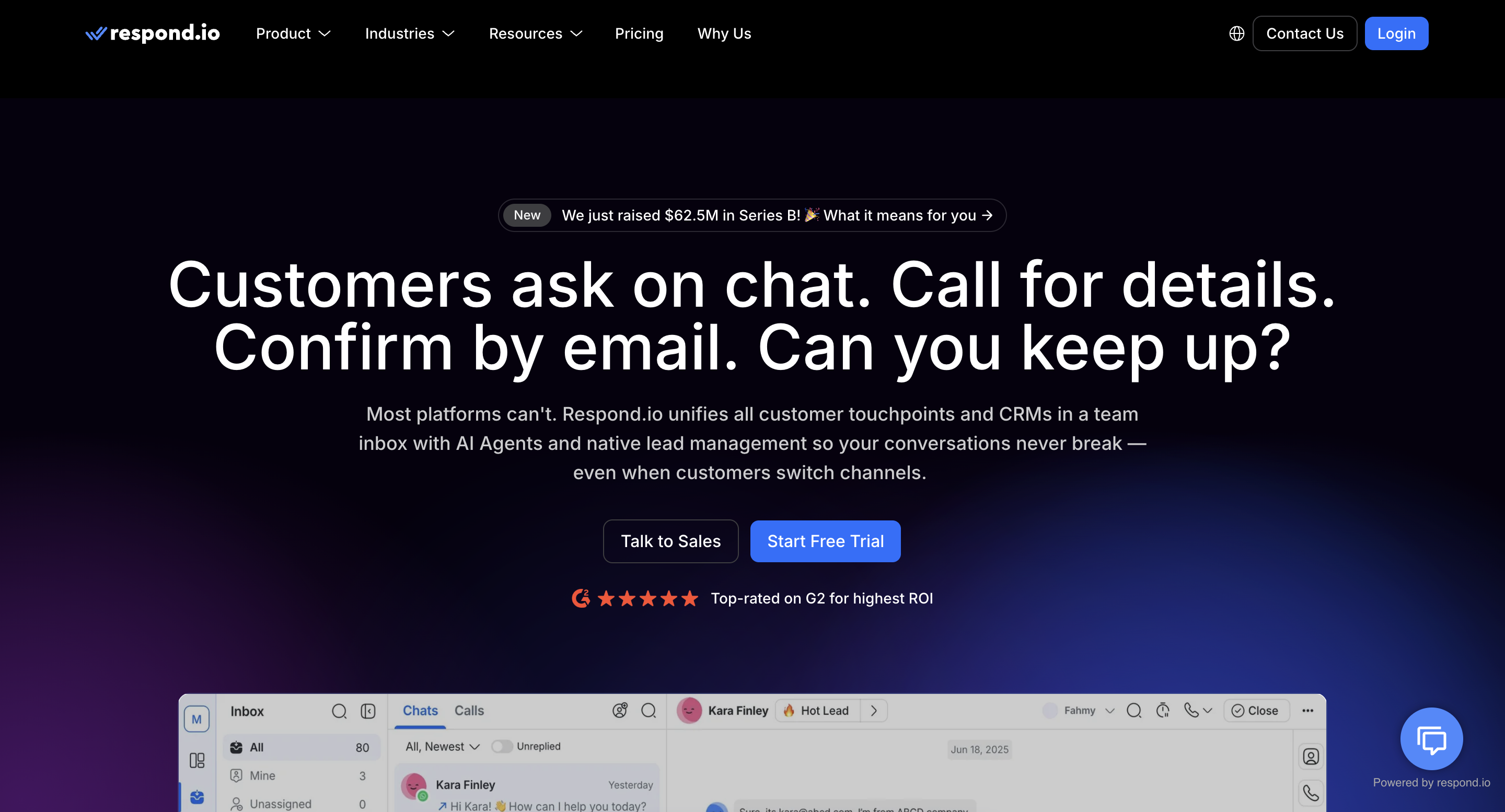
Respond.io is a customer conversation management platform for high-volume, mid-market B2C businesses where conversations drive revenue. It centralizes WhatsApp, Instagram, Messenger, TikTok, Telegram, LINE, Viber, WeChat, voice calls, and email in one unified workspace – giving teams full customer context without switching between tools.
Best Fit: B2C businesses in retail, automotive, healthcare, beauty, and hospitality where high-volume conversations directly drive revenue. A 7-day free trial is available.
Both tools are built around eCommerce support, but they serve different stages of growth. Gorgias pairs a full helpdesk with an AI Agent designed for Shopify-centric brands. Tidio combines live chat with Lyro, an AI agent that gives small and midsize stores an accessible entry point to automation.
Best Fit: DTC and retail brands wanting fast time-to-value with minimal configuration.
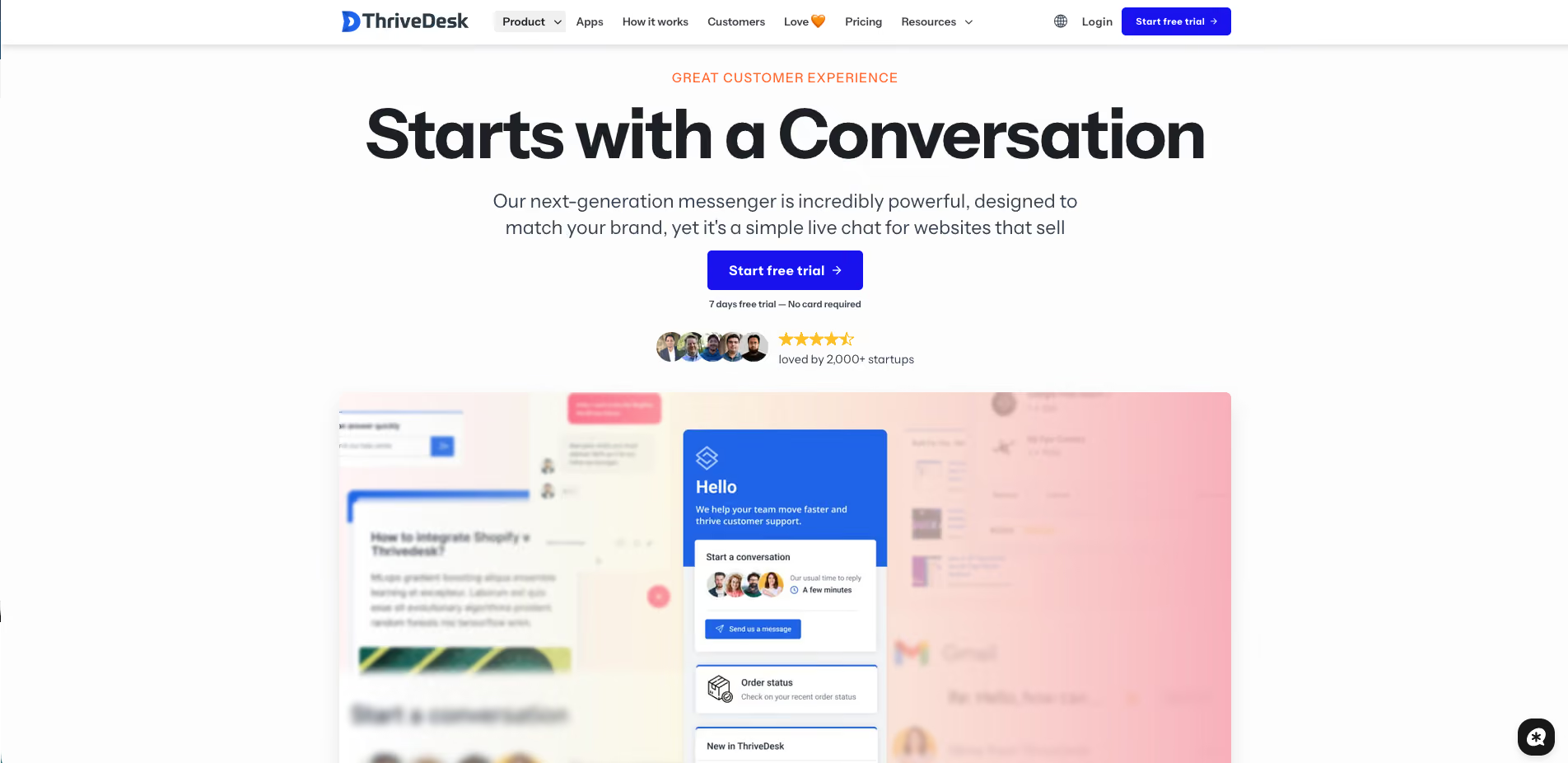
ThriveDesk's e-Commerce chatbot offers a WooCommerce-oriented support platform with live chat, shared inbox, knowledge base, automation, and NEO, its AI assistant trained on a knowledge base, website, and documents. Its WooCommerce integration supports order, refund, shipping, and subscription workflows within tickets.
Best Fit: WooCommerce and WordPress-based eCommerce brands wanting a lean, budget-friendly AI-powered live chat setup without a long implementation cycle or ambitions for full process automation.
Solutions like Forethought and Ultimate.ai add AI to existing help desks without replacing them.
Best Fit: Organizations with mature technical operations wanting AI as a modular layer rather than a new core platform.
Related articles: Top 10 Most Functional Support Channels to Fit Your Support Strategy
Selecting the best live chat software for websites solves half the challenge. Implementation quality, ongoing governance, and cost transparency determine whether your investment delivers sustained value or becomes shelfware.
Map your top 10 use cases by volume and complexity. Align with legal and compliance early: address data residency, consent management, and retention policies before pilot launch.
Here are a couple of examples from our projects to help you with a quick start.
Involve frontline agents in flow design. They know which questions generate the most frustration and which responses maintain brand voice. Document current baseline performance on target use cases to measure improvement accurately.
Define these success metrics:
One of our clients from the SaaS industry, a styling service app, had a total of 23,200 inquiries handled by 24 humans, both complex and simple ones. After AI integration, they maintained the ticket volume with a smaller team: AI & bot covered 17,000 questions, while 8 remaining agents answered 6,200.
Launch on limited intents and channels. Start with high-volume, low-risk queries like order status, password resets, or basic product information.
Run parallel operations initially. Keep human agents available to monitor AI performance and catch errors before they impact customers. Use the pilot to stress-test integrations, measure actual response accuracy, and refine escalation triggers.
Set these success thresholds:
Expand to new markets, languages, and use cases based on pilot learnings. Build feedback loops. Capture customer feedback systems data on AI interactions. Review low-confidence exchanges weekly. Update knowledge bases and prompts monthly. Treat AI performance as an ongoing optimization practice, not a launch-and-forget project.
Set these integration points:
Try this cost modeling exercise to expect those unexpected charges:
Related articles: Pros and Cons of AI in Customer Service
The best AI live chat software for customer service isn't the one with the most features or the biggest brand. It's the platform that aligns with how your customers want to engage, integrates cleanly with how your team works, and adapts as your business evolves. Make the choice deliberately! That's how AI turns into your sustainable competitive advantage.
{{cta-lm}}
For companies considering external support alongside internal AI investments, exploring call center outsourcing companies in addition to live chats can provide extra flexibility. The combination of excellent customer service principles with modern AI capabilities creates a foundation for building customer loyalty that withstands competitive pressure.
{{cta}}
AI live chat software uses machine learning and natural language processing to automate responses, learn from interactions, and handle multiple conversations simultaneously without human intervention. Traditional live chat requires human agents for every interaction, limiting scalability and operating hours. Understanding the live chat vs chatbot distinction helps clarify which approach fits your needs.
Pricing is usually per-seat or usage-based. SMB plans cost $30–$150 per user/month, mid-market and enterprise plans range from a few hundred to tens of thousands per month, while usage-based pricing may vary between $0.60 to $2.00 per AI conversation or successful AI resolution, plus any required help-desk, agent-seat, or base subscription fees. Large enterprises may negotiate custom rates of $100–$500 per user and annual commitments of $50,000–$500,000+, including implementation.
Modern platforms handle complex scenarios through layered approaches: AI resolves straightforward queries while routing nuanced, sensitive, or high-value issues to human agents based on confidence thresholds, detected sentiment, or predefined rules. Success depends on proper configuration, robust knowledge bases via a customer support knowledge base, and clear escalation protocols rather than expecting AI to replace skilled agents entirely.
eCommerce, SaaS, financial services, healthcare, and hospitality see the strongest ROI due to high support volumes, repetitive query patterns, and 24/7 availability requirements. However, any industry with significant customer interaction volume and clear documentation benefits when implementation addresses industry-specific compliance and workflow requirements.
Track four primary metrics:
For eCommerce, add revenue attribution – purchases influenced by support interactions. Baseline these metrics before implementation and measure monthly for 12 months to capture seasonal variations and optimization effects. Avoiding poor customer service through proper measurement ensures your AI investment delivers value.
Help someone else stay in the know. Hit that share button!



.webp)

.avif)
.avif)
.webp)