AI & Automation
Published on
14.02.2026
Last updated on
01.09.2026
Top Contact Center AI News for Future-Proof Customer Support

Oleksandr
AI Integrations Lead

Oleksandr
AI Integrations Lead

Something shifted in 2025, and it wasn't subtle. After years of AI pilots that looked impressive in boardroom demos but barely made it into real operations, contact center AI news this year speaks about a different story. Agentic AI moved out of the lab and into production, embedding itself across IVR systems, agent co-pilots, workforce management platforms, and real-time analytics dashboards.
According to a PwC 2025 survey, 79% of organizations now report some level of agentic AI adoption, and 88% plan to expand those investments. And just like that, the pilot era is officially over. Now, though many industries, and support in particular, have moved into the era of AI-assisted service, some businesses are still weighing in all the pros and cons of AI in customer service. But, truth be told, you are either getting on board with innovation or staying behind in competition.
With this article, we aim to show the most important contact center AI developments from the past year and help CX leaders chart a clear, strategic path: from reactive ticket-clearing to proactive, agentic AI ecosystems that drive loyalty, efficiency, and growth.
Today's contact center AI landscape looks nothing like it did even 18 months ago. AI is no longer a bolt-on feature or an experimental chatbot lurking in the corner of a website. In the most forward-looking businesses, it is already embedded across virtually every layer of the contact center stack.
Back in 2024, a Gartner survey found that 85% of customer service leaders planned to explore or pilot conversational GenAI solutions in 2025 – and the industry has delivered on that promise. Specifically, Calabrio’s “State of the Contact Center 2025” has found that 98% of contact centers use AI in some form, based on a global survey of 437 contact center managers, with most deployments including chatbots and voicebots, chatbot analytics, and AI-powered scheduling.
AI touches nearly every interaction now. Think:
But the most interesting headline is the rise of agentic AI. These “agents” take on tasks like:
Why has it become so popular? Well, there are many reasons, but the financial benefits are probably the most incentivising for businesses. McKinsey, in particular, highlights examples where AI in contact centers reduces call volumes and handling time, and cites vendor cases reporting up to 50% lower cost per call alongside higher customer satisfaction.
The best AI voice agents have also moved well beyond the clunky IVR experience of old. Today, these tools can screen leads, prequalify customers, and handle tier-one inquiries with consistency that human-only teams struggle to match at scale.
What does all this point to? Contact centers are increasingly becoming engines of customer loyalty and growth. And the contact center AI news points to the need for businesses to shift from tool-by-tool adoption to platform-level AI strategies, where agentic capabilities are woven into every customer interaction.
November 2025 marked a turning point in the conversation: the industry collectively stopped asking "should we adopt AI?" and started demanding "where's the measurable ROI?"
Early in the year, Gartner's bold prediction set the tone: by 2029, agentic AI will autonomously resolve 80% of common customer service issues without human intervention, slashing operational costs by 30%. Despite being quite alluring, such a timeline puts enormous pressure on leaders to redesign roles, workflows, and KPIs right now – not after the transformation has already passed them by.
At the same time, while AI capabilities are accelerating rapidly, the way many organizations measure performance remains stuck in the past. Research from Contact Center Pipeline (November 2025) highlighted a persistent disconnect:
And when your measurement framework was designed for a pre-AI world, you're less likely to see any difference when introducing these new technologies, and thus, less likely to stick with it. Leaders who recognized this shift are now updating success measures to reflect what actually matters in an agentic world: experience quality, customer loyalty, proactive deflection rates, and the value of AI-generated interaction data – not just how fast an agent hangs up.
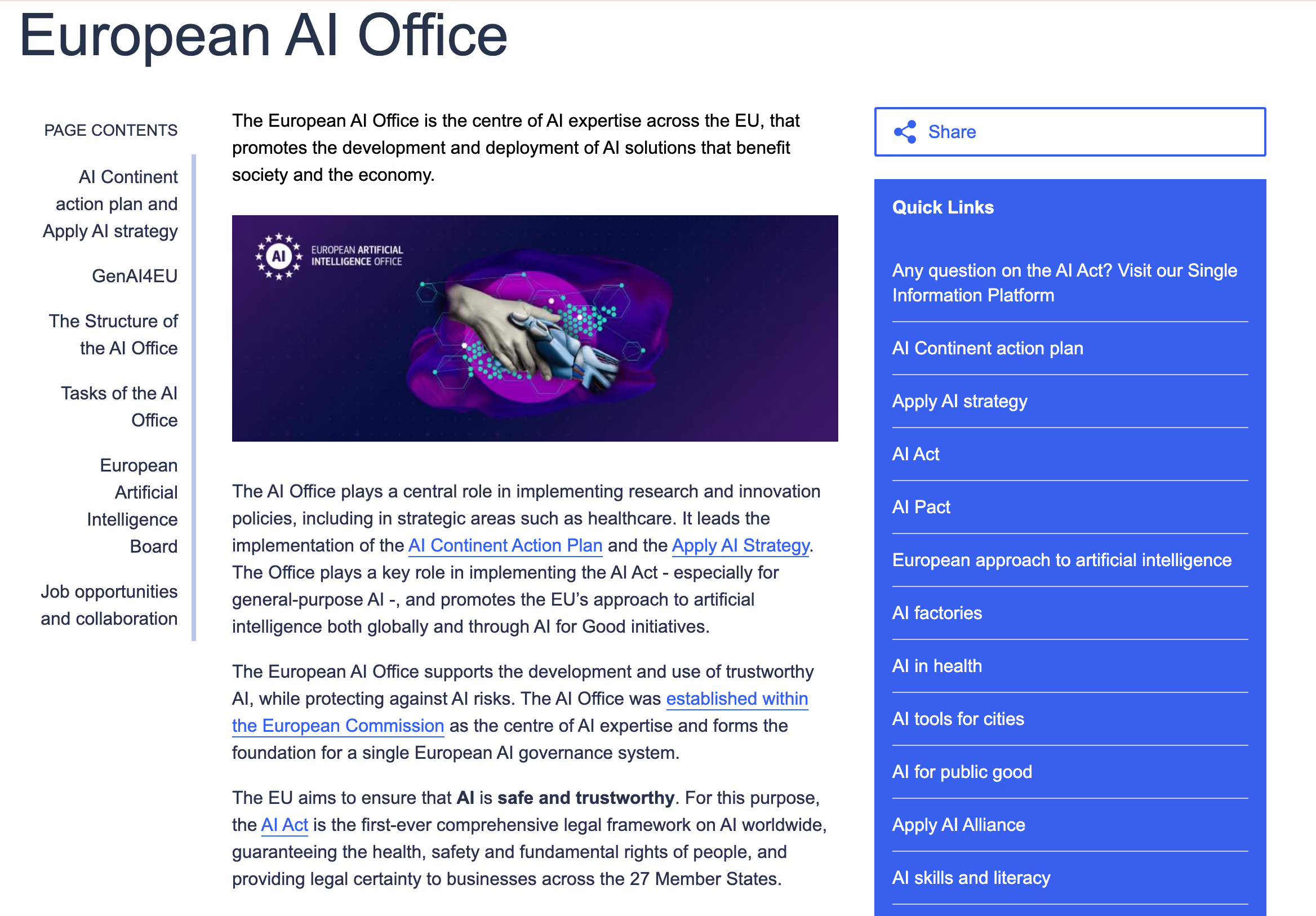
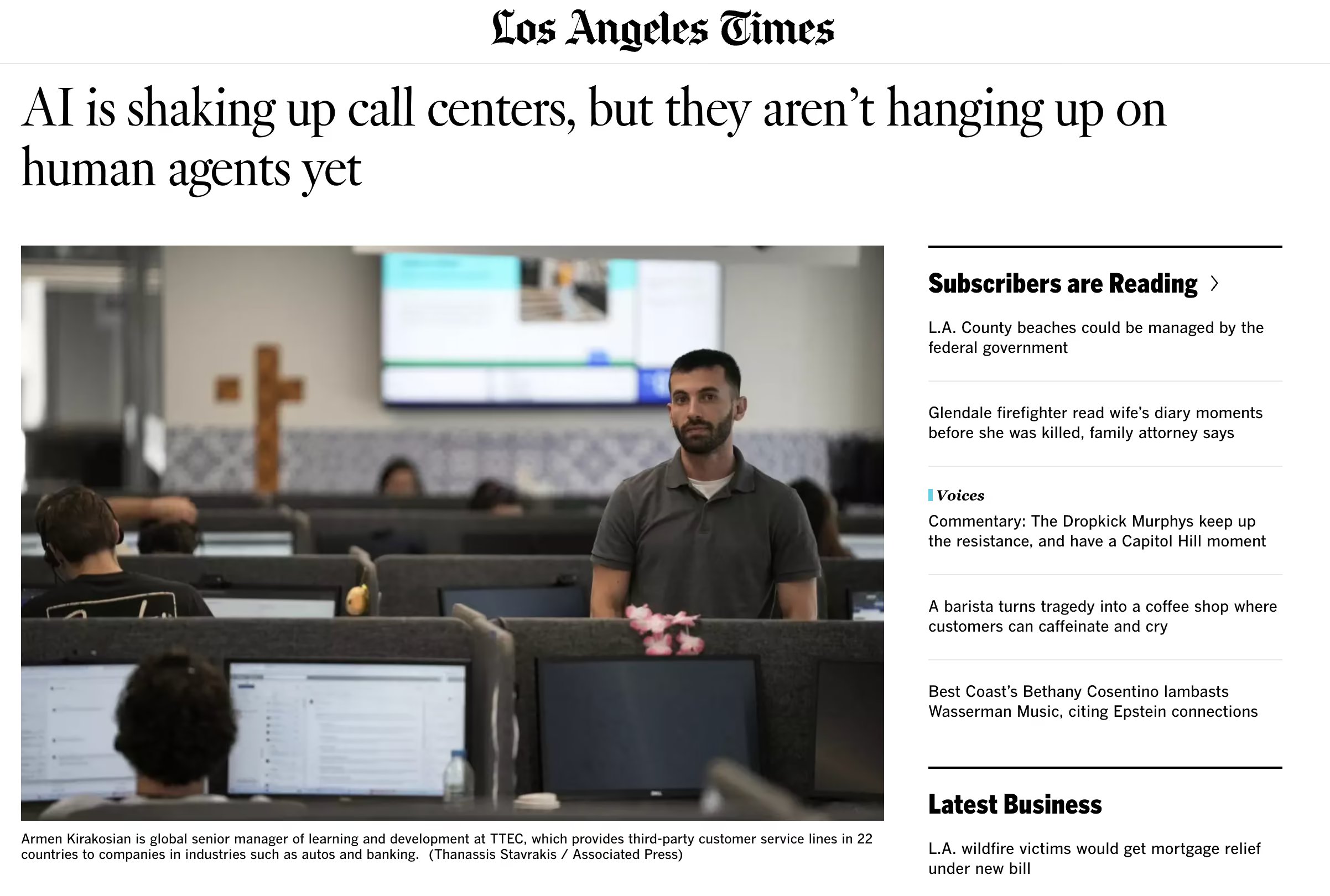
The November news cycle also highlighted some other, much harder questions about job design, governance, and ethics in AI-augmented environments:
{{cta}}
In contrast to November, October 2025 was a month of platform-level announcements that defined what "AI in the contact center" even meant and looked like.
Microsoft led the charge by expanding Dynamics 365 with a suite of new AI agents across sales, service, and contact center operations. The release included:
In the same article, a nonprofit organization yourtown (Kids Helpline), reported that these agents were helping reduce abandonment rates from 20–30% to under 5% in their fundraising.
And while AI was increasingly being portrayed as a very helpful (and much-needed) addition to conventional businesses, a Gartner survey of 265 service leaders (April–May 2025) found that 77% felt pressure from senior executives to deploy AI, and 75% reported increased budgets for AI initiatives. Pair that with the EU's emerging AI governance signals at that time, and you can easily understand why CX leaders rushed to formalize their own compliance and ethical frameworks later in the year.
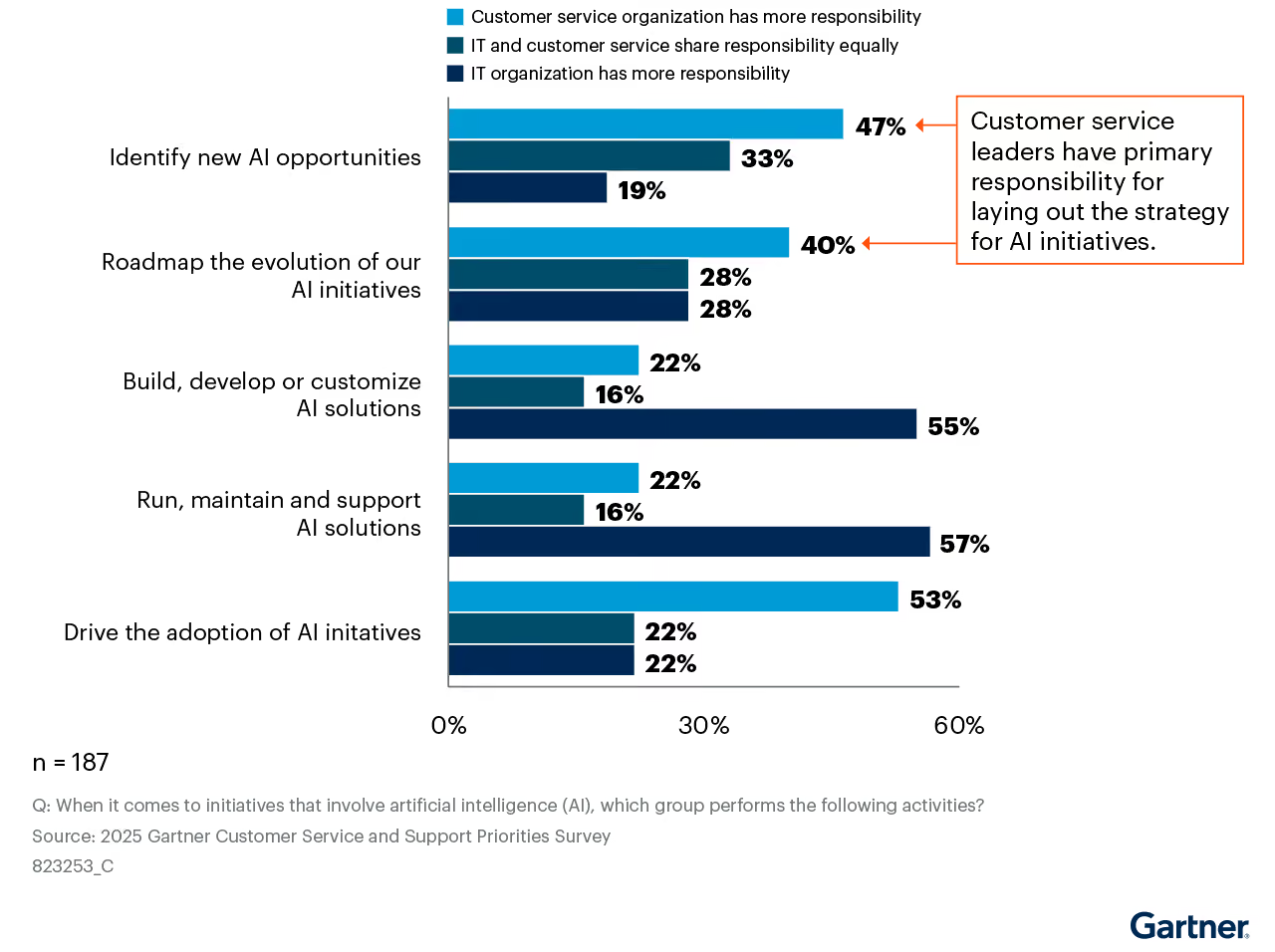
As such, in October, the industry slowly moved from adopting single-feature AI tools to releasing and deploying full integrated agentic ecosystems embedded in core CX platforms.
The biggest trend now is that proactive and predictive support is rapidly becoming one of the default customer service standards.
Today, AI is more widely used to:
For example, the company Verizon has started using generative AI to prevent 100,000 customers from churning back in 2024, with AI models accurately predicting the reason for a customer's call 80% of the time across 170 million annual calls.
Another area that is currently being transformed through automation and AI is QC. Now, there are whole quality evaluation agents like those introduced by Microsoft for Dynamics 365 Customer Service and Dynamics 365 Contact Center. These solutions let leaders see patterns across the majority of conversations instead of relying on the old manual sampling. Combine this with real-time analytics flagging anomalies as they happen and triggering corrective action before small problems become big ones, and you will have yourself a truly proactive customer service.
Major research in this area confirms the effectiveness of such AI-powered proactive engagement. More specifically, McKinsey states that it can:
In practice, organizations deploying these capabilities are seeing fewer inbound contacts, shorter interactions, and higher CSAT scores driven by early interventions. According to Master of Code's 2025 analysis, 75% of organizations that deployed AI agents reported improvements in satisfaction scores, with an average 6.7% boost in CSAT.
For us, at EverHelp, 2025 also marked the year of AI transformation. Seeing the rapid growth of interest in solutions powered by artificial intelligence, our executives decided to join these early waves of popularity. In February, EverHelp came up with the concept of an AI customer support assistant that would be customizable enough to match our clients’ versatile needs.
In May 2025, this idea came into existence in the form of Evly – an AI-powered customer support solution, designed to help any support team assist their customers quickly and effectively. We designed the service to help our clients handle support issues that they so frequently faced:
Taking into account our client’s challenges and what they wished to see in a truly tailored automated solution, our team trained Evly to:
Over the past year, we have deployed Evly for many of our projects. And the results didn’t disappoint, as now, our product:
Of course, these are just a few of Evly’s achievements. If you are interested in learning more about how our product performs for different projects we are working on, check out our AI in customer service handbook.
{{cta}}
Reading the news is one thing. Translating it into a roadmap is another. We’ve prepared a brief phased approach that builds on the patterns emerging from contact center AI news throughout 2025. Each phase is designed to layer on the previous one, as it’s important to ease into AI implementation gradually. Otherwise, you'll end up automating the chaos you already have.
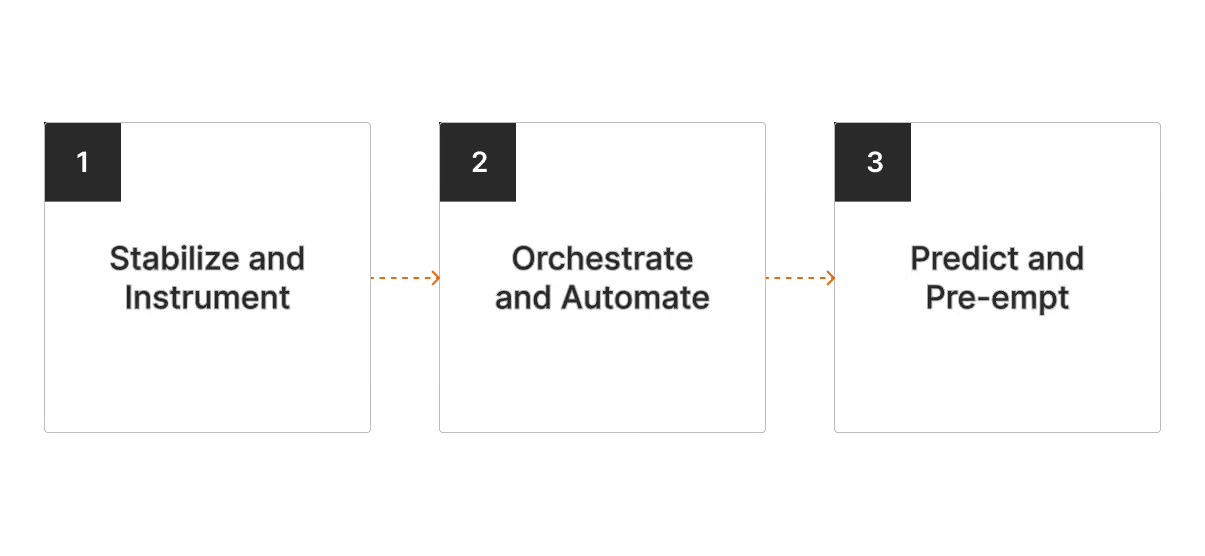
Before you automate anything, you need to know what's actually happening in your contact center. That sounds obvious, but you'd be surprised how many organizations jump straight to AI live chat software and custom agents while their customer conversations are scattered across five different tools with zero shared context.
Step one is:
Think of this phase as wiring up the nervous system. Agentic AI can't work with what it can't see. And if your data is messy or siloed, you're teaching it to replicate that exact behavior.
Now that you have clean data and a stable foundation, it's time to hand over the stuff your best agents shouldn't be doing anyway:
These interactions consume hours of agent capacity. Even though they don’t really require human judgment or thoughtful empathy statements.
Agentic AI can handle these tasks end-to-end across all main customer support channels (chat, voice, and email), but only if you set clear guardrails:
Get that escalation logic right, and you free your people to do the work that actually improves call center customer experience and builds customer relationships.
This is where things get genuinely exciting. Instead of waiting for customers to report problems, start connecting operational data, product telemetry, and customer journey signals so AI can spot trouble before anyone picks up the phone.
For example, you can set up a bot in your billing system that detects a pricing anomaly and sends a clear explanation to affected customers before they notice. Or, your product monitoring will be able to quickly detect a service hiccup, and let the support p[repare beforehand, not after tickets from angry customers start flooding in.
As a result, you will soon see fewer inbound contacts, shorter interactions when they do occur, and a support organization that shapes customer experience rather than reacts to it.
Here's the thread that runs through all three phases and never goes away: someone has to be watching the watcher. We advise setting quality criteria, escalation rules, and compliance guardrails from day one. AI shouldn't operate as a black box that nobody questions.
And just as important: rethink what "agent" means in your organization. The contact center professional of 2026 shouldn’t be just reading scripts. Their responsibilities will likely expand to include:
That role is harder, more valuable, and worth investing in through real upskilling programs.
Of course, nobody really knows what the future holds, and we all can only speculate on the role AI technologies will play in our lives in the future. However, if we look more closely at the sentiment on Reddit, for instance, we will see that the hottest topic in the industry for the past 12 months was human + AI support.
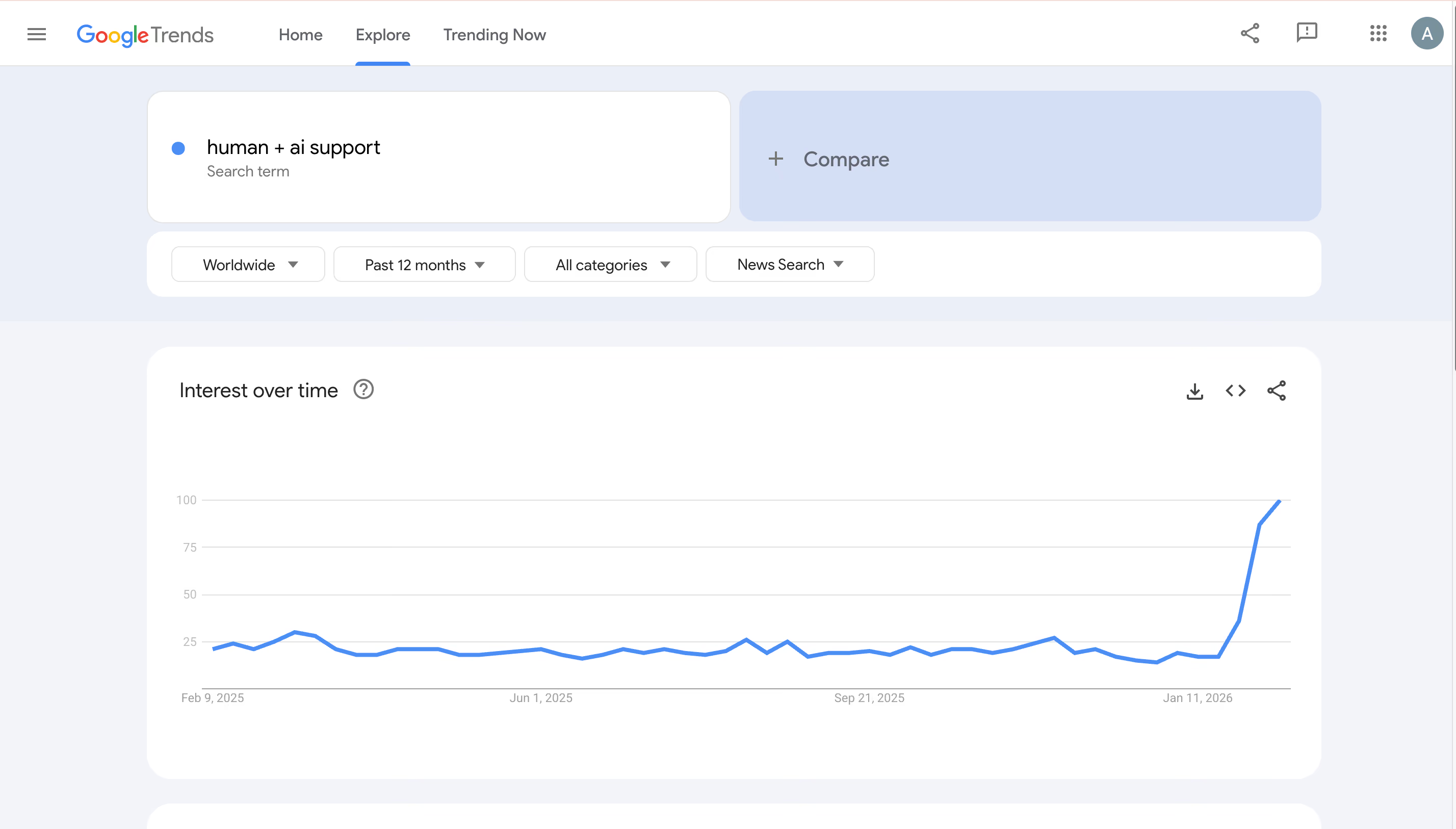
And the interest in such a hybrid approach to support organisation only grows stronger (just see the Google Trends yourself). It seems that the topic has gained the most popularity in the African countries (namely, Andora, Algeria, Tanzania, Kenya, and Nicaragua), as well as in Azerbaijan, Canada, the US, and Finland.
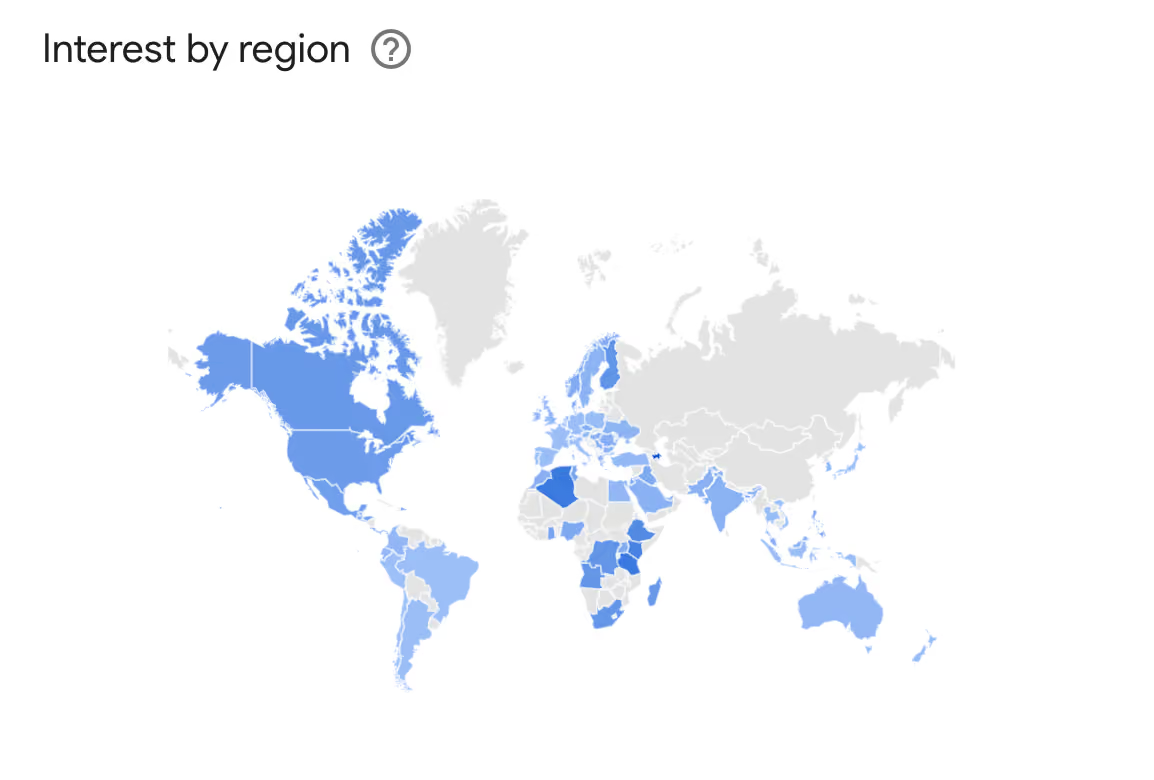
What does this mean? This means more businesses are exploring opportunities to combine the skills and knowledge of human agents with the precision and automation of AI tools to both stabilize and maximize the effectiveness of customer service.
As many leaders have previously noted, AI won’t fully replace humans. But people who know how to adopt and implement that technology will definitely surpass those who don’t. And that's exactly where the real competitive edge is forming. The companies investing in training their support teams to work alongside AI – reviewing its outputs, stepping in when conversations get nuanced, using AI-generated insights to anticipate problems before they escalate – are already pulling ahead. As such, the winning system is not the one that only operates on bots or is only run by humans. It’s the one where each makes the other better.
If the search trends and industry signals tell us anything, it's that the next few years won't belong to whoever has the most advanced AI or the largest human team. They'll belong to whoever figures out the handoff between the two.
2025 proved that agentic AI isn't a trend to watch, but a transformation already underway. The organizations pulling ahead are the ones that have finally moved from pilots to full-on execution, replaced legacy metrics with outcome-driven KPIs, and redesigned their teams to partner with intelligent systems rather than compete against them.
If you're ready to turn these insights into a concrete strategy tailored to your business, EverHelp can help you get there. Our team combines deep CX expertise with hands-on AI implementation experience to build support ecosystems that actually deliver. Book a meeting with EverHelp, and let's design your 2026 AI playbook together!
Help someone else stay in the know. Hit that share button!
.webp)

.webp)
.avif)
.avif)
.webp)
.webp)