Support Ops & Teams
Published on
22.08.2026
Last updated on
01.09.2026
Tone of Voice examples: how to align your brand identity with customer support
.avif)
Andrew
Chief Commercial Officer

Andrew
Chief Commercial Officer

TL;DR: Tone of voice in support functions as a retention lever with measurable business impact: most customers walk away after a bad experience, and most never complain first. thinkJar found that 25 out of 26 dissatisfied customers simply leave. The same facts, delivered in two different voices, can land as either reassuring or dismissive, as shown through real examples from Slack, Mailchimp, and Zappos. As AI takes on more support volume, tone becomes a governance question as much as a writing one, which is why a ready-to-copy framework with vocabulary banks, punctuation rules, and guardrails is included as a downloadable PDF.
What makes one brand's outage message feel reassuring, and another's feel like a legal disclaimer, when both say the same thing? According to the Zendesk Customer Experience Trends Report, half of customers switch to a competitor after a single bad experience, and that number climbs to 80% after two. The difference rarely comes down to what happened. It comes down to tone of voice examples: the specific words, structure, and warmth a brand uses the moment something goes wrong, and whether that voice holds up under pressure.
As the Zendesk study mentioned above shows, what triggers that departure is rarely the technical failure itself. It is how the brand handled it. Tone of voice examples are everywhere in customer support: the live chat that made you feel like a nuisance, the email that sounded like it was written by a legal department, the social reply that was technically accurate but somehow made you angrier. Your product gets customers through the door. The way you speak to them during high-friction moments determines whether they stay, and how much they spend over time.
To make that concrete, we will use one universal scenario throughout: your SaaS platform is experiencing an active database outage affecting all EU customers.
This is one of the most common high-friction incidents support teams face, alongside billing errors and lost shipments, and it is a useful stress test precisely because the pressure is high and the margin for tone error is low. Dashboards are inaccessible, reports will not load, and users are contacting you across every channel. The facts, the SLA, and the resolution steps are identical across every example. Only the tone changes.
At EverHelp, we train our agents to maintain each client's brand voice across every channel, even under pressure, because that consistency is the difference between a resolved ticket and a lost account.
According to Forrester, customer-obsessed organizations report 41% faster revenue growth, 49% faster profit growth, and 51% better retention than their peers. The differentiator in most cases comes down to the quality of the experience more than product quality, and experience is communicated through language.
When a customer contacts support about a billing error or a delayed shipment, they arrive already stressed. The language they encounter in the next 60 seconds either confirms that your brand is trustworthy or adds to their anxiety. Brand tone of voice examples matter most in these friction moments because that is where the gap between brand promise and reality becomes visible.
That gap matters because it rarely shows up where you would expect to catch it. Customers who leave after a tone failure rarely complain first. According to thinkJar research, 25 out of 26 dissatisfied customers never raise a complaint; they simply leave. Your dashboards stay green while your churn compounds silently, which is why churn prediction models that factor in tone signals surface risk earlier than those tracking resolution metrics alone. The connection to customer lifetime value follows directly: every silent departure represents lost future revenue that never appears as a flagged complaint or a support escalation.
Most brand voice guides present examples in isolation: a cheerful social post here, a polished email there. That removes friction, and friction is exactly where tone earns its value. The subsections below put four distinct brand personas through the same active outage, expose the specific language patterns that make a response feel dismissive or genuinely trustworthy, and define the failure modes that most guidelines never name.
The scenario: 45 minutes in, EU customers cannot access dashboards or run reports, and your team is managing inbound contacts across live chat, email, and social simultaneously. The SLA commitment, the root cause, and the estimated resolution window are identical across every version. What shifts is the voice, and with it, the entire experience.
Below are message comparisons from the outage scenario. Each pair shows the same information through two entirely different lenses.
"We are aware of a technical issue affecting database access for customers in the EU region. Our engineering team has been notified and is currently investigating. We apologize for any inconvenience this may cause."
"Hey, we know your dashboards are down, and we are already on it. The team is actively investigating, and we will send an update within 30 minutes. Thanks for hanging tight with us."
The stiff version is cold, passive, and reads like a liability disclaimer. The aligned version conveys the same urgency with a tone that feels human and accountable.
"We are experiencing intermittent service disruption. Your data remains secure. We apologize for the issue."
"Your data is fully secure and unaffected. This outage relates only to dashboard access. Our team is working to restore service and will keep you updated every 30 minutes until it is resolved."
In fintech, security is never assumed. Those are examples of tone of voice in communication working correctly. What you prioritize says as much as what you say.
Every brand persona has a version of itself that goes too far. A "witty and casual" brand can tip into flippancy. An "authoritative" brand can tip into condescension. This is the negative space most brand guidelines fail to define.
"As we mentioned in our previous communication, this is a known issue." The phrase "as we mentioned" implies the customer was not paying attention. Respectful reiteration sounds like: "To recap: our team identified the issue at 10:42 AM and is actively deploying a fix."
"Looks like our database decided to take an unscheduled vacation!" Playful brands can be warm without treating serious disruption as a punchline.
"Errors are being experienced by some users." Zonka Feedback's customer service research puts it plainly: 91% of unhappy customers who do not complain simply leave. A tone that minimizes or deflects accelerates the exit.
Social media is the highest-stakes support channel because a single reply is visible to thousands of people who were never part of the original conversation. This section covers why public-facing tone demands its own rules and what real crisis responses look like when brand voice is embedded rather than improvised.
Social media responses are real-time, public, and permanent. Brandwatch's research on brand voice makes the case clearly: brands with an established tone navigate crisis management more effectively, because audiences who already know how a brand sounds can distinguish genuine accountability from corporate spin. The digital customer experience risk is amplified because what you write to one frustrated customer becomes your public statement on how you treat all of them. Multilingual support adds another layer: the same tonal misstep can land very differently across markets when translated.
Slack's handling of a five-hour service outage is one of the most referenced examples in B2B crisis communication, precisely because the incident itself was unremarkable and the response was not.
Slack experienced a widespread outage affecting messaging and connectivity for roughly five hours, disrupting work for thousands of teams that depend on it daily.
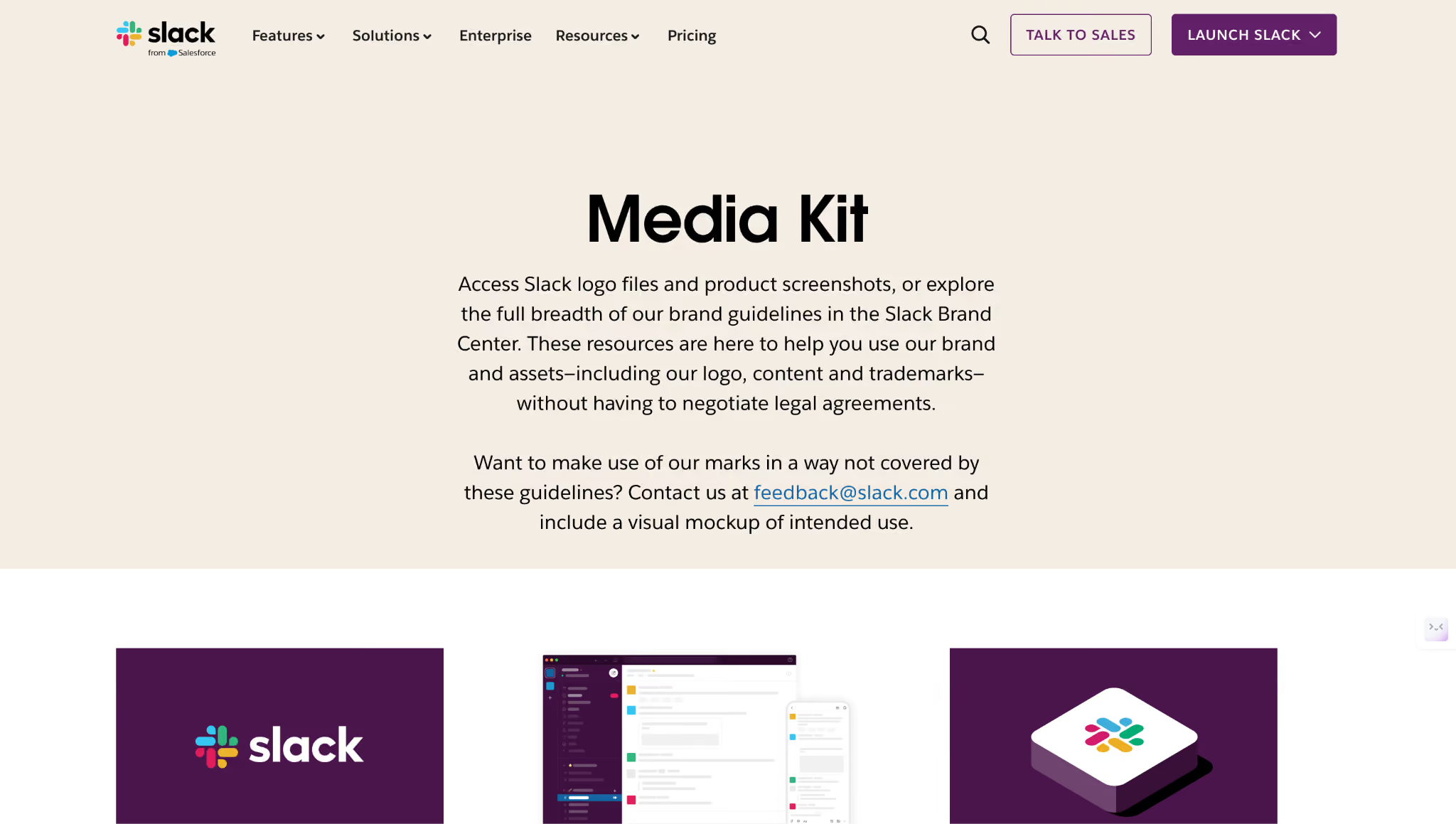
Sprout Social's crisis analysis documents how the company posted updates roughly every 30 minutes, called out its own missteps transparently, and used a tone on X that was authentic and apologetic rather than evasive. Slack's guidelines describe their tone as "clear, concise, and human, like a friendly, intelligent coworker", and that standard held even while the product itself was failing. Updates named the problem plainly, avoided corporate hedging, and kept the same conversational register customers expect from Slack on a normal day.
Brands that respond to outages with boilerplate apologies and ticket numbers may convey the same facts, but the tone signals depersonalization, where the customer becomes a case number instead of someone the brand recognizes. Slack's consistency, by comparison, kept the brand relationship intact even as trust in the product itself was temporarily shaken. That is the brand tone of voice examples distinction that actually moves customer sentiment.
Seeing tone applied to the same outage scenario across different brand types makes the concept operational. This section covers three distinct contexts: a SaaS brand with a publicly documented voice that adapts by context, a people-first retailer whose support culture is as famous as its product, and EverHelp's own approach to maintaining client brand voice under pressure.
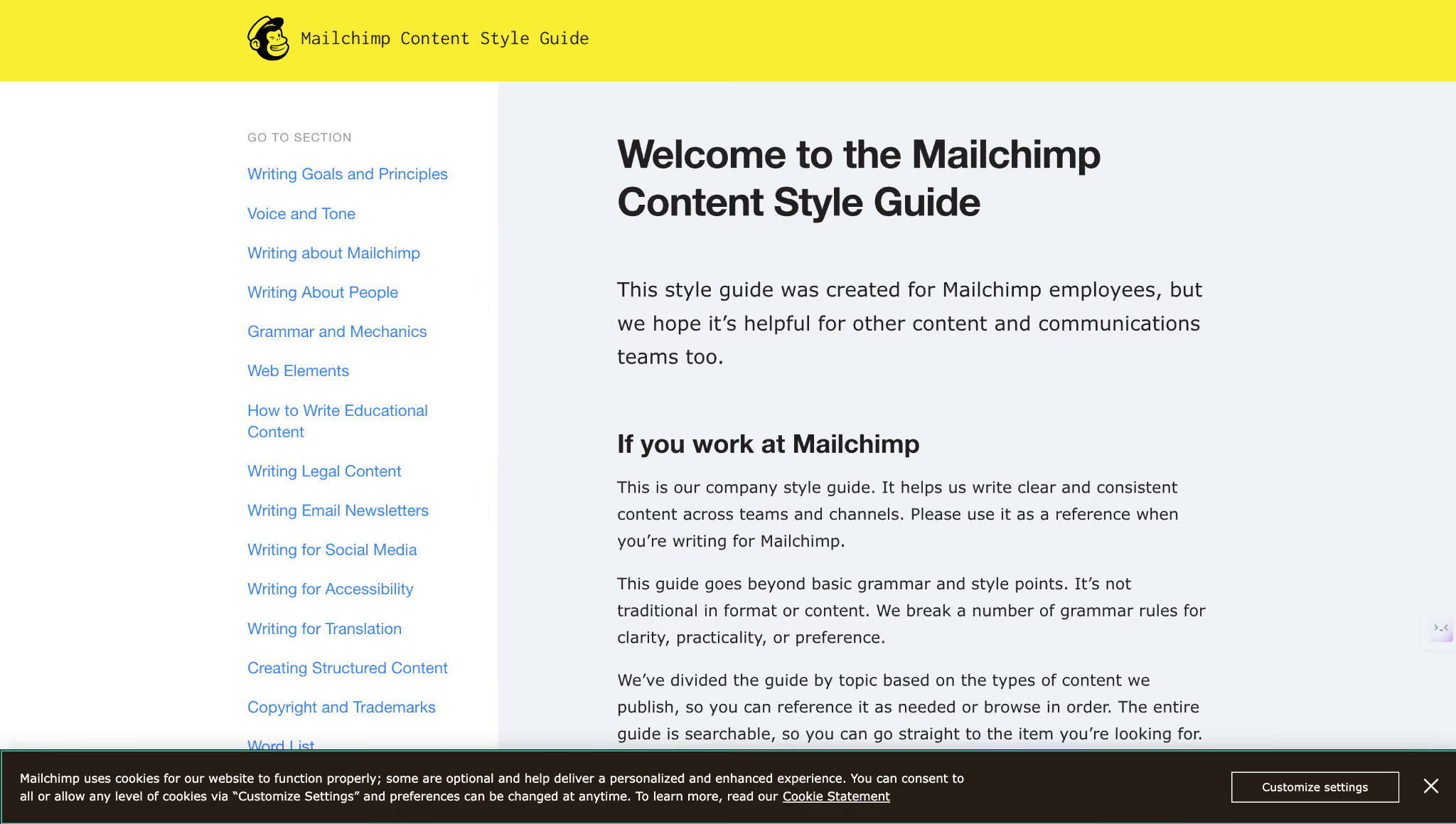
Mailchimp is one of the few SaaS companies to publish its full content style guide publicly, including a dedicated voice and tone section. Their principle is precise: voice stays constant, tone shifts with the customer's emotional state. During a service disruption, Mailchimp's guidelines explicitly steer writers away from humor on error pages, because a user who cannot access their campaign is not in a place to appreciate wit. The support response instead leads with acknowledgment, states the known facts, and ends with a clear next step.
Applied to our outage scenario, a Mailchimp-aligned live chat response looks like: "Hey, we know your dashboards are not loading, and we are already working on it. Here is what we know right now, and we will update you here as soon as we have more." No unnecessary softening, no legal-sounding disclaimers, and no humor that would land badly in a moment of real frustration. The excellent customer service discipline here is knowing which version of your brand to show, and when.
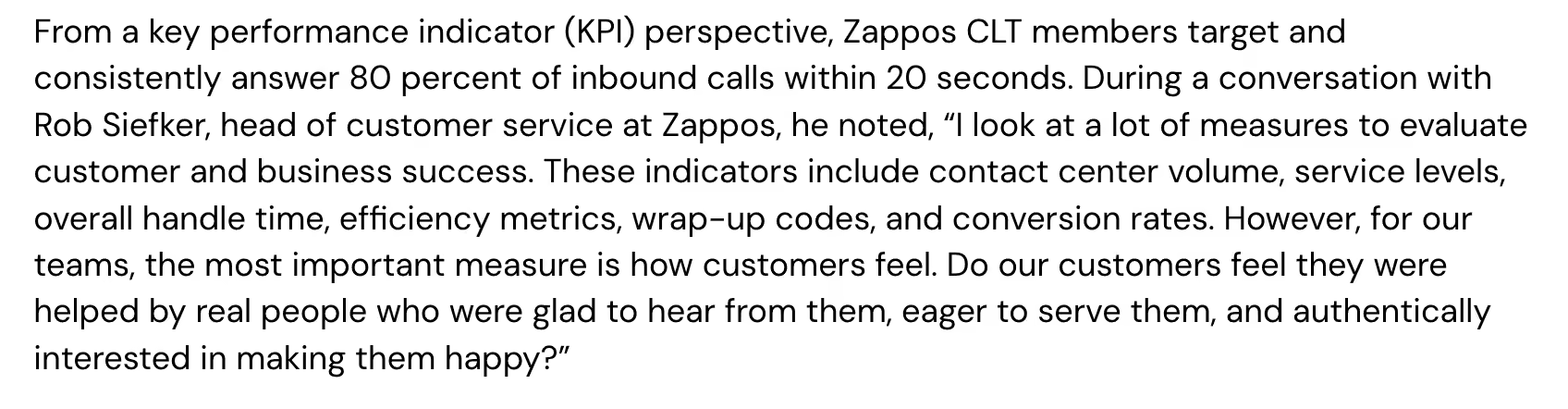
Zappos has built its entire reputation on treating support as a relationship rather than a transaction. Their customer loyalty team has no strict call time limits. Agents are trained to make genuine personal connections and are empowered to make independent decisions without management approval. As Rob Siefker, former head of customer service at Zappos, put it: the most important measure is whether customers felt they were helped by real people who were glad to hear from them, more than handle time or efficiency metrics.
In practice, that means a delayed shipment response at Zappos leads with the person, not the order number. Personalized customer support at this level means the agent might ask what the delivery was for before offering a resolution, because understanding customer wants and needs is what shapes what "resolved" actually means for that customer. The contrast with a process-first response is stark:
Process-first: "Your order #48201 is showing a delay. Please allow 3-5 additional business days."
People-first (Zappos style): "We can see your order has not arrived and we are really sorry about that. What was this order for? We want to make sure we get the right solution for you, not just the standard one."
That second version contains more humanity, and that is the retention signal.
At EverHelp, our agents are trained in each client's specific tone of voice, including vocabulary banks, punctuation rules, escalation phrasing, and channel-specific calibration. Brand voice degrades under pressure. An agent who has internalized the persona responds consistently during a crisis; one who has only read a brand brief reverts to personal defaults when volume spikes. As we highlighted in our agent skills article, the competencies that move CSAT scores are communicative as much as technical, and tone is at the center of both.
{{cta}}
The goal is coherence across the full omnichannel support experience rather than uniformity. Customers should feel the same personality whether they are on a phone call, reading a status page, or seeing a public post. The vocabulary and pacing shift by channel. The values underneath them should not.
Customers who get warmth on live chat and a robotic auto-response via email experience a brand inconsistency that erodes trust. Every channel is a touchpoint, and every touchpoint is a vote for or against the relationship.
Adjective-based tone guidelines ("professional but approachable") are accurate but not actionable. An agent still has no idea how to phrase a response to an angry customer. Shifting from adjectives to real example phrases is the single most impactful change you can make to your tone documentation.
This matrix becomes a training tool. Tone is observable, coachable, and correctable when expressed as real phrases rather than abstract descriptors.
Every brand persona needs a vocabulary layer: the specific words that reinforce the voice, and the ones that undermine it.
Words we love (calm, accountable, direct brand): resolve, confirmed, update, your data, we are on it, here is what is happening, by [specific time]
Words to avoid: inconvenience, kindly, rest assured, at this point in time, we apologize for any disruption, please be advised
Punctuation rules:
Consistent vocabulary and punctuation reduce tone variability across agents and make customer feedback more actionable. When language is standardized, CSAT patterns are easier to attribute to specific tone behaviors.
Guardrails do the work that inspiration cannot. A well-written persona description tells agents what to aim for. A guardrail table tells them where the line is and what happens when it gets crossed.
This framework helps QA teams catch tone issues that pass content checks. A response can be factually accurate, comply with policy, and still be emotionally off.
Pre-approved guardrails reduce the cognitive load on agents during high-pressure incidents. PRNEWS research on crisis communication shows that consistent, human-centered tone during crises reduces backlash and rebuilds trust faster than technically correct but emotionally flat communication. Building this into a knowledge base agents can reference during incidents is one of the most practical investments a support organization can make.
AI is already handling a significant share of customer support volume. The question is not whether AI will interact with your customers. It already does. The question is whether those interactions sound like your brand or like a generic assistant. This section covers how AI is changing tone calibration today and what teams need to do to stay ahead.
ClearDesk's industry data shows that 80% of businesses plan to integrate AI-driven voice technology into their customer service operations by 2026. When your AI customer service agent is speaking to customers, whose voice is it using? Without deliberate design, AI defaults to generic. PwC's consumer research, referenced by Vonage, shows that satisfaction declines sharply when AI interactions feel impersonal. NextLevel AI's enterprise deployment data shows that emotional intelligence capabilities in voice AI are already reducing escalations by approximately 25%. Tone is no longer just a human problem. It is a system design problem.
The future of tone of voice with AI is already taking shape in contact centers. Near-term predictions:
How to prepare now: build machine-readable tone guidelines with real examples for AI prompts and guardrails; review AI transcripts for tone alongside accuracy as part of regular analytics cycles; train human agents and AI on the same persona examples; use VoC programs to flag tone mismatches before they surface as CSAT drops.
Examples of tone of voice are most useful when immediately actionable. Paste this framework into your internal documentation and adapt it for each scenario your support team handles.
Scenario: [Outage / Lost shipment / Billing error / Cancellation]
Persona summary:
Vocabulary bank:
Punctuation rules:
Channel-specific sample messages:
Guardrails:
Apply this to every major support scenario and review quarterly. Customer service standards that include language as a measurable dimension are consistently associated with higher CSAT, lower churn, and stronger brand perception over time.
Every support interaction is a micro-moment of brand truth. The brand your customer actually experiences when something goes wrong is defined by tone of voice examples: the specific words your agents choose, the empathy they extend or withhold, and the consistency of that voice across every channel.
Keap's own research shows that companies that improve customer experience see a 42% increase in customer retention. The customers you lose after a tone failure are largely invisible: they do not complain, they do not respond to win-back campaigns, they just stop renewing. Customer retention depends on how safe and respected your customers feel every time they contact you. Building customer loyalty through consistent, empathetic communication pays off in customer satisfaction, lower churn, and stronger lifetime value.
We train our agents to sound like your brand, even in the moments when that is hardest. If your support language does not yet reflect the standards your brand promises, that gap is worth closing.
{{cta}}
Help someone else stay in the know. Hit that share button!
.png)

.avif)

.png)
.png)