Growth & Metrics
Published on
25.03.2026
Last updated on
01.09.2026
How to Develop Your Digital Customer Experience Strategy

Hlib
Delivery Manager

Hlib
Delivery Manager
Most customers don't ghost brands after a dramatic blowup – they just leave quietly, after one too many frictions.
70% of consumers will abandon a brand after just two negative digital experiences. Two! That's a brutally low margin for error.
Knowing how to develop your digital customer experience strategy is the difference between bleeding customers to better-prepared competitors and building a self-reinforcing engine for loyalty.
This guide covers the essential steps, platforms, and trends you’ll need to build a strong digital customer experience. All recommendations are grounded in EverHelp's hands-on experience across 100+ projects, because a well-executed digital CX strategy directly cuts support costs up to 40% and measurably boosts customer satisfaction.
A digital customer experience strategy is a comprehensive blueprint dictating how an organization engages with buyers across every online channel. It aligns your technology, support teams, and data to create frictionless interactions.
Instead of treating your website, mobile app, and social media profiles as separate entities, a strong digital customer experience strategy unifies them. It ensures that a user starting a conversation with a chatbot can seamlessly transition to a live agent without having to repeat their issue.
Building this ecosystem requires focusing on three core components:
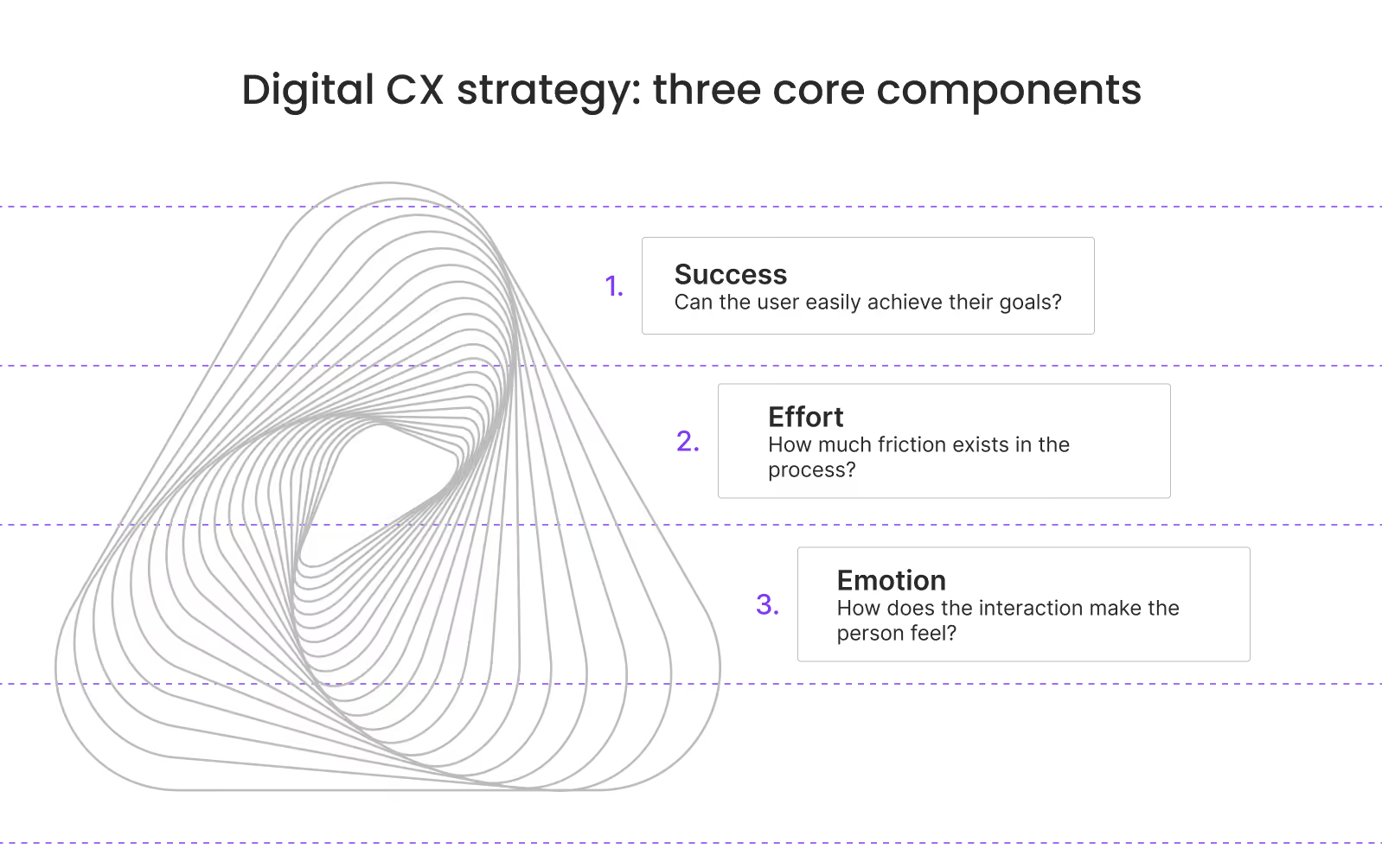
You need a unified digital CX approach because modern buyers rapidly abandon brands after poor online interactions, and retaining them requires flawless omnichannel engagement. Investing in this framework directly protects your revenue.
The cost of ignoring your online touchpoints is staggering.
Brands that invest in strong omnichannel customer service strategies retain an average of 89% of their customers, compared to just 33% for companies with weak engagement.
Consider three key reasons to prioritize your digital customer experience strategy:
{{cta}}
A unified digital customer experience strategy cuts support costs, lifts retention, and deepens brand loyalty – because every interaction becomes consistent, contextualized, and harder for competitors to replicate.
Organizations that formalize their approach see profound shifts in both internal metrics and external brand perception.
Digital transformation pushes companies to replace outdated legacy systems with agile, cloud-based solutions. This technological shift allows brands to connect disparate customer support channels, enabling real-time data syncing.
When a buyer interacts with your mobile app, the underlying infrastructure ensures your support agents instantly see that activity on their dashboard – enabling hyper-contextualized assistance rather than generic responses.
Creating a functional digital customer experience strategy is an ongoing operational commitment. It required the following 5 critical steps to build an ecosystem that scales with your growing user base.
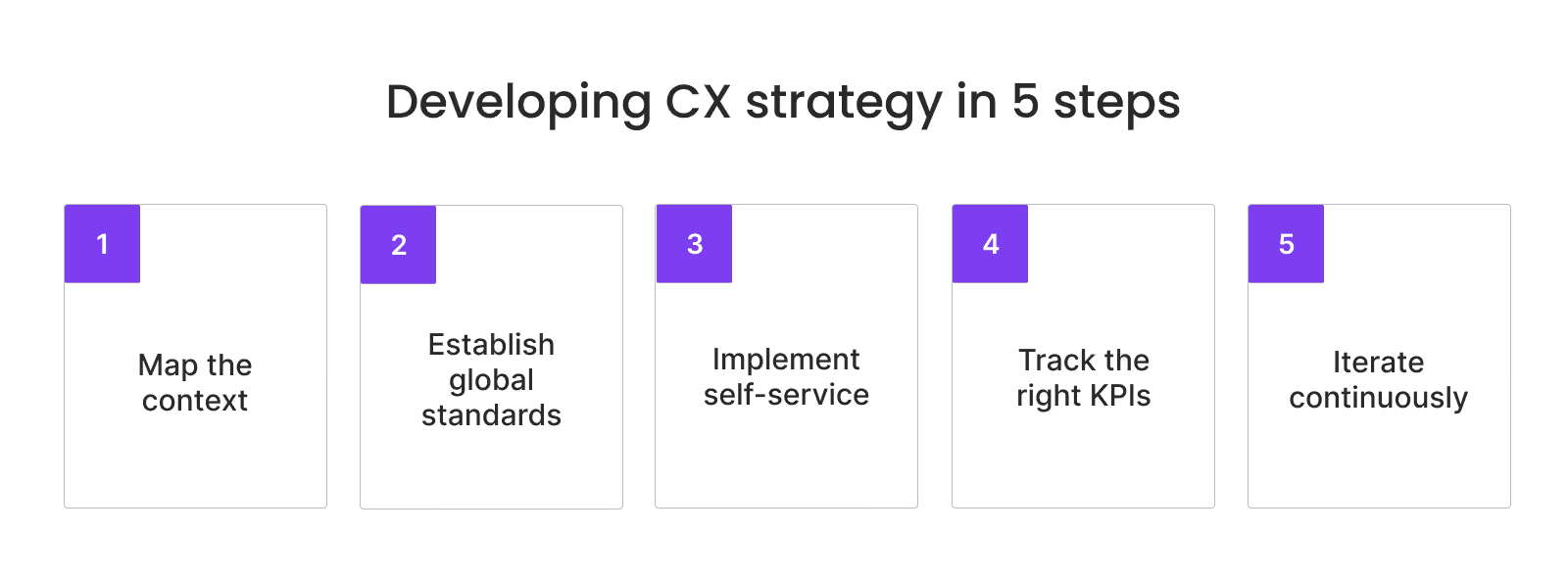
Start by documenting every online interaction, from initial discovery to post-purchase support. Plot these three:
Let’s call it your journey map. It becomes the diagnostic foundation on which everything else is built. Without it, you're optimizing blind.
Inconsistency erodes trust faster than a slow load time. Define your customer service standards for response times, tone, and escalation paths across all digital channels. When a buyer gets the same quality experience on live chat as they do via email, that consistency compounds into loyalty.
Check out Zendesk’s Service Culture Books for more ideas.
Most buyers would rather solve their own problem than wait in a queue.
67% of customers would rather solve the problem themselves than wait for a support agent to connect.
Deploy robust FAQs and AI-driven portals so they can do exactly that. Effective customer self-service does wonders:
Ticket count shows volume, but it doesn't indicate how hard your customers had to work. Move beyond surface metrics and monitor key customer satisfaction metrics like Customer Effort Score (CES) and First Contact Resolution (FCR) – numbers that reflect the actual quality of your digital journey.
A digital CX strategy isn't a one-time launch; it's a living system that requires continuous iteration. Use our structured voice of customer guide to:
Check out all the details in our VoC article linked above.
Choosing the right technology stack is the foundation of any successful online strategy. You need interconnected tools like omnichannel contact centers, the right integrations, AI assistants, and analytics dashboards that consolidate data and empower your human agents.
These platforms unify voice, chat, email, and social media into a single agent dashboard, so no matter where a conversation starts, context follows. No more "can you repeat your issue?" moments. For support teams handling high volumes across channels, this is the operational backbone.
The most popular and trusty platforms to try out:
P.S. We at EverHelp love Zendesk, Salesforce, and Freshdesk. By the way, check out our comprehensive Freshdesk vs Zendesk comparison!
Every support interaction is richer when agents can see the full customer history before they say hello. CRM integrations surface that data instantly, enabling deeply personalized customer service conversations grounded in context rather than guesswork.
Intelligent bots handle high-volume routine inquiries around the clock: answering FAQs, processing returns, and updating orders. Then, they seamlessly escalate complex issues to live representatives without losing the thread of the conversation.
AI agents and visual assistants we recommend for good automation and self-service:
Our own Evly AI is worth a special mention: it spots recurring patterns in support requests and feeds that intelligence back into your CX strategy, while handling 85% of tickets autonomously.
These tools track live sentiment, queue health, and agent performance, giving managers the visibility needed to adjust tactics before small issues become churn events. A solid customer feedback system feeds directly into these dashboards, creating a closed loop between buyer signals and team responses.
Good real-time analytics dashboards to use:
Today's most impactful digital customer experience trends all share a common thread: they eliminate the gap between what buyers expect and what brands can deliver in real time.
As you refine your approach, keep these three dominant 2026 trends in mind:
Static websites are out. Using behavioral data, platforms now dynamically adjust content, product recommendations, and support prompts to match the user's exact profile. 75% of customers still expect personalized interactions, so let’s keep delivering them.
The barrier between physical and digital is dissolving. Consumers expect to scan a QR code in a physical store to instantly access digital reviews or launch a live chat with remote multilingual support agents. Modern in‑store experiences deliberately integrate QR codes, mobile apps, AR/VR, kiosks, and IoT to bridge the offline and online, and customers love it!
Instead of waiting for a user to complain about a software bug, predictive analytics flags the error and triggers an automated email containing the solution before the user even reaches out. This way, predictive resolutions can reduce customer churn rates by 15-25%.
Achieving digital excellence requires more than buying software – it requires a holistic methodology that blends skilled global talent with advanced AI. EverHelp delivers this through a specialized Human + AI framework designed to rapidly scale your operations.
To fully execute a digital customer experience strategy, brands need a partner capable of managing operations beyond basic ticketing. EverHelp's CX approach encompasses more than just regular support:
By leveraging EverHelp's CX optimization, organizations can build resilient, 24/7 global operations.
{{cta}}
You develop it by mapping the user's online journey, unifying your communication channels (chat, email, social media) into an omnichannel dashboard, implementing AI for self-service, and continuously tracking performance data to eliminate friction points.
Check out our dedicated breakdown of customer service vs. customer experience (CS vs. CX) for a deep dive. In short:
A fragmented online presence leads to user frustration and high churn. A dedicated strategy ensures consistent, personalized customer service interactions that build trust, increase conversions, and reduce the operational costs associated with inefficient support routing.
Partnering with EverHelp grants you access to:
Digital transformation allows businesses to adopt cloud-based CRMs, AI-driven analytics, and omnichannel platforms. This technology ensures that customer data flows freely between departments, empowering support agents to deliver faster, highly contextualized, and personalized resolutions.
Help someone else stay in the know. Hit that share button!
.webp)

.webp)

.avif)
.avif)
.webp)
.webp)