Growth & Metrics
Published on
13.05.2026
Last updated on
01.09.2026
Why your 24/7 support strategy is obsolete: The rise of the always-on resolution economy

Nataliia
Chief Executive Officer

Nataliia
Chief Executive Officer

TL;DR: Most businesses run 24/7 support and still lose customers to slow resolutions. The gap isn't staffing; it's architecture. AI-led resolution systems now handle billing fixes, account changes, and refunds in under 60 seconds, with no agent involved. Companies that have made the shift report up to 40% lower costs and ticket volumes down by half. The ones still running queue-based models are competing on a metric customers stopped caring about.
If a customer contacts you at 2 a.m., waits 12 minutes, and reaches an agent who can't resolve their issue, have you provided 24/7 customer support? Technically yes. In practice, no.
According to Salesforce's State of the Connected Customer, 83% of customers expect immediate engagement. And yet most businesses still run on a pre-AI model: open a ticket, wait, escalate. This article breaks down why availability alone is no longer enough, how AI is raising the bar on what customer support 24/7 should deliver, and what steps actually move the needle from response to resolution.
Instant, automated issue resolution with no agent required, no ticket opened, and no follow-up email. The goal used to be a fast reply. Now it's a closed problem. Gartner predicts that by 2027, one in four organizations will use AI chatbots as their primary service channel. The cost of maintaining live customer service outsourcing across time zones kept climbing, making automation not just attractive but necessary.
A customer reports a duplicate charge. The AI reads intent, pulls the account, verifies the error, issues the credit, and sends confirmation in under 60 seconds. That's what well-integrated platforms are doing today.
Availability was never the same as quality, but for years, the two got treated as equivalent.
Three problems that don't go away with more staff:
Customers who say they prefer a human agent are really saying they prefer someone who fixes their problem.
See how leading companies approach customer retention when they shift their support model.
The upside of 24/7 coverage is real, but competitors now clear that bar as a given.
What 24/7 support gets right:
A fast response still includes waiting. Support availability solves access, not outcomes, and that's the distinction worth building a strategy around.
{{cta}}
Speed expectations are rising across every age group. How they prefer to engage, though, differs.
Customers across all four groups expect personalized customer support that adapts to their context. Omnichannel support is what makes that manageable at scale.
AI-driven support isn't a chatbot answering FAQs. At the resolution layer, it's a connected system that takes action.
The resolution flow:
The customer describes the issue. AI detects intent, retrieves the relevant account data, executes the action, and sends a confirmation. No ticket opened, no agent involved, no follow-up required. The interaction is logged automatically, resolution metrics are updated in real time, and a CSAT prompt fires within minutes. What used to take an agent 8–12 minutes of handling time is done in under 60 seconds.
EverHelp's Evly handles this end-to-end. Trained on 100,000+ real support tickets across industries, it resolves routine issues accurately without scripted shortcuts or generic deflection. How can AI improve customer service covers the full implementation picture.
Not all platforms are built for the same job. Many optimize for ticket management. Fewer are built to eliminate tickets.
Zendesk and Freshdesk are strong for organizing volume. Ada and Forethought are closer to resolution engines. That difference matters when the goal is reducing ticket load, not just sorting it faster.
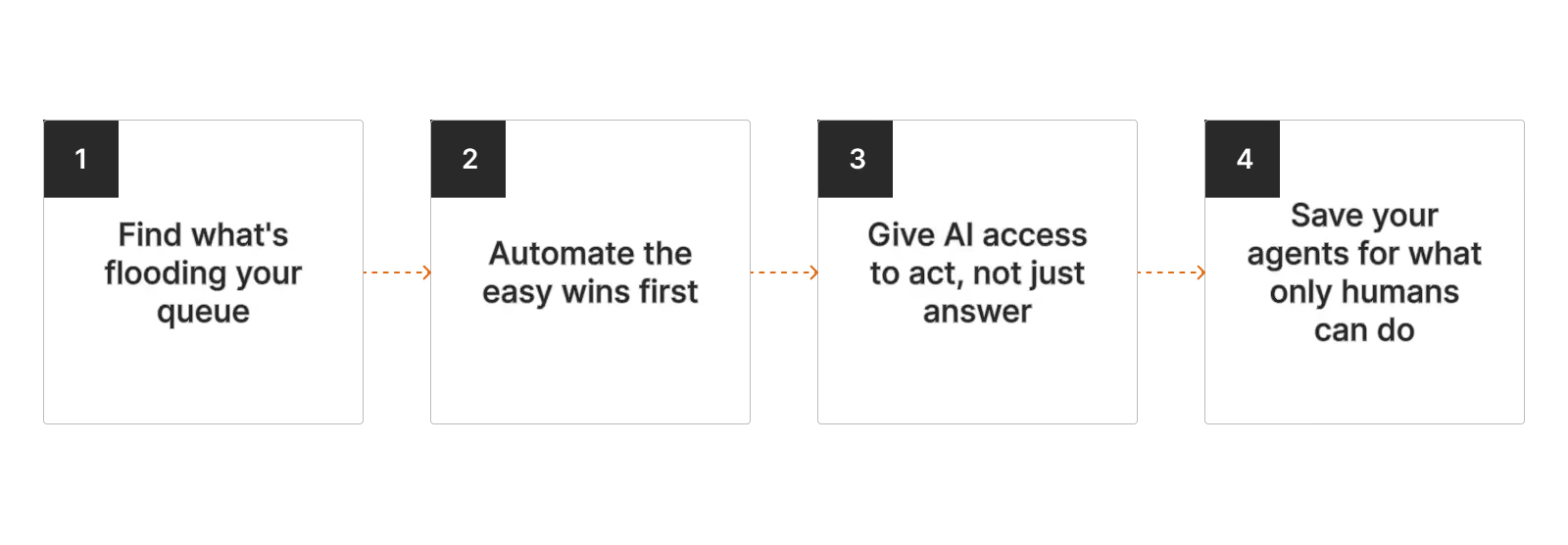
Scaling support doesn't mean scaling headcount. It means getting clear on what your team should and shouldn't be handling.
Step 1: Pull 90 days of ticket data. The top 5–8 issue types typically account for half of all contacts.
Step 2: Automate high-frequency, low-complexity issues first: password resets, order status, and refunds. This alone can cut queue volume by 30–40%.
Step 3: Integrate AI with backend systems. Connected to your CRM and billing platform, it resolves rather than just responds.
Step 4: Move agents to escalations and high-customer lifetime value retention conversations. That's where human judgment changes outcomes.
Pro tip: Before rolling out AI-led resolution, establish baselines for the metrics that will show the clearest business impact: cost per ticket, first-contact resolution (FCR) rate, average handle time (AHT), CSAT score, and ticket volume by category. Run the ROI calculator to project savings against your current headcount and ticket volume. These are the numbers that get buy-in from finance and operations, not just the support team.
McKinsey reports AI deployments reduce total support interactions by 40–50%. Gartner data shows AI-first platforms achieve 60% higher ticket deflection and 40% faster response times. Those numbers stack; they don't trade off.
Response time is an input. Resolution is the output. Raising your customer service standards around resolution rather than response is where the shift starts. Use customer service analytics to baseline where you are.
Against a competitor resolving billing disputes in under a minute, a ticket-queue model doesn't just feel slower. It feels like a different era. Customers won't say "their AI is better." They'll say, "This company is easier to deal with."
Labor costs keep rising. Live customer service outsourcing remains viable, but quality control and training cycles still demand ongoing investment. AI resolution cost per interaction keeps falling. Being available 24/7 will be the expected baseline, like having a website. It won't win customers. It's just the price of entry.
Customers don't want support. They want their problem gone.
If your current model is built around availability, that's a starting point, not a finish line.
{{cta}}
Most major platforms offer round-the-clock coverage: Zendesk, Intercom, Freshdesk, Ada, and Forethought among them. What separates them is whether that coverage means availability or resolution. Ada and Forethought are built for autonomous resolution. Traditional platforms like Zendesk still rely on agents for most resolutions, so true 24/7 requires staffing them overnight.
For businesses evaluating outsourced support:
EverHelp pairs human agents with its Evly AI model, trained on 100,000+ tickets, to deliver resolution 24/7, not just availability. See excellent customer service benchmarks for what good looks like.
When your digital customer experience is built around resolution, the benefits of 24/7 coverage actually land.
Help someone else stay in the know. Hit that share button!
.webp)

.webp)

.avif)
.avif)
.webp)
.webp)