Support Ops & Teams
Outsourcing
Published on
11.03.2026
Last updated on
01.09.2026
The 28-Day Launch: Our Model of Customer Service Outsourcing Process

Valentyna
VP of Customer Support

Valentyna
VP of Customer Support
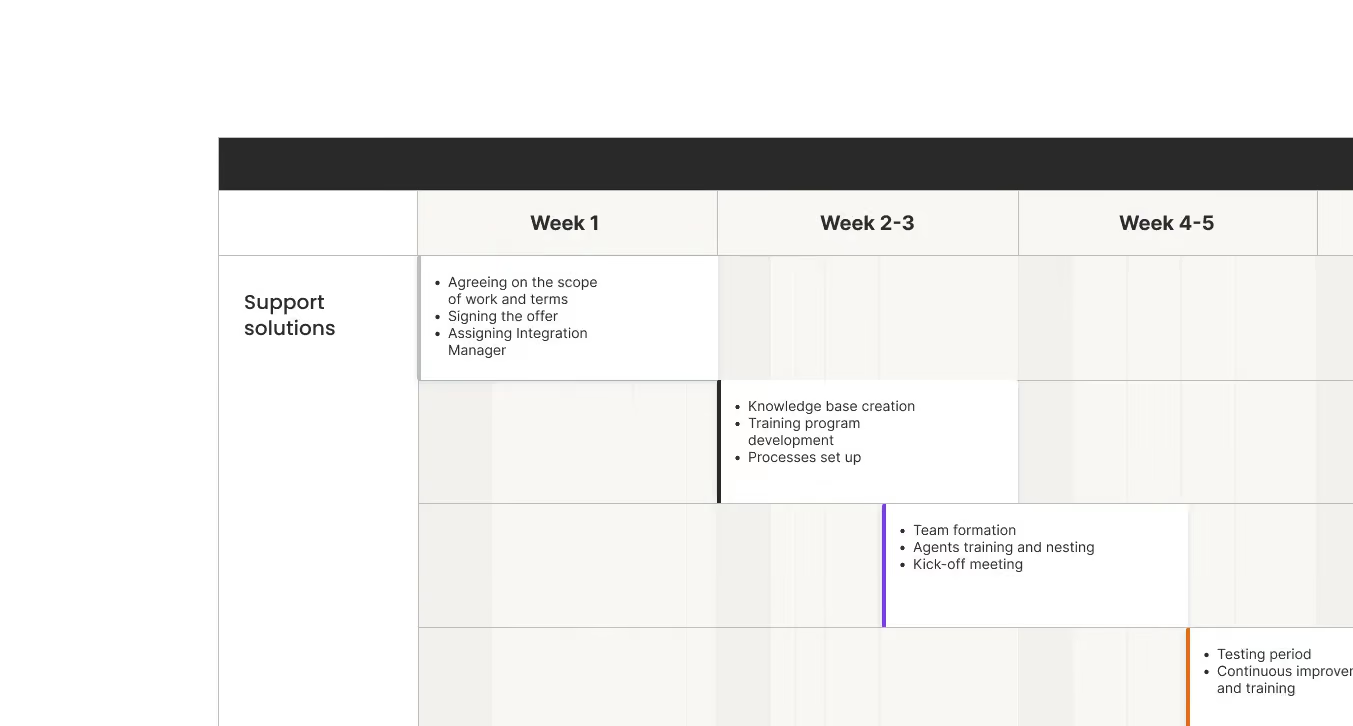
Your company must provide customers with quick and high-quality assistance for them to consider it excellent customer service. As EverHelp values your time, we have structured our customer support integration process to cover all necessary steps within a 28-day limit.
Below you will find exactly how we organize our work with the clients in the first few weeks after signing the contract.
Before our collaboration starts, to ensure we are a good match, we will have a discovery meeting where our representative will tell you everything about EverHelp. We will also ask you about your company, expectations, and current support request.
However, this stage is also an opportunity for you to ask any questions about our operations, possibilities, and deliverables. Remember, the primary goal of this call is to find out whether we will be good partners for each other.
Since a discovery call should be fruitful for both of us, we will help you prepare a little bit. In the table below, you will see a summary of all the topics and questions we recommend discussing during our first discovery meeting.
If we sign a contract together, this means we need to start planning our collaboration. Throughout the upcoming integration period, there will be a number of times when you, as a client, will have to be involved.
The purpose of our kick-off meeting is to get to know your business. And what we ask of you is to make a little pitch of your company:
After discussing your project and its needs, we will turn to planning our partnership. We will need to establish:
If we have missed anything during the kick-off meeting, we will hold another interview to clarify the necessary data. We are most likely to ask about:
During this time, we need you to stay focused and connected with us. You will most likely need to dedicate time to at least 2-3 meetings during the week following our kick-off.
After the first week, we will start active integration into your business. Here, we need you to:
Additionally, when we create a knowledge base for your support team, we will ask you to review the final materials. This will allow us to make necessary improvements early on, before the training starts.
The rate at which you, as a client, get involved during the 28-day integration depends largely on:
If you, for example, wish to take part in the hiring process, we will definitely ask you to set aside some time for candidate meetings and to provide feedback afterward. Similarly, it will be on you to schedule and spend time on support team training if you decide to handle that process alone.
1 day before and 1 day after the official launch of your support team, we will need your full involvement. Mainly, we will need you to help us:
To set our partnership up for success, we believe in building from a place of collaboration from day one. The more we understand your business, your customers, and your goals, the better equipped we are to represent your brand the way it deserves. So, we ask you a couple of things that will help us ensure exactly that:
Remember: we are trying ensure that the support we provide is exactly what you business needs and were looking for.
At EverHelp, we strive to provide maximum transparency about how we operate and structure our support processes. Thus, we feel it's extremely important for you to understand the structure of our team and its responsibilities.
Disclaimer: Your final team structure depends heavily on the type of collaboration model you choose for your business. The composition of shared, dedicated, talent-only, and AI-copilot teams is adjusted according to your specific needs.
This person becomes the primary point of contact between you, the client, and our EverHelp team. Their key role is to oversee your overall experience during our collaboration.
Main responsibilities:
They connect with your project right away, starting from the early stages of integration. Their primary focus is to organize your customer service outsourcing process according to your requirements.
Main responsibilities:
FYI: EverHelp is all about knowledge sharing, and our Delivery Managers sometimes post their insights on our blog. We invite you to check out their work.
As 86% of our employees are internally promoted, they understand the whole support process from bottom up. Thus, our team leads become your primary people managers and oversee the creation and further organisation of your support team.
Main responsibilities:
FYI: If you want to learn more about support operations, we invite you to check out what one of our Support Operations Managers, Olha, shares in our blog.
We strive to provide our clients with the highest-quality services, and we pride ourselves on our 93% internal quality score. To ensure consistent performance, we assign a QC agent to oversee quality evaluation.
Main responsibilities:
FYI: If you want to learn more about our stance on quality control, we invite you to check out what one of our QC Team Leads, Victoria, shares in our blog.
Finally, the driving force of our operations is our customer support representatives. Their main task, of course, is to address incoming requests across all necessary support channels.
Main responsibilities:
FYI: If you want to learn more about how support operates, we invite you to check out what our VP of Customer Support, Valentyna, shares in our blog.
EverHelp starts working on your project as soon as we sign a collaboration agreement. And the goal of the first week of integration is to gather all necessary insights into your operations to ensure our processes are fully aligned with your needs. Thus, we assign an Integration Manager who will be responsible for setting up everything during this period.
First things first, we will hop on a call to get to know more about your product or service. We are interested in learning:
If your company has already had a pre-set support operation, our Integration Manager will review your preferred SLAs and existing workflows. They will analyze what works and what needs improvement, and discuss all possible opportunities to optimize your customer service outsourcing process.
After we’ve collected the necessary information regarding your project and clarified your needs and requirements, we will create a roadmap for our collaboration. This will basically be our future work plan, called to ensure clear process setup, transparent communication, and team readiness to work from the official launch date.
Our next step is to set up your internal support infrastructure. This is a critical period in our partnership, as it’s when we will lay the foundation for your support team to operate successfully.
We start by looking for people who would make up the best support team for your brand. We have access to the database of 1000+ agents, which allows us to find trusted talent more quickly and efficiently.
Besides, our recruiters follow a structured 5-step process to ensure we hire top-quality support agents for your team:
At the same time, our experts work on the materials your future support team will use. This includes the creation of the Knowledge Base (or KB), which is basically a description of your company that includes information on:
It’s worth noting that our Integration Manager builds the KB based on both the details provided by you, as well as their own account of your product/service. They test everything themselves, going through the whole customer journey and using all the functionality you offer. After all, we want our outsourced customer support to work as if they were in-house.
Note: As a client, you have full access to the knowledge base, including support materials and a dedicated section for customer feedback collected by our team. If your product requires feedback tracking beyond Zendesk statistics, we handle that too. Whenever an update is needed, simply let us know. Our quality control team takes it from there, updates the knowledge base, and keeps agents informed, so you never have to manage it directly.
Well-organized workflows are the backbone of any successful support team. So, to make sure our agents can answer your customers within 45 seconds and provide them with the assistance they need instantly, we will create a flow for the processing of the most frequent requests.
To do this, we will:
The EverHelp team also creates answer templates, which are usually stored in the knowledge base. We write them in the style of a specific client, taking into account all wishes regarding tone of voice (e.g., friendly, professional, serious) and the channels of application (email, chat, phone, etc.).
Lastly, since this time is all about organising our customer support process, our team pays extra attention to the software your business uses. As it sometimes takes time for agents to go through the learning curve and get used to the new toolkit, we write out specific instructions on how to interact with CRMs and ticket platforms, which functions to use, and how to use them.
Finally, we have reached the end of our 28-day integration. This time is mostly dedicated to training and launch preparation.
We take full responsibility for training and onboarding support teams. Thus, our team leads create customized training materials and conduct instructional sessions with the agents. You can be sure that each representative receives hands-on assignments and guided practice so they are prepared for real-life interactions.
After the agents complete the final test task, they are ready to start working on real customer tickets. They get informed about the organization and structure of the support process, after which they are onboarded and start working on your project.
Before letting agents out “in the field,” EverHelp also covers the technical setup, including:
The customer service outsourcing process is a work in progress. Thus, even though we set up the system and our agents start processing tickets, our optimization processes don’t stop.
Post-launch, our very own Managers and DeliQC specialists will continuously work with advanced analytics to improve existing operations and help your support team be as highly effective as possible.
As we pair deep data analysis with manager-led strategic reviews, our team ensures a continuous feedback loop that proactively optimizes our processes and drives customer satisfaction.
{{cta}}
Since we always want to be as transparent and straightforward with our clients as possible, our descriptions might have turned out to be too long. So, for your convenience, we’ve collected all the details into a single table summary, which you can use for guidance.
To prepare for your first discovery call with EverHelp, focus on understanding the scope of support operations you’re considering outsourcing. It’s helpful to gather some basic information about your current support setup, such as ticket volume, the channels you use, required languages, and coverage hours. You can also refer to the Discovery Call Prep Summary above for guidance on the key topics and questions you may want to discuss during the call.
The best model depends on the scope of your project. Consider factors such as the complexity of your support operations, the team size required, and the number of processes you plan to outsource. Our Sales and Delivery Managers can also guide you through the available models and help you choose the one that best fits your exact business needs. Book a meeting with us, and we will discuss what support solution is suitable for your goals.
Your most active participation will be especially required during the first 2 weeks of the 28-day integration. During this time, we will hold interview meetings to learn about your product/service and clarification calls for extra details. We will also ask you to give us access to your existing materials, workflows, software, and tools. Of course, you will need more time if you decide to participate in the hiring and training processes yourselves.
It doesn’t matter, since our Integration Manager will work together with your team to create a unified and detailed knowledge base regarding your current business. We will gather information about your product and workflows, as well as test the product ourselves, to see what exactly needs to be optimized and put into the final KB.
Yes, in many cases we can. The exact timeline depends on several factors, including:
Depending on these conditions, the integration process can often be optimized. For some clients, we have successfully completed onboarding and training in as little as 2–3 weeks.
The transition to the EverHelp collaboration is handled by our Dedicated Integration Managers, which we assign to each separate project. Their primary focus is to ensure that the launch of the customer service outsourcing process goes smoothly. Your Integration Manager is always available, as they become the main point of contact between us.
In this case, a temporary backlog may occur. We then prioritize scaling the team as quickly as possible to handle the additional workload. Additionally, we can deploy a dedicated rescue team to quickly process accumulated tickets and clear the backlog, ensuring that support operations return to normal as soon as possible.
All we expect is that you stay collaborative and open to communication. We need you to focus on providing us with all the materials necessary to fully operate within your business system. As a result, we will have the opportunity to create up-to-date documentation and effective workflows, so your support agents reply to customers within 45 seconds, handle their requests quickly, and achieve 83%+ CSAT.
Help someone else stay in the know. Hit that share button!



.webp)

.avif)