Support Ops & Teams
Published on
29.06.2026
Last updated on
01.09.2026
UCaaS vs CCaaS: Key differences and which one you need

Olha
Support Operations Manager

Olha
Support Operations Manager
TL;DR: UCaaS and CCaaS solve different problems: one organizes how your team talks to itself, the other organizes how it talks to customers. Most companies eventually need pieces of both, and a growing share of the market already buys them from the same vendor. UCaaS tends to win first when internal collaboration is the bottleneck; CCaaS wins first once contact volume or CX becomes the bigger risk. CPaaS extends into custom workflows once you outgrow packaged tools. Treat the choice as a sequencing decision rather than a permanent winner.
If your support agents already have call queues built into your team chat app, do you really need a separate contact center platform? It's a fair question we hear from clients constantly as they sort out their UCaaS vs CCaaS options.
The short answer: Unified communications as a service and contact center as a service were built to solve two different problems, even though they share some channels.
Metrigy's research puts the global UCaaS market at roughly 19 billion USD as of 2022, with CCaaS growing even faster. Both categories keep expanding because the old split between phone systems for staff and phone systems for customers no longer holds up.
We sit on the CCaaS side of this conversation day-to-day. Still, we wrote this to help you figure out which problem you're actually solving: internal collaboration, customer experience, or both, rather than to sell you a platform.
UCaaS focuses on how your employees communicate with each other: calls, video meetings, chat, and file sharing. CCaaS focuses on how customer-facing teams communicate with customers: voice, chat, email, and increasingly AI-handled channels, routed and measured at scale. Both are cloud-delivered and increasingly bought from overlapping vendors, which is where CPaaS comes in, the third piece in the UCaaS vs. CCaaS vs. CPaaS comparison covered further down.
The table below lays out who each platform serves, what problem it solves, and the broad pros and cons, without favoring any vendor. Read the sections after it for context on why these differences matter.
Contact center as a service, or CCaaS, is cloud software for managing customer interactions across voice and digital channels, replacing the on-premise hardware many teams grew up with. A contact center as a service CCaaS platform is built for high-volume, multi-channel conversations, many already involving some level of AI before a human joins.
In practice, that means omnichannel routing across voice, chat, email, social, and messaging, plus IVR, skills-based routing, and callbacks that keep queues moving. Quality monitoring, call recording, and workforce management round out the operational side, while dashboards track first call resolution, CSAT, and NPS, the kind of customer service analytics leaders use to justify the spend.
Metrigy puts the global CCaaS market at about 5.6 billion USD as of 2022, growing roughly 30% year over year, with a forecast climbing to 9.7 billion USD by 2027. That growth alone signals this isn't a niche category, raising the real question: when should CCaaS move to the top of your priority list?
CCaaS tends to become the priority once a few signs show up together: high contact volume, a growing list of digital channels, and a business case built on CSAT, retention, or service-driven revenue.
One ecommerce client was buried in "where is my order" messages until a proper CCaaS setup with routing and AI deflection cleared the backlog within weeks.
Our guide to inbound call center services covers the operational side in more depth.
Unified communications as a service, UCaaS, is a cloud model bringing calling, meetings, messaging, and often SMS into a single platform for internal and external communication. The UCaaS meaning isn't complicated: instead of separate tools for desk phones, video calls, and chat, everyone works from one service on any device.
Core functions include:
Metrigy tracked the global UCaaS market at about 19.0 billion USD in 2022, up 8% year over year, with a forecast reaching 24.4 billion USD by 2027. That's a slower growth curve than CCaaS, which tracks, given how mature UCaaS already is. So, when does that maturity translate into "buy this first"?
UCaaS usually rises to the top of the list when a legacy call center phone system needs replacing, a fast shift to remote work exposes fragmented internal tools, or teams stitch together separate apps for calling, chat, and video.
For smaller teams without a formal contact center, UCaaS alone often covers basic customer calling alongside internal collaboration, until volume or channel complexity outgrows a single queue. A pattern we see constantly: a business runs fine until a missed call costs them a deal, and that's usually the moment CCaaS enters the conversation, layered on top of UCaaS rather than swapped in for it.
{{cta}}
Metrigy's research found that 29% of companies already use the same vendor for both UC and contact center platforms, with another 43% planning to consolidate. The lines between these categories are already blurring, and a third piece is accelerating that: CPaaS.
UCaaS governs how your people communicate with each other. CCaaS manages how your team communicates with customers at scale. CPaaS, communications platform as a service, is the third piece: APIs and SDKs that let developers embed messaging, calling, or verification directly into a company's own app.
Most buyers don't pick one and ignore the rest. UCaaS runs employee collaboration, CCaaS runs the customer-facing operation, and CPaaS extends both into custom territory, like SMS appointment reminders, two-factor verification, or in-app voice a packaged platform can't cover.
Yes, and a growing number of organizations integrate them on purpose. When UCaaS and CCaaS share data, agents can pull in an internal expert without leaving the customer conversation, which speeds resolution beyond a standard script and improves customer experience in call center settings where escalations are common.
A 2026 analysis from UC Today, citing Forrester, found that about 66% of companies are actively interested in sourcing both from a single vendor rather than stitching tools together, a sign the consolidation trend Metrigy identified back in 2023 has only picked up speed.
Benefits include shared identity and presence, faster expert handoffs, and cleaner analytics across the full customer journey instead of two disconnected data sets. Tradeoffs are real, too: vendor lock-in, integration complexity across multiple providers, and a genuine need for data governance. On the AI side, an integrated stack makes it easier to apply the same automation logic internally and externally.
Here's what that looks like for real buyers.
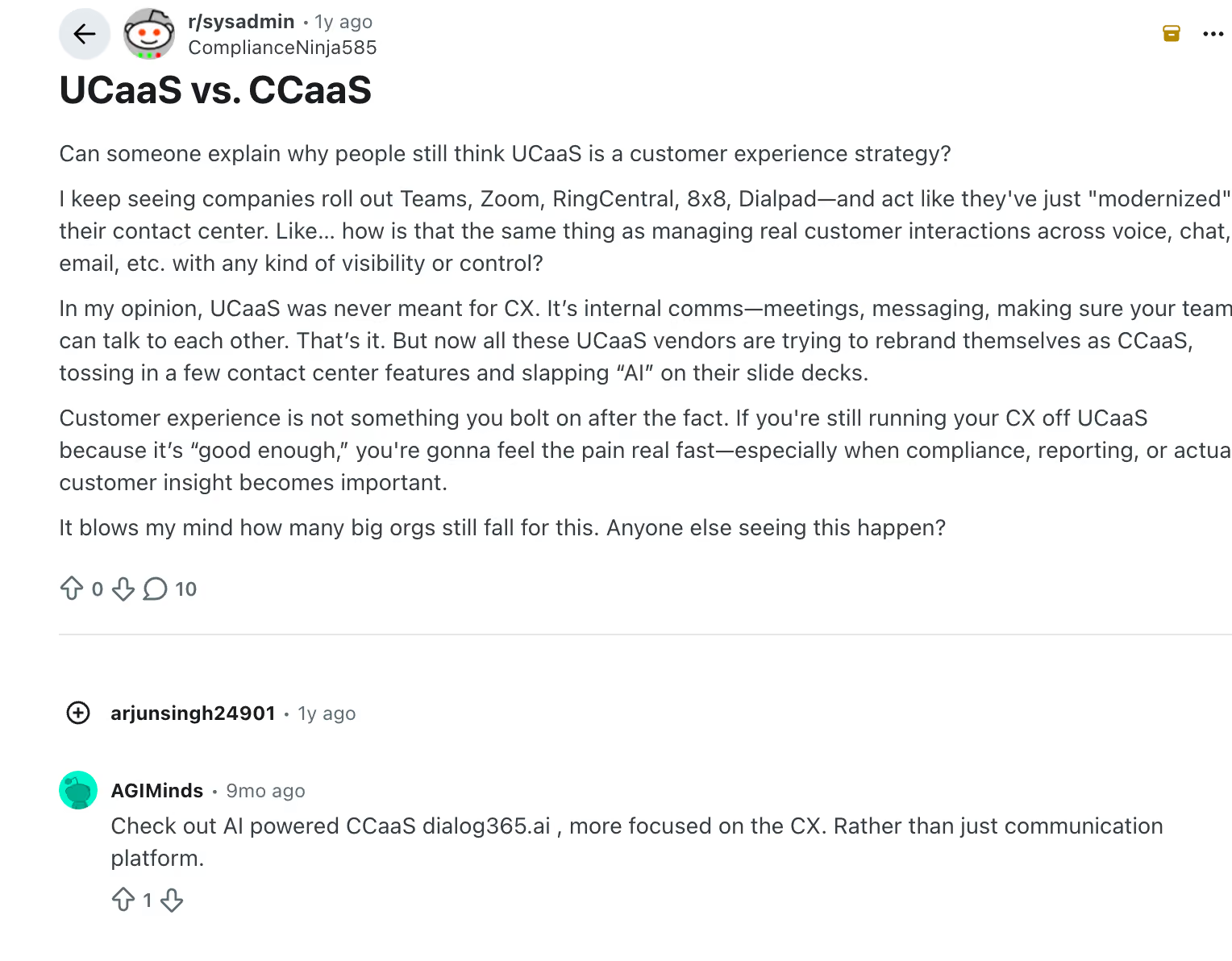
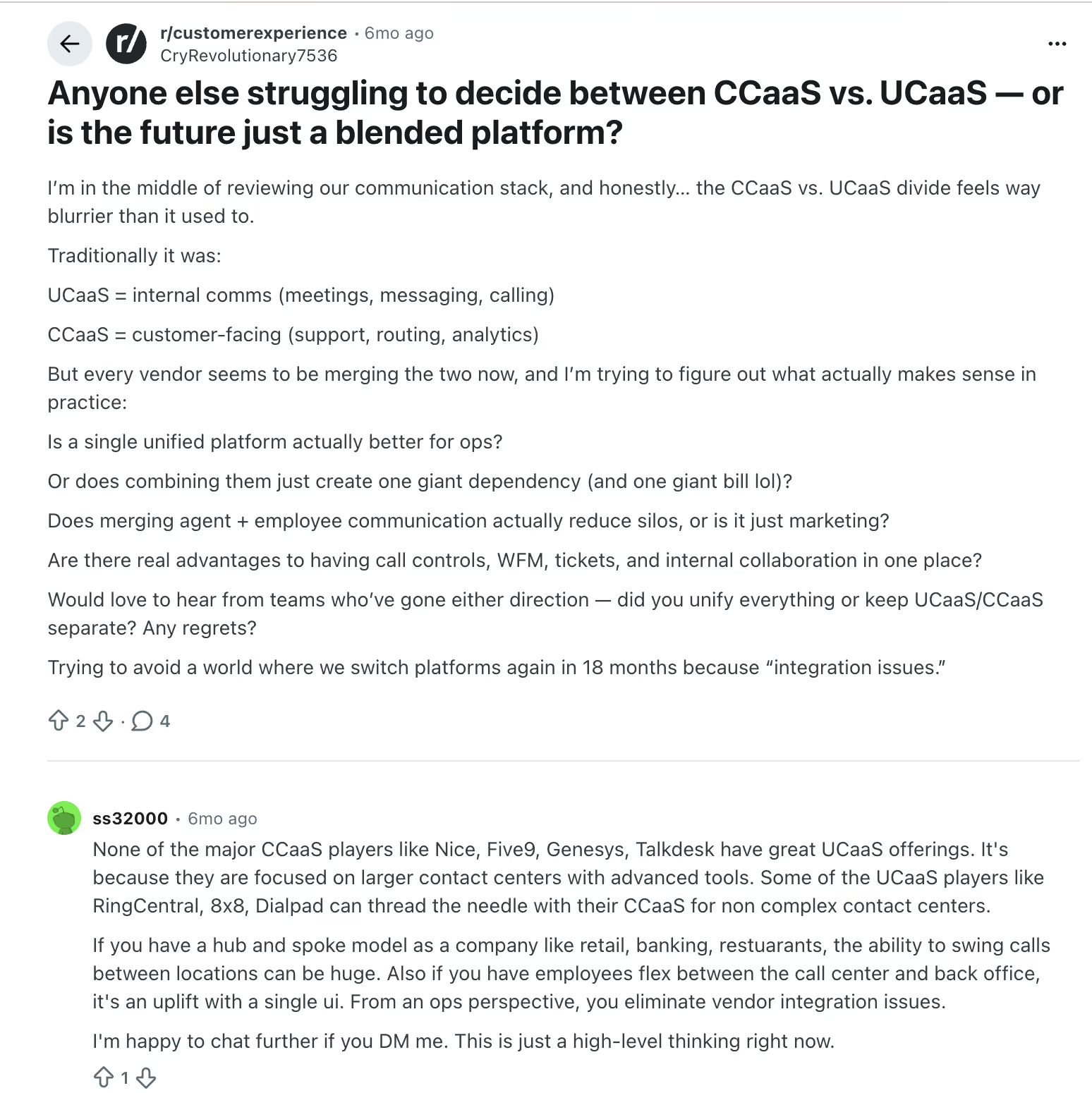
The thread pushes back hard on vendors rebranding platforms like Teams, Zoom, RingCentral, 8x8, and Dialpad as contact center tools by bolting on a few features and an AI label. The argument: UCaaS was built for internal meetings and messaging, not for the visibility, compliance, and reporting real CX work demands. Running customer experience off UCaaS because it's "good enough" tends to catch up with you once those needs show up.
With hybrid work and AI pushing vendors toward all-in-one ecosystems, the OP asks whether organizations are actually merging the two platforms, or whether convergence just adds complexity without the benefits.
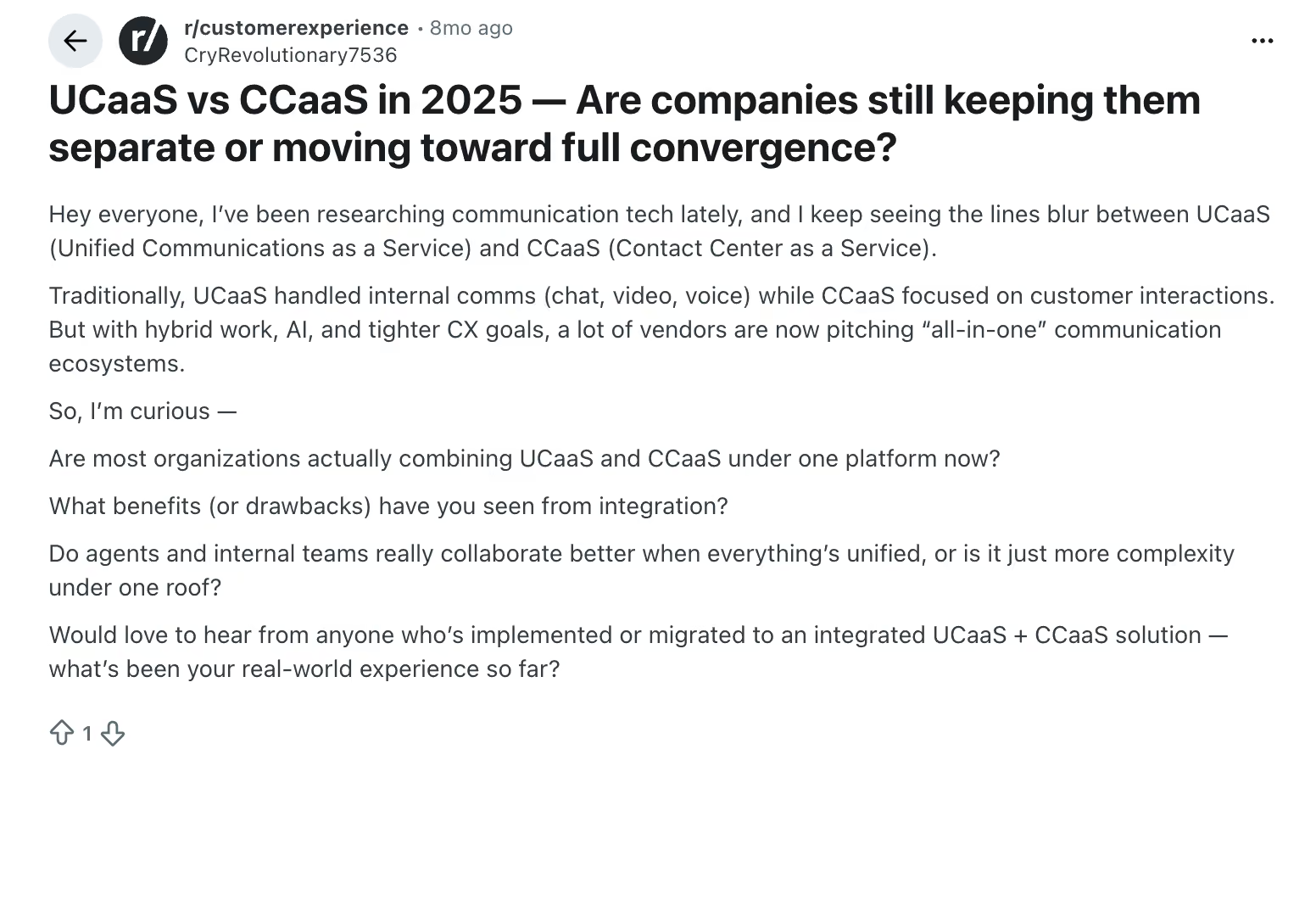
The original poster is weighing up whether unifying everything under one vendor means one bigger bill and one bigger dependency, and is wary of switching platforms again in 18 months over integration issues. The most useful replies:
Many early-stage teams start with UCaaS plus a shared inbox or basic help desk, then add CCaaS once volume, compliance, or reporting needs outgrow that setup. The clearest signal we see when clients make that shift is the need for real inbound vs outbound routing, quality management, and AI-powered automation, not just more lines.
The right choice depends on the mix of internal collaboration pain and customer-facing complexity you're carrying, not on which category sounds modern. A support-light SMB, a high-volume B2C operation, and a global B2B SaaS company all land in different places on that spectrum.
As a rough pattern, UCaaS wins first when the priority is collaboration and voice modernization. CCaaS wins once customer experience becomes a growth lever or a risk worth protecting. The table below breaks that down.
This table summarizes typical advantages and tradeoffs from a neutral buyer's seat rather than a single vendor's marketing copy.
2025 and 2026 turned out to be the years AI stopped being a side experiment in support. PwC's 2025 survey found 79% of organizations report some level of agentic AI adoption, with 88% planning to expand it. Calabrio's State of the Contact Center 2025 study, surveying more than 400 contact center managers, put usage even higher at 98%.
On the UCaaS side, that means meeting transcription, automated summaries, real-time translation, and noise suppression built into the platform.
On the UCaaS side, that means meeting transcription, automated summaries, real-time translation, and noise suppression built into the platform. On the CCaaS side, it's virtual agents, AI-driven triage and routing, agent assist, and journey-based analytics, the same shifts shaping every omnichannel support trends conversation in 2026.
What we hear most from clients rarely centers on feature lists. It's questions like whether a platform will cut backlog, whether tickets can be automated without losing the human touch, and whether they'll rebuild the stack again in two years. Our answer stays consistent: stabilize data and channels first, then layer AI on top.
Suggested read: Contact center AI news – get to know what's actually shipping in 2025 and 2026, beyond the vendor slide decks.
Treat this as a sequencing decision rather than a permanent either-or choice: which problem do you solve first, and in what order do you add the rest?
If most of your pain is internal, fragmented tools, remote collaboration headaches, low customer contact volume, start with UCaaS. If you're already struggling with contact volume, service levels, or inconsistent support quality, prioritize CCaaS. If both are genuinely painful and you're operating at mid-market or enterprise scale, an integrated roadmap with clear phases and ownership beats picking one and hoping the other resolves itself.
Turning that into action starts with a few honest questions.
This checklist is built for non-technical leaders in CX, operations, or founder roles, so you can score your own readiness before any vendor conversation starts.
Whichever column scores highest should anchor your first investment rather than the platform with the flashiest demo.
Most rollouts that underdeliver share the same handful of mistakes. Here's what to watch for.
Start with one or two high-impact use cases, a support queue, or a single internal workflow, before turning on every feature. Teams that go all-in on day one typically use a fraction of what they paid for.
Without clear KPIs upfront, teams routinely underuse both UCaaS and CCaaS and misattribute whatever AI return on investment shows up. Define success metrics before you sign anything.
Call recording rules, AI guardrails, data security, and quality monitoring frameworks need to be in place before AI handles meaningful volume, not bolted on after.
AI-augmented workflows require real contact center workforce optimization, not just a new login. The teams that invest in training and change management see gains and land faster and stick longer.
UCaaS and CCaaS solve different, complementary problems, and most mature organizations end up using both, often alongside CPaaS and AI. The buyer-first advice is simple: start where the pain and ROI are clearest, validate with real metrics, then expand.
We work across tools rather than pushing one platform, because we care more about the outcome than the vendor logo on the contract, and we can help design the call center outsourcing plan that fits your volume, budget, and regulatory context.
{{cta}}
Help someone else stay in the know. Hit that share button!
.webp)

.webp)

.avif)
.avif)
.webp)
.webp)