Support Ops & Teams
Published on
16.04.2026
Last updated on
19.10.2026
PCI compliance call center guide: the 4.0.1 update, industries, hidden costs & how-tos

Valentyna
VP of Customer Support

Valentyna
VP of Customer Support
TL;DR: PCI DSS 4.0.1 is fully enforced, pause-and-resume is no longer acceptable, and any system that could inadvertently receive cardholder data is now in scope by default. For companies outsourcing customer support, that means your vendor's certification gap becomes your liability. This guide covers what changed, what it costs to ignore it, which industries carry the highest risk, and what genuinely compliant outsourced support looks like in practice.
Call center PCI compliance isn't optional – and with PCI DSS 4.0.1 now fully enforced, it's also no longer as simple as hitting "pause" before a customer reads their card number.
According to IBM's 2024 Cost of a Data Breach Report, the global average cost of a data breach reached $4.4 million – a 10% increase year over year.
For companies outsourcing customer support, that exposure doesn't disappear just because the call is handled by a third party. It follows the data.
PCI DSS 4.0.1 – the latest revision of the Payment Card Industry Data Security Standard – became fully mandatory on March 31, 2025. The update didn't overhaul everything, but the changes it made hit contact centers squarely in the operations.
The headline shift: any system that could inadvertently receive or transmit cardholder data is now in scope by default. Previously, teams could argue their way out of scope with narrow definitions. That grey area is gone.
What this means in practice:
The bottom line for outsourcing: if your BPO partner isn't already operating in a zero-scope or descoped cardholder data environment, your brand carries the risk.
Compliance looks different depending on where your business operates, be it eCommerce, SaaS, fintech, or other sectors. The core requirements of PCI DSS apply universally, but the practical implications – and the business risk of getting it wrong – vary significantly by industry.
Where it applies:
Both sectors handle high-volume, card-not-present transactions across multiple support interaction types. The risk profile is consistent across both, but spikes hard during peak periods like Black Friday, when controls that hold at normal volume can quietly buckle under pressure. Common in-scope interactions include:
Where it applies:
Fintech support sits at the intersection of PCI DSS and regional financial regulation, meaning a single support call can trigger multiple compliance obligations simultaneously. The exposure is compounded – and harder to isolate than in most sectors. Typical in-scope interactions include:
Where it applies:
SaaS support teams encounter cardholder data more often than most companies realize. The risk isn't always obvious – it creeps in through the edges of ordinary billing conversations, especially as products scale and support volume increases. Common in-scope interactions include:
Where it applies:
Patient billing support operates under two compliance frameworks simultaneously. HIPAA governs health information; PCI DSS governs payment data. In practice, a single call – a patient querying a co-pay charge, for example – can involve both, and the data environments must be kept cleanly separate. Typical in-scope interactions include:
Where it applies:
Travel support handles some of the highest-value, highest-frequency payment interactions in customer service – often under time pressure, which makes compliance shortcuts tempting and consequential. The customer experience in call center environments for travel brands demands fast, seamless resolution without data risk. Common in-scope interactions include:
The fines get the headlines, but the real cost of failing call center PCI compliance sits in several layers.
Card networks can impose penalties of $5,000 to $100,000 per month on acquiring banks for non-compliant merchants – costs that quickly flow downstream to the business. A confirmed breach typically triggers forensic audit costs, mandatory remediation programs, and in some cases, the temporary suspension of card processing rights. For a company that depends on card-based revenue, that's existential.
Then there's the breach itself. The average financial services breach costs over $6 million, according to IBM's 2024 data, with healthcare breaches running even higher. Reputational recovery is slower and harder to quantify – customer trust, once broken over a payment data incident, rarely fully returns.
Three cost categories operators often miss:
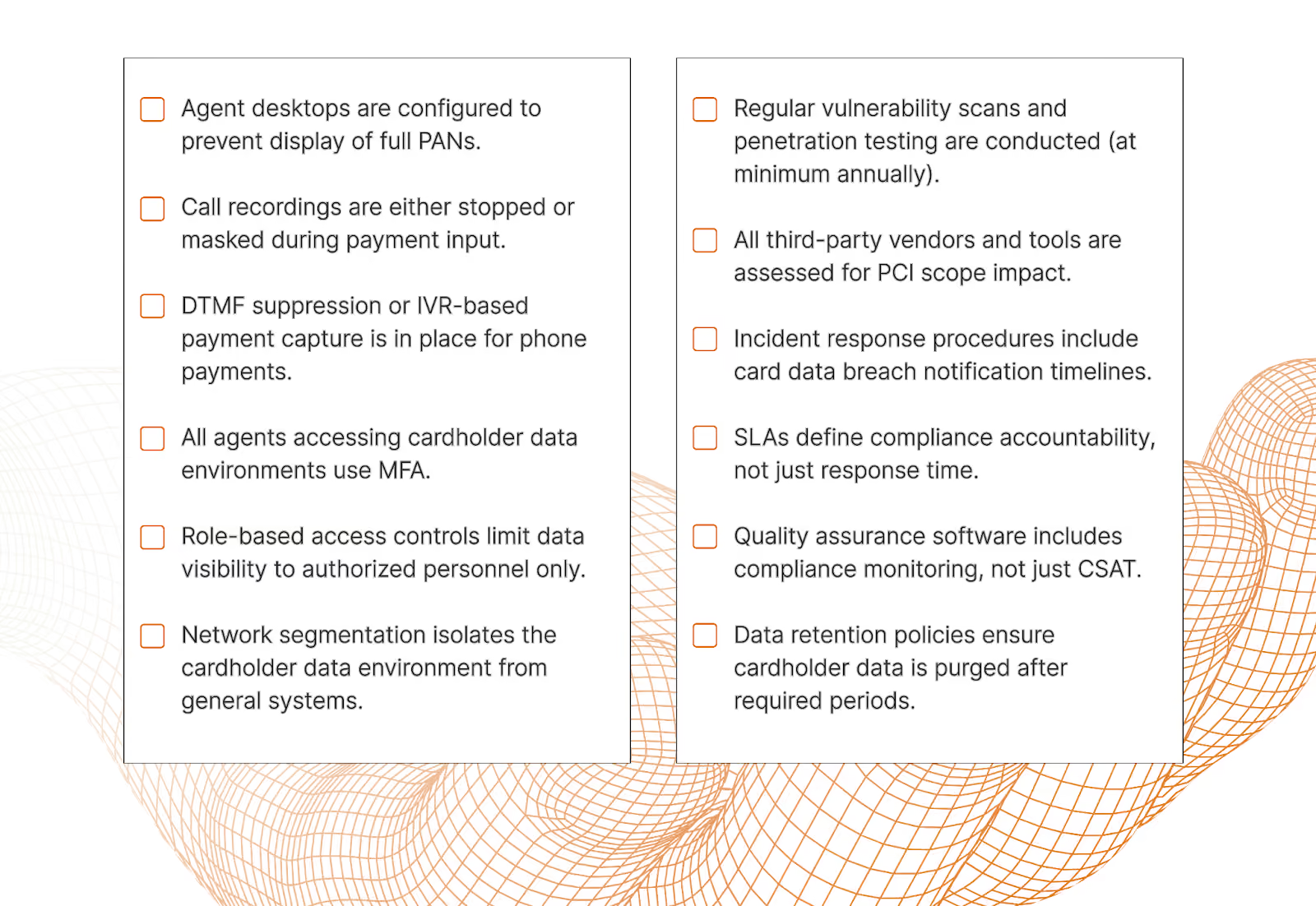
Before evaluating any outsourcing partner, run through these non-negotiables:
{{cta-lm}}
Most outsourcing vendors will tell you they take security seriously. Fewer can show you the independent verification. EverHelp holds PCI DSS Level 1 Service Provider certification – the highest tier of the standard, requiring independent assessment by a Qualified Security Assessor (QSA), not self-attestation. We've also recently received PCI DSS Level 3 Merchant certification, covering our own transactional operations.
The operational model behind those certifications is where it gets practical. Our approach to handling payment data is built around a zero-scope principle: agents should never touch cardholder data in the first place. Here's what that looks like in our day-to-day operations:
Evly, our AI support assistant, holds SOC 2 Type II certification and is fully GDPR-compliant. All PII accessed by the system is stripped before any historical data is processed, and nothing is retained beyond what an active conversation requires.
That means AI-assisted support doesn't create a compliance backdoor.
Our security practices align with the principles of SOC 2, and our systems undergo regular independent security reviews. For fintech clients handling payment escalations or eCommerce brands running checkout support, this isn't a nice-to-have – it's how we protect your brand every time a customer call touches a payment.
In a virtual call center model, these controls extend to remote agents through device security policies, clear screen protocols, and mandatory security training before any agent goes live.
PCI DSS 4.0.1 removed the grey areas. Pause-and-resume and scope ambiguity are gone. What remains is a clear standard – and a clear choice about which outsourcing partner can actually meet it.
EverHelp operates at PCI DSS Level 1, the certification standard that applies to the highest-volume and highest-risk payment environments in the world. We didn't get there by luck; we got there by building compliance into how we operate, not bolting it on after the fact. If your support operation handles payment data – at any volume, in any industry – we'd rather walk you through our controls than let you find out the hard way that your current vendor can't pass an audit.
{{cta}}
Yes, and it's worth understanding what that actually means. Level 1 is the highest tier of the Payment Card Industry Data Security Standard, requiring independent assessment by a Qualified Security Assessor (QSA) rather than a self-completed checklist. EverHelp's current certifications include:
Both certifications are subject to ongoing controls and regular third-party audits, not a one-time sign-off.
The short answer: agents never touch card numbers in the first place. EverHelp's approach is built around a zero-scope model, removing cardholder data from the agent environment entirely rather than relying on agents to handle it carefully. In practice, that means:
Yes. Evly, EverHelp's AI support assistant, holds SOC 2 Type II certification and is fully GDPR-compliant. All personally identifiable information (PII) accessed by Evly is stripped before any historical processing occurs, and data is not retained beyond the active conversation. AI-assisted interactions don't create a compliance exception – the same data handling standards apply across every channel and tool we use.
Yes. EverHelp operates across several frameworks, depending on client requirements:
Yes. EverHelp's support operations integrate with major eCommerce platforms, including Shopify and Magento, through PCI-compliant connection architectures. Payment data is routed through tokenized systems before reaching support agents, keeping checkout support workflows decoupled from the cardholder data environment.
It's the set of security rules your support operation must follow whenever customer payment card data passes through it. Set by the PCI Security Standards Council, PCI DSS defines how cardholder data must be handled at every stage. For contact centers specifically, compliance means:
Non-compliance can result in monthly fines from card networks, suspension of card processing rights, and direct liability for any resulting breach – regardless of whether the contact center is in-house or outsourced.
Help someone else stay in the know. Hit that share button!



.webp)

.avif)