Outsourcing
Customer Support
Support Ops & Teams
Published on
05.03.2026
Last updated on
04.10.2026
How the Advantages of Outsourcing Customer Service Drive Your Growth
.avif)
Andrew
Chief Commercial Officer

Andrew
Chief Commercial Officer

Your support queue is growing faster than your team can handle, and hiring internally means months of recruiting, training, and unbudgeted overhead. It's a familiar trap. While weighing the outsourcing customer service pros and cons makes it look like the obvious fix, most companies hesitate, worried about quality slipping or their brand voice getting lost in translation. The data, however, tells a more reassuring story. When executed well, outsourcing customer support transforms a cost center into a genuine growth engine:
Your choice of partner directly shapes your brand reputation, so the strategy has to align with your company's values from the start. This guide walks through the real trade-offs, the main outsourcing models, and how to know whether handing off support is the right call for your business.
Customer service outsourcing is the strategic delegation of customer support functions to specialized third-party organizations. These external service providers bring the infrastructure, technology, and trained personnel to manage your brand's customer interactions, often with AI-augmented teams that can handle volume at a scale most in-house setups can't match.
A modern outsourcing partnership typically covers a full range of communication channels:
Understanding why companies outsource customer service has shifted significantly. The transition from simple cost-cutting to specialized value is driven by three primary factors:
The depth of an outsourcing partnership is flexible and generally falls into two categories:
Location and team structure shape everything from cost to communication quality. Location and team structure shape everything from cost to communication quality. Outsourcing providers vary widely across these dimensions, so here's how the main models compare:
Onshore outsourcing means partnering with a provider in your own country. You get cultural alignment, native language fluency, and easy collaboration during business hours, at a higher cost than other models.
Nearshore outsourcing places your outsourced team in a neighboring country or similar time zone. Meaningful cost savings, fewer scheduling headaches, and communication that stays straightforward. For example, businesses evaluating nearshore outsourcing companies for software development can compare providers based on engineering expertise, geographic and time-zone alignment, security standards, scalability, and experience integrating external specialists with internal teams.
Offshore outsourcing moves support to a distant country where labor costs are significantly lower. The savings can be substantial, but language nuances and time zone gaps need deliberate management to avoid friction.
A dedicated outsourced team works exclusively on your account. Agents go deep on your product and represent your brand consistently. Shared teams split attention across multiple clients, which costs less but sacrifices that depth.
If brand voice and product expertise matter most, dedicated teams typically deliver better results. If budget flexibility is the priority, shared teams offer a more affordable entry point.
.avif)
The benefits of outsourcing customer support often come down to a straightforward principle: do more with less, without cutting corners on quality.
Outsourcing eliminates recruiting costs, overhead costs like office space, training, and employee benefits. These are all the infrastructure expenses that stack up well beyond base salaries. It also converts fixed costs into variable costs, so you're paying for what you actually use rather than maintaining capacity year-round.
With agents distributed across multiple time zones, round-the-clock coverage becomes feasible without running three internal shifts. Tapping into global talent means 90% of customers who rate an immediate response as critical, and whose customer expectations for round-the-clock availability have never been higher, can actually be served. Outsourcing makes meeting that expectation realistic rather than aspirational.
Providers employ agents already experienced in high-volume customer support environments. Given that 74% of employers struggle to find skilled support talent, skipping the months-long internal learning curve is a meaningful advantage. Specialized expertise arrives ready to deploy, and the result is high-quality service from the first week rather than the fourth month.
Seasonal spikes, product launches, or unexpected surges driven by eCommerce supply chain challenges become manageable when your partner can flex team size up or down quickly. No excess capacity sitting idle in January to handle the December rush.
When customer service operations run externally, your team can redirect energy from ticket queues and customer care firefighting toward strategic initiatives: product development, marketing, and business growth. That reallocation frees up internal resources and compounds over time.
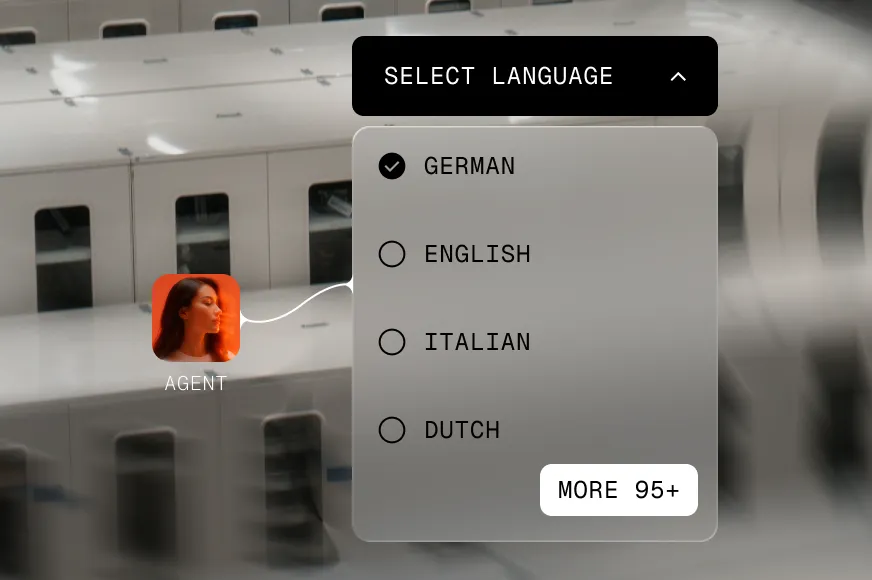
Many outsourcing companies offer support in multiple languages, often 30 or more, opening international markets without hiring specialized staff for each region, a genuine competitive advantage for companies scaling globally.
Companies that outsource to specialist providers consistently see a direct link between expert support coverage and long-term customer loyalty. A Human-AI Support Model accelerates this further: AI handles routine customer inquiries instantly while human agents bring empathy and judgment to complex issues, keeping satisfaction high across the board.
{{cta}}
Outsourcing customer support comes with real friction. Before you commit, the outsourcing customer service pros and cons deserve honest consideration. Here's what to watch for.
Maintaining consistent service quality requires robust QA processes and clear SLAs. Without them, standards drift in ways you won't notice until customer issues start surfacing in reviews and churn data.
External agents don't absorb your company culture the way employees who live it daily do. That gap directly affects the positive customer experience you're trying to deliver, and it takes deliberate onboarding to close.
Sharing customer data with a third-party provider introduces real risk. Certifications like GDPR compliance and PCI DSS Level 1 aren't optional. Addressing security concerns upfront and verifying certifications independently is non-negotiable before anything changes hands.
Coordinating product updates, policy changes, and escalations across organizational boundaries takes real effort. Miscommunication here leads directly to inconsistent customer experiences.
Time zone gaps and cultural nuances can slow response times and create misunderstandings in support operations. Manageable, but it requires planning, not wishful thinking.
Setup fees, per-ticket charges, and rigid contract terms can quietly erode the savings you expected. Read the contract carefully, not just the pitch deck.
The true cost comparison goes well beyond hourly rates. Outsourcing bundles most expenses under a single third-party service provider arrangement, which simplifies budgeting considerably.
For most companies, customer support outsourcing is the most cost-effective solution when all factors are on the table. That said, if your support requires deep institutional knowledge or handles particularly sensitive situations, keeping things in-house may still justify the premium.
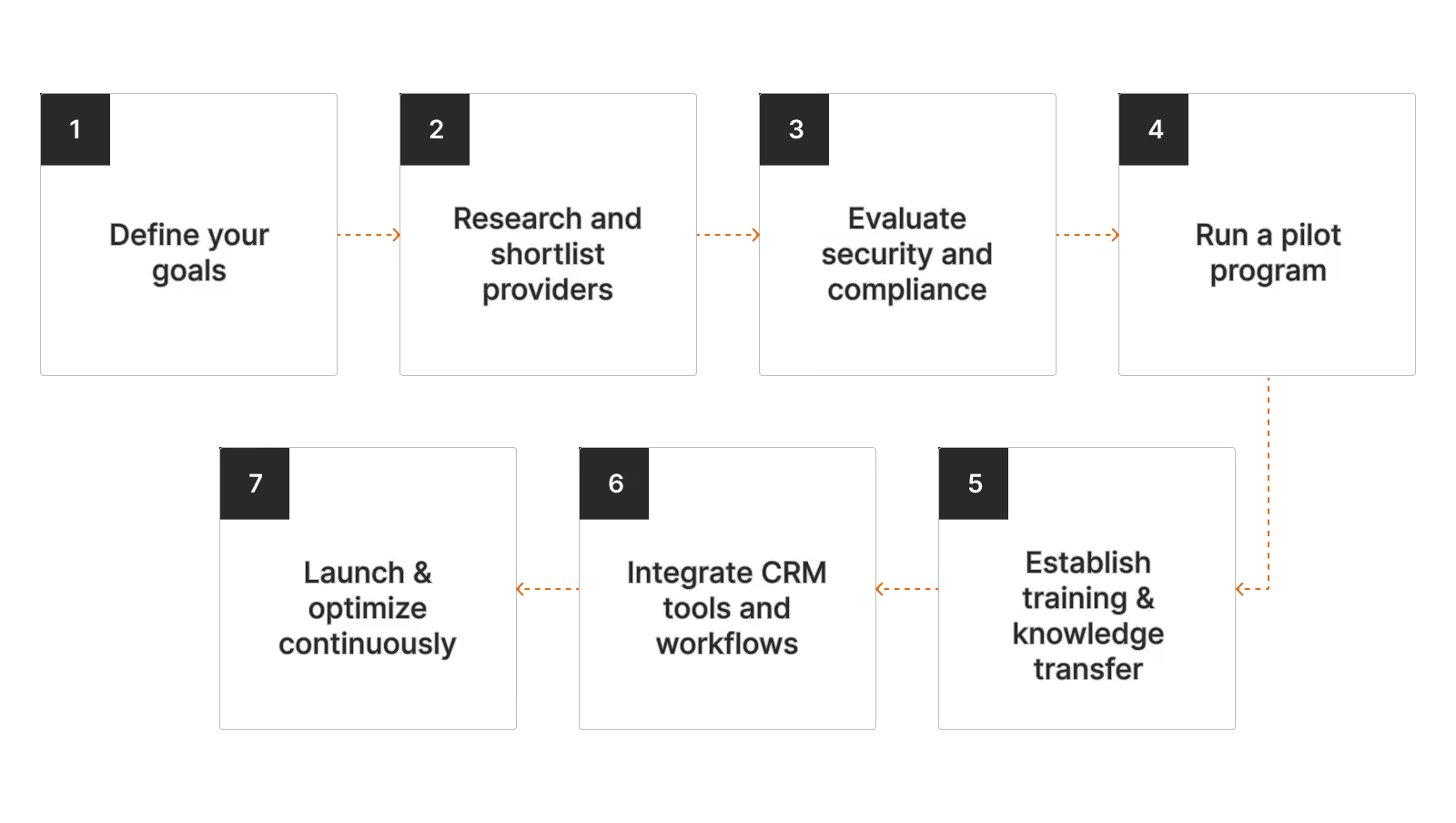
Moving from in-house to outsourced support works best as a structured customer service outsourcing process rather than a rushed handoff. Here's what that looks like in practice:
Not all service providers are equal. The wrong one will cost you more than staying in-house. When you choose a customer service outsourcing partner, these are the criteria that separate strong partnerships from risky ones:
{{cta-lm}}
Ongoing oversight of your support teams is what separates a partnership that holds its quality over time from one that gradually drifts.
The honest answer depends on your situation. Outsourcing your customer service operations overall can help you deliver a good customer experience and, with the right partner, achieve excellent customer service. Here are the scenarios where outsourcing customer support makes clear sense, and one where it might not:
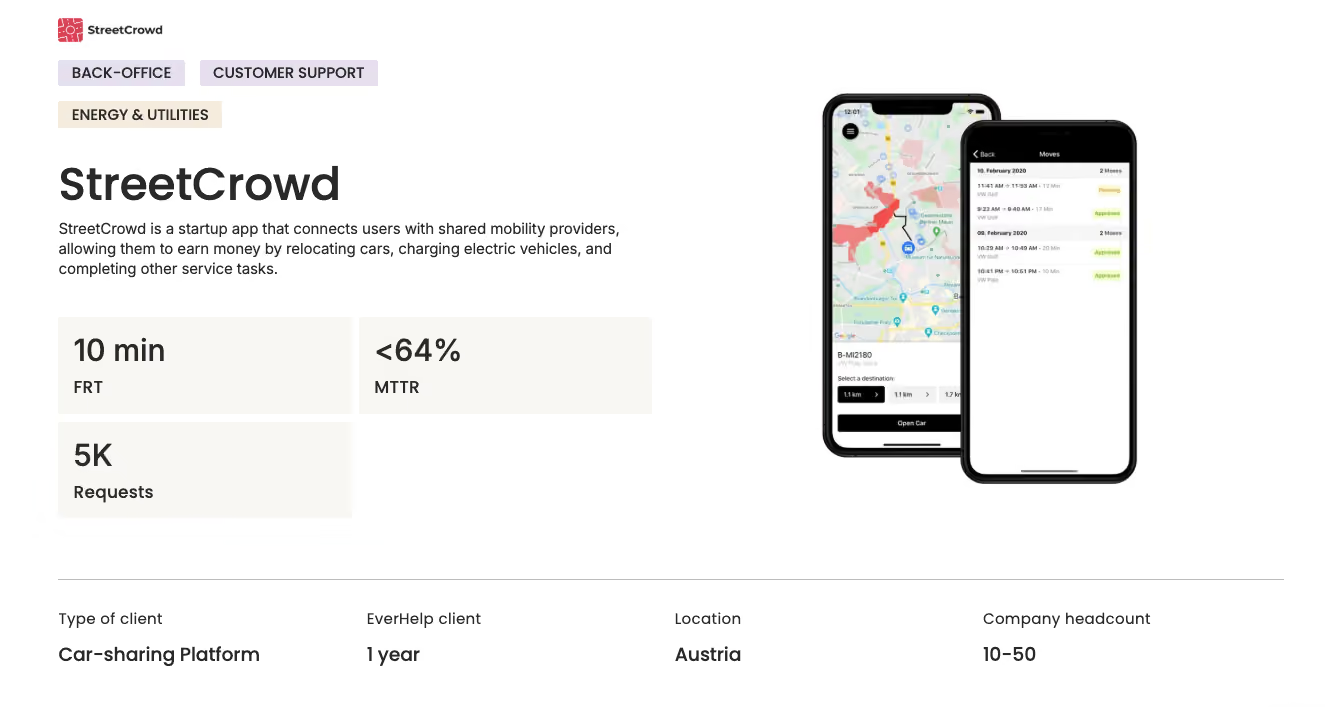
Consider the success of StreetCrowd, a global mobility startup that partnered with EverHelp to solve its scaling challenges. Within just one quarter, they transformed a struggling support operation into a high-performance engine.
StreetCrowd faced a common scaling bottleneck: an overflowing ticket queue that pushed their First Response Time (FRT) to over 1 hour and resolution times to over 70 hours. Without 24/7 coverage, their global user base was left waiting.
EverHelp deployed a 24/7 shared team of 15 agents and built a centralized knowledge base to standardize responses. By bridging the gap between support and technical teams, they ensured that complex issues were no longer lost in the shuffle.
The impact was immediate and measurable:
The Outcome: These quick response times, combined with high service quality and expert care, didn't just clear the queue; they skyrocketed customer experience that reset StreetCrowd's reputation for reliability, turning support from a liability into a brand asset.
Outsourcing customer service works when the right partner is in place. The wrong one creates more problems than it solves: inconsistent brand voice, security gaps, and quality that drifts without oversight.
The right partner closes all of those gaps from day one. That means deep product training before agents ever touch a ticket, native integration with your existing tools, and enterprise-grade security built in, not bolted on.
EverHelp is built around exactly that model:
Companies that get outsourcing right don't just clear their queues; they deliver exceptional service that builds lasting loyalty. If your support queue is growing faster than your team can handle, the answer isn't hiring more. It's partnering smarter. Book a consultation to see what outsourced customer support could look like for your team.
Most outsourcing providers need four to eight weeks to recruit, train, and integrate a new outsourced team. Timelines vary based on team size, product complexity, and how quickly knowledge transfer happens. EverHelp launches dedicated teams in under 28 days, with agents trained on your product and plugged into your existing workflows from day one.
Yes. Many external providers offer technical support services where agents are selected for their technical expertise, trained on your product documentation, and follow structured troubleshooting processes to resolve complex issues effectively and deliver quality service consistently.
Expect a knowledge transfer period where you share product information, brand guidelines, and escalation procedures. A ramp-up phase follows as agents build proficiency, typically two to four weeks before reaching full productivity.
AI handles routine customer inquiries automatically: password resets, order status checks, basic troubleshooting. Complex cases route to human agents. AI-assisted agents handle 33% more tickets per hour while maintaining higher customer satisfaction scores, which means that workload pressure is meaningfully reduced during peak periods.
Help someone else stay in the know. Hit that share button!



.webp)

.avif)