AI & Automation
Technology
Published on
11.04.2026
Last updated on
02.10.2026
Top 7 AI help & support platforms to automate your CX in 2026

Oleksandr
AI Integrations Lead

Oleksandr
AI Integrations Lead
Your support queue doesn't wait. Neither does your competition.
Teams that once triaged manually are now running at 70–85% automation – same headcount, double the output.
According to Gartner, 91% of customer service leaders are under pressure to implement AI in 2026.
The shift is underway. The real question: which platform gets you there fastest – and without a six-month implementation? Then, here are seven worth your time, explored by capabilities, best fit, pricing metric, and bot-to-human ratio.
Disclaimer: This article was written by Everhelp, which is one of the providers featured in this comparison. All trademarks and brand names belong to their respective owners and are used for identification purposes only. No affiliation or endorsement is implied with any third-party company listed here unless explicitly stated. Competitor information is based on publicly available sources and is accurate as of October, 2026. Providers may update their offerings at any time, so we recommend confirming current details directly with each company before making a decision.
These platforms set the bar for AI-powered support in 2026 – ranked by real-world performance, deployment speed, and how well they balance automation with human judgment.
Who is this for? Large enterprises and scale-ups with high ticket volumes are already on Zendesk Suite.
2026-specific capability:
Why we love it: Supports integrations with Salesforce, Slack, Jira, and other systems through its Marketplace and native integration options. No middleware. Clean agent workspace.
Automation approach: Zendesk combines AI agents for autonomous resolution with Copilot, intelligent triage, knowledge-powered answers, and unified ticketing workflows for human-assisted cases. Automation results depend on the quality and coverage of the knowledge base, workflow design, connected data, and escalation policy.
Who is this for? SaaS companies and product-led growth teams prioritize live chat and in-product messaging.
2026-specific capability:
Why we love it: Fin resolves 76% of conversations on average across Intercom customers, with many customers seeing more than 90%.
Automation approach: Fin transfers conversations to human agents with the history and context of what it attempted, so agents can continue the interaction without requiring customers to restate the issue.
Who is this for? Mid-market teams migrating off legacy helpdesks and needing ROI in the first quarter.
2026-specific capability:
Why we love it: Best value at mid-market price points. The onboarding is genuinely fast.
Automation approach: Freddy AI Agent and chatbots can automate routine self-service conversations, while Freddy AI Copilot assists human agents.
Who is this for? SaaS, eCommerce, and fintech teams that want proven AI outcomes without building infrastructure. Teams that need human backup at scale, not just a bot.
Why we love it: The results are in production. For a styling service app, Title, implementing Evly AI alongside our human agents allowed AI to handle 65% of requests end-to-end. This reduced total FRT to just 1 minute, enabled scaling to 40K tickets per month, and cut operational costs by approximately 54%.
The AI agent model runs in two modes:
Bot-to-human ratio: 40–85% automation, scalable by tier – the widest range on this list, intentionally.
{{cta}}
Who is this for? Companies serving APAC, MENA, or LatAm markets with deep localization needs.
2026-specific capability:
Why we love it: Fills a gap where Western tooling falls short linguistically.
Automation approach: Udesk positions AI as part of an omnichannel support and contact-center platform.
Who is this for? Enterprises wanting a fully outsourced AI CX layer with no internal model management.
2026-specific capability:
Why we love it: Accountability baked into the pricing model. That changes the vendor conversation.
Automation approach: Crescendo positions human support, QA, and operational services alongside AI automation.
Who is this for? Companies whose CRM is HubSpot and want CX, sales, and marketing data unified.
2026-specific capability:
Why we love it: The CRM-native advantage is real. No integration layer, no data lag.
Automation approach: HubSpot Customer Agent can resolve supported customer conversations through CRM-connected workflows, while HubSpot’s agent tools can also support human teams.
Three things that most comparison articles skip – and that matter more than feature lists.
AI processes thousands of sensitive conversations daily. That's an exposure point if the infrastructure doesn't match the volume. What to look for:
Everhelp holds PCI DSS and SOC TypeII certifications and processes every interaction, whether AI- or human-driven, under full GDPR compliance. More on what that means in practice: Everhelp's security approach.
An AI agent without CRM access answers FAQs. With CRM access, it resolves refunds, cancellations, and billing disputes end-to-end. Non-negotiables for high automation rates: CRM sync (Salesforce, HubSpot, Zoho), eCommerce data (Shopify, WooCommerce), and payment APIs.
Inputs you need:
The formula:
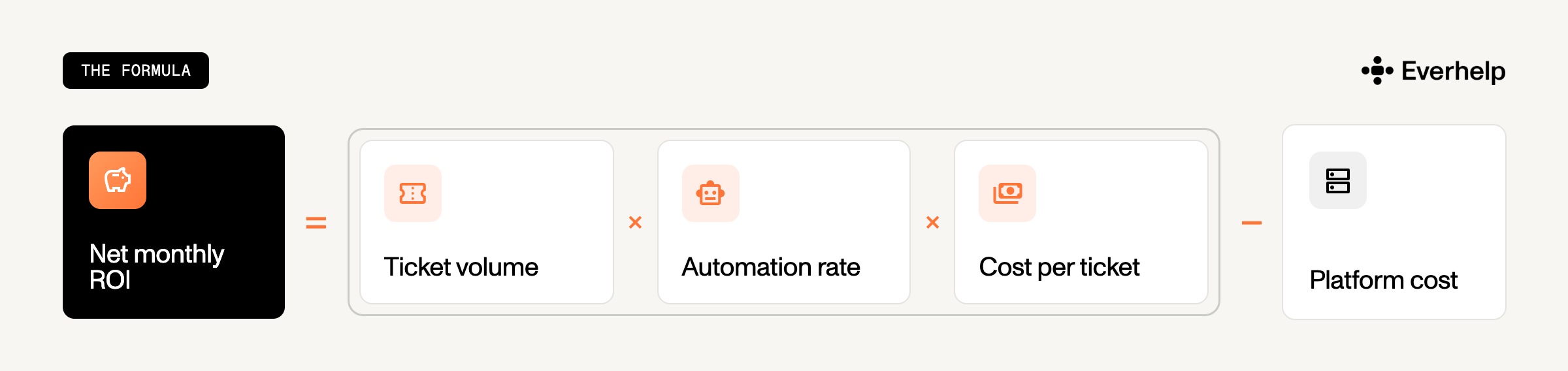
Payback period: Most teams hit positive ROI within 60–90 days.
For a broader view of support optimization with AI, use this formula as your baseline, then adjust for your actual AHT and headcount costs.
Example: For SaaS platform Forma, EverHelp deployed Evly and cut FRT from 12+ hours to under 5 minutes, automated 65% of all requests, and saved $80K/month on hiring.
High automation rates are real. So is the ceiling. Here's what every vendor pitch glosses over.
Every platform listed here includes sentiment detection. The smarter implementations use it as a live trigger. When frustration crosses a defined threshold – abusive language, legal intent, explicit escalation – the ticket automatically routes to a human, with full conversation context attached.
No cold transfers. No "can you describe the issue again?"
Set your escalation logic before go-live. It's the difference between a 4.8 and a 3.1 review score. See how it’s done in our AI support playbook.
Not every team is ready for 80% automation. The co-pilot model is a smarter entry point: AI drafts the reply, a human reviews and sends. Agents can handle 3× the volume with half the cognitive load. The human + AI support model isn't a fallback – it's where most teams should start; and this is what we practice at EverHelp.
One number worth keeping: 84% of consumers still believe humans are more accurate than AI for complex issues. That's a design constraint, not a problem. Build your escalation model around it.
Best overall: Everhelp & Evly AI. Automation from 40% to 85%. Human backup included. PCI DSS + GDPR compliance built in. No infrastructure to manage as we handle it all on our side.
Best budget pick: Everhelp & Evly AI, again. "Budget pick" here isn't about sticker price. It's about what Evly does to your operational costs once it's running:
Also, it’s fast to deploy, solid as a copilot, and a strong first step into the benefits of AI in customer service.
Stay current with the latest support AI news.
{{cta}}
Help someone else stay in the know. Hit that share button!



.webp)
.avif)
.avif)
.webp)