AI & Automation
Published on
08.05.2026
Last updated on
01.09.2026
AI use cases in hospitality for improved guest experience

Olha
Support Operations Manager

Olha
Support Operations Manager
Today’s customers are pampered by Netflix knowing their next binge before they do, and Amazon reordering their coffee pods before they notice the shortage. And now those same people are walking into hotel lobbies (or opening booking apps) with exactly those expectations in tow.
Just look at the stats:
It’s neither unreasonable nor impossible. Yet, unfortunately, hotel businesses face a stark reality: seasonal surges, leaner staffing, and guest communication that must be supported across 4 channels. A standard, staffing-dependent support model won’t solve this issue, and that’s exactly where AI can help.
In this piece, we will discuss the most impactful AI use cases in hospitality and hospitality support outsourcing paired with smart automation, which can help you turn support into a profit driver.
When thinking about AI-assisted support, the first benefit that comes to mind is quicker response times. In reality, adding AI to your stack helps shift your support from a reactive, standardized model to a proactive, data-driven customer service, tailored to each of your clients.
In a traditional model, personalization is a resource question. A well-staffed team with experienced agents can deliver genuinely tailored service, but only for as many guests as the team can handle at once. Such an approach doesn’t work during peak periods, when request volume is largely uncontrollable. Midnight billing queries, simultaneous check-in surges, a wave of post-event F&B requests - in these situations, something always gives, and it's usually the customer service quality.
AI doesn't eliminate the need for human judgment. What it does is remove the processing ceiling. By handling routine queries, preference updates, and service routing at any scale and any hour, it frees staff to focus on the interactions where human presence is a must. Plus, AI can draw on booking history, behavioral signals, past service interactions, and real-time inputs to help tailor the service specifically to each client’s needs.
The table below examines the differences between the two support approaches more closely.
Yes, AI won’t replace warm, empathetic human service. But it will create the space for the staff to deliver that warm support, rather than spreading themselves thin, answering “which room did we book?” queries every 10 minutes.
A guest journey map is a visual representation of every stage a traveler passes through, from initial discovery to long after checkout, and captures the key interactions, emotions, and expectations at each step. For hospitality operators, it becomes a strategic blueprint, revealing exactly what needs to be improved and where exactly.
The standard journey comprises seven stages, with each being a potential customer service touchpoint. Below, we discuss what happens at every stage and how you can use AI automation to optimize your service and match clients’ unique needs.
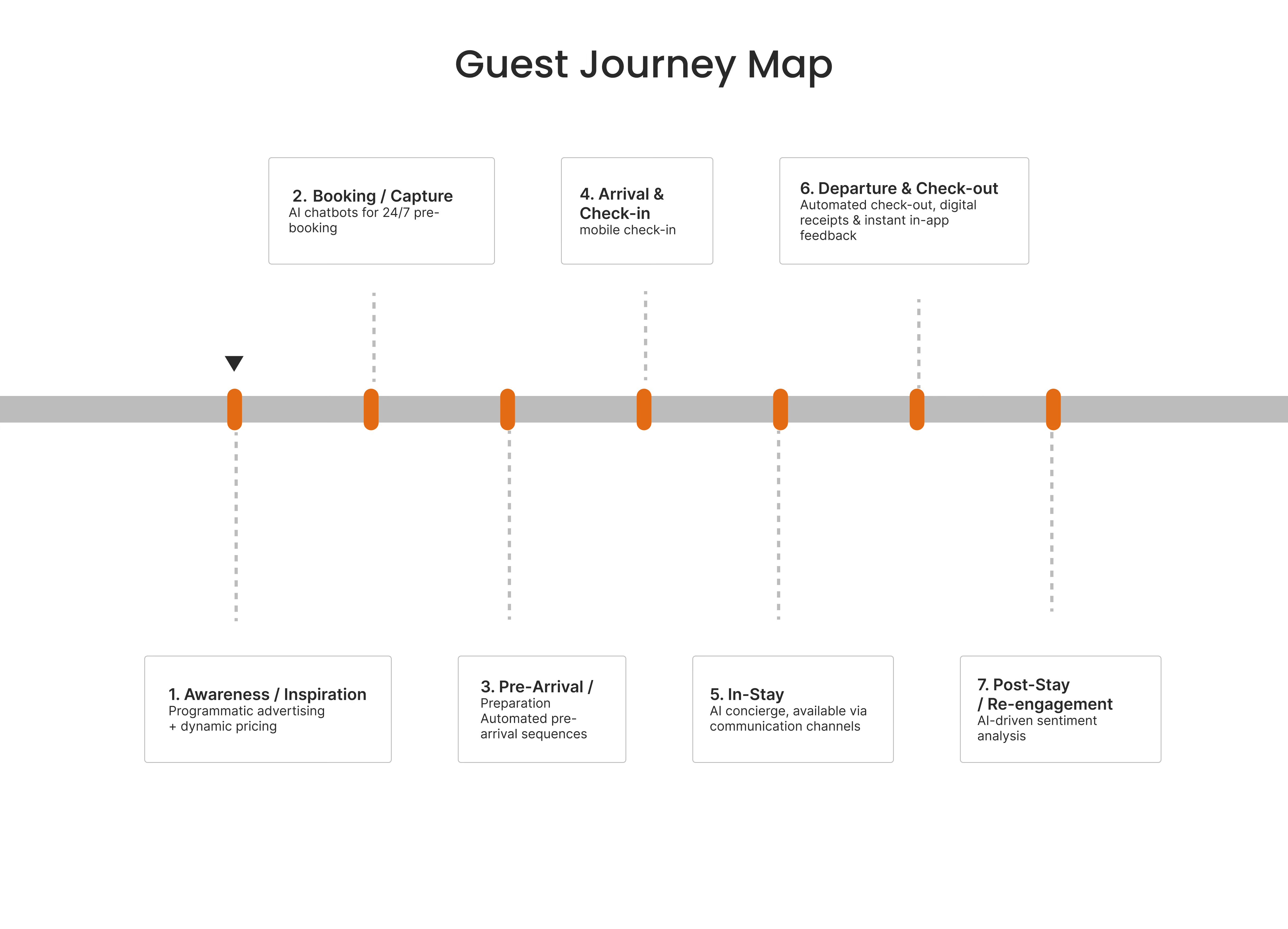
A potential guest starts browsing, possibly looking at travel blogs, Instagram, Google searches, and OTA listings. They're comparing destinations, reading reviews, and forming an impression of your property. At this stage, most hotels have limited control over what a traveler sees or when they see it. After all, marketing campaigns run on fixed schedules, and content rarely adapts to who's looking at it.
AI opportunity: Programmatic advertising and dynamic pricing will have the most effect here, as it can serve property content, tailoring what appears based on:
Timing and placement, therefore, would be adjusted automatically based on the likelihood to convert.
Next, that traveler lands on your site or OTA listing and starts evaluating:
They will most likely have questions come up about accessibility, early check-in availability, pet policies, etc. Many of those go unanswered because the information is buried or there's no one available to respond at 10 pm on a Sunday. Some guests will indeed book anyway, but many won’t.
AI opportunity: Here, AI chatbots can be introduced to handle pre-booking queries 24/7, keeping hesitant browsers in the funnel and converting questions into confirmed reservations.
As the booking is confirmed, the guest experience has officially begun. The traveler is likely considering logistics: transport, check-in time, restaurant reservations, and whether to request a specific room. Most hotels send a generic confirmation email and a reminder a day before arrival. Oftentimes, that’s the full extent of pre-arrival communication.
AI opportunity: Automated pre-arrival sequences can do considerably more, as they can personalize messaging based on the guest's profile and booking history:
Finally, the guest arrives. If it's a hospitality peak season (e.g., a Friday during summertime or a conference check-in wave), there's most likely a queue. A staff member works through identity verification, payment confirmation, room assignment, and key issuance for each person in line. Thus, the guest's first physical interaction with the property is often one of waiting.
AI opportunity: Here, introducing a mobile check-in, completed 24–48 hours before arrival, can eliminate the queue issue. With PMS integration handling room assignment and preference configuration, the guest would only need to get a key for their room (that is, if it’s not digital too).
Once settled, the guest's needs become varied and unpredictable. Room service, extra towels, a dinner reservation, a question about the gym hours, and a complaint about noise from the corridor. These requests can come from multiple channels (phone, in-person, app) at any time, and the volume is impossible to predict. Staff handles what they can, which leads some guests to wait longer than they should.
AI opportunity: An AI concierge available via app, WhatsApp, or in-room voice assistant can take on the routine layer of these requests. And if you power it with predictive analytics, it can even help anticipate housekeeping demand based on occupancy patterns, or flag maintenance needs before they affect a guest's stay.
As the guest is ready to leave, they need:
Check-out is often pretty rushed, which is why feedback collection typically happens via an email survey that arrives a day later and may be ignored.
AI opportunity: Automated check-out, digital receipts, and instant in-app feedback prompts can help compress the departure process and capture satisfaction signals while the experience is still fresh.
The guest is home. Most hotels send a thank-you email and a survey. Both are usually identical regardless of who the guest is or what happened during their stay. The opportunity to act on real feedback, address a specific dissatisfaction, or invite a genuinely loyal guest back offering something meaningful, is largely missed.
AI opportunity: By introducing sentiment analysis, your team can process reviews, chat transcripts, and post-stay signals to detect what actually shaped the guest's experience. Follow-up communications can then be personalized, and customer loyalty offers can be timed and targeted based on what the guest responded to during their stay.
{{cta}}
It’s clear that AI has vast potential to improve the guest journey. However, some use cases were already proven to deliver ROI and improve hotel CX, and you can find them described below.
Most guests don't articulate what they want. They just notice when a hotel gets it right or wrong. We are talking room temperature, shampoo type, and dinner menus. Hyper-personalization is hidden in the small details like that.
However, to not overburden your staff by making them notice and memorize everything about the guests they tend to, you can implement AI. The tools with analytic capabilities can draw on booking history, behavioral patterns, and real-time signals to anticipate preferences before the guest has to voice them.
The front desk queue has been a hospitality friction point for decades. But who said it has to stay? With the modern AI capabilities, contactless check-ins are not a fantasy anymore. Here’s just one example of how they can be organized:
What makes this more than a convenience feature is real-time PMS integration. Room status, loyalty data, and preference history are all connected through a single system that staff can easily access and check.
The chatbots guests complained about five years ago were essentially FAQ machines: useful for basic queries, frustrating for anything else. Generative AI for hotel concierge works differently. They use their predictive analytics and personalization capacity to read context and handle any follow-up questions based on it.
Examples: A guest asking for a dinner recommendation near the hotel will get a suggestion calibrated to what they previously visited.
A complaint about noise will be flagged and routed to the right team member, not bounced between departments.
Not to mention that such an AI agent for travel support can work across every communication channel you offer, be it email, app, or WhatsApp, and do so 24/7.
For properties working with a travel call center model, the strongest setup pairs AI for routine volume with live agents for escalations. This helps speed up more standard procedures (like bookings and reservation confirmations) and relocate the freed-up resources to manage more urgent (cancellations and rebookings) or VIP cases.
Reactive service is slowly becoming a thing of the past, and predictive analytics has become the main driver of this shift towards proactive support. In hospitality, it can be used for:
Well, according to some industry reports, predictive maintenance can reduce overall maintenance costs by 25-40% cut guest complaints by up to 75%.
However, the foundation for all of it is PMS integration. Predictive systems are only as useful as the data flowing into them, making a connected property management infrastructure a prerequisite for successful implementation.
A standard post-stay sequence looks like this:
A thank-you email → followed by an NPS survey → then a discount code offered for a future stay
All of this is sent to every guest regardless of what actually happened during their visit. Most of it gets ignored.
AI makes the post-stay window useful by tying follow-up to real behavior.
A guest who mentioned the rooftop bar twice during their stay gets an early invitation when something new opens up there.
A guest whose check-in experience was slow gets an acknowledgment and a targeted upgrade offer for next time, giving them a reason to return.
Yet, aside from individual communications, you can also use AI for sentiment analysis across reviews, social media, and chat transcripts, giving your support team a cleaner read on what's actually driving customer satisfaction and dissatisfaction. But the longer-term value is profile depth. Every post-stay data point feeds back into the guest's profile, making the next stay more informed than the last.
Pro tip: You can use sentiment analysis to improve your public review profile, which directly affects OTA ranking and conversion. AI tools like MARA Solutions can detect the specific language guests use when they're satisfied and help you mirror that tone in review responses, which search algorithms and potential guests both notice.
Knowing what to use the AI for is one thing. Knowing where to start without disrupting operations that are already running is the challenge most hospitality decision-makers face.
The answer is simple: don’t try to launch everything at the same time. Here’s a better way to approach this.
AI is only as effective as the data it learns from. Before deploying any guest-facing tool, hotels should prioritize connecting their PMS, CRM, and booking systems. Without this, "personalization" defaults to generic automation, which can feel worse than no personalization at all.
Now, the next recommendation is to integrate your AI tool in phases:
Throughout all of this, we advise maintaining a hybrid support model:
That combination is what drives top satisfaction scores; neither element performs as well on its own.
Why does the human layer still matter so much, even with AI doing most of the work, you ask? The truth is, when conditions change fast and guests are stressed, automation reaches its ceiling quickly.
Example: When Europe's new Entry/Exit System (EES) went fully live on April 10, 2026, it immediately triggered chaos across Schengen airports. Just imagine those three-hour queues and the number of missed flights – no chatbot was trained to handle all that. t Milan's Linate Airport on April 13, only 34 of 156 booked passengers managed to board an EasyJet flight to Manchester. One family caught in the disruption spent over £1,600 on an unplanned overnight reroute just to get home. And as chatbots kept them on hold for 40 minutes, or simply refused to do anything, the frustration of these passengers wasn't directed only at the border system. It was also aimed at every travel and hospitality brand that failed to help them in that moment.
Generally speaking, if you establish solid support standards and integrate AI thoughtfully, your business is likely to have a competitive advantage compared to those properties that still rely solely on human assistance.
Good question. But a better one is, which AI tools are actually worth deploying for your property type, size, and existing tech stack?
To be honest, no single platform does everything well.
Most hotels that have moved beyond early adoption are running two to three tools in combination: typically some guest communication tool, a revenue or reputation management system, and a 1st-line support solution. The specific mix depends on where your biggest friction points in guest experience are.
Before evaluating any tool, though, another question should be asked: Does it integrate with your PMS in real time?
Any platform that can't read from or write to your property management system will be limited in what it can personalize.
Below, we have compiled a table chart with five tools that cover the core use cases.
AI tools for hospitality – what they do and who they're suited for
A few things worth noting as you evaluate these:
For more information on the benefits of introducing AI solutions, read our article about the 8 Ways Digital Customer Service Tools Deliver ROI
82% of hoteliers plan to expand AI usage in 2026, and 71% say it's already having a significant or transformative impact on the industry, per Canary Technologies' 2026 global research. The shift is happening with or without you — the only real variable is whether you get ahead of it or catch up later.
If you're not sure where your operation fits or which touchpoints to prioritize, that's exactly the kind of questions we can help answer. Book a free consultation with the EverHelp team and walk away with a clear picture of whether (and where) AI can improve your guest CX.
Help someone else stay in the know. Hit that share button!
.webp)

.webp)

.avif)
.avif)
.webp)
.webp)