Technology
Published on
12.08.2026
Last updated on
23.09.2026
Intercom alternative in 2026: 8 tools + one unpopular option

Hlib
Delivery Manager

Hlib
Delivery Manager
%2520(1).avif)
Disclaimer: This article was written by Everhelp, which is one of the providers featured in this comparison. All trademarks and brand names belong to their respective owners and are used for identification purposes only. No affiliation or endorsement is implied with any third-party company listed here unless explicitly stated. Competitor information is based on publicly available sources and is accurate as of August 12, 2026. Providers may update their offerings at any time, so we recommend confirming current details directly with each company before making a decision.
Intercom (now Fin) is still genuinely good at the thing that made its name. Live chat, in-app messaging, a messenger customers actually engage with, and an AI agent that clears a large share of routine questions on its own. If that’s everything you need and the budget makes sense for your operation, staying put is a perfectly defensible call.
However, we strongly believe that a little optimization hurts nobody. It’s also natural for a company to outgrow the system that it started with. And, as Gartner predicts that more than 50% of customer service organizations will double their technology spend by 2028, there is even more reason to start looking for the stack that works in the long run. So no wonder you ended up looking at this blog in search of better helpdesk software.
Below you will find 8 Intercom alternative options against the same six criteria – predictable cost, administrative burden, AI containment, migration risk, multilingual coverage, and AI-to-human handover capabilities. We also add a ninth option that rarely makes a shortlist: a managed support model.
So, what is the best Intercom alternative? There is no single answer. Zendesk suits enterprise ticketing, Freshdesk suits value-focused help desks, Help Scout suits email-led teams, and Chatwoot suits teams that want to self-host. If your real constraint is staffing, coverage, or quality management rather than software, a managed provider such as Everhelp is the better operational fit.
*Disclosure: Everhelp provides outsourced support services. Software recommendations are included where they are the better operational fit.
The massive stir this year in Intercom’s user community was triggered by a press release. On June 15, 2026, Salesforce signed a definitive agreement to acquire Fin, the company known as Intercom until a few weeks earlier, for approximately $3.6 billion. Closing is expected in the fourth quarter of Salesforce's fiscal year 2027, subject to regulatory approval.
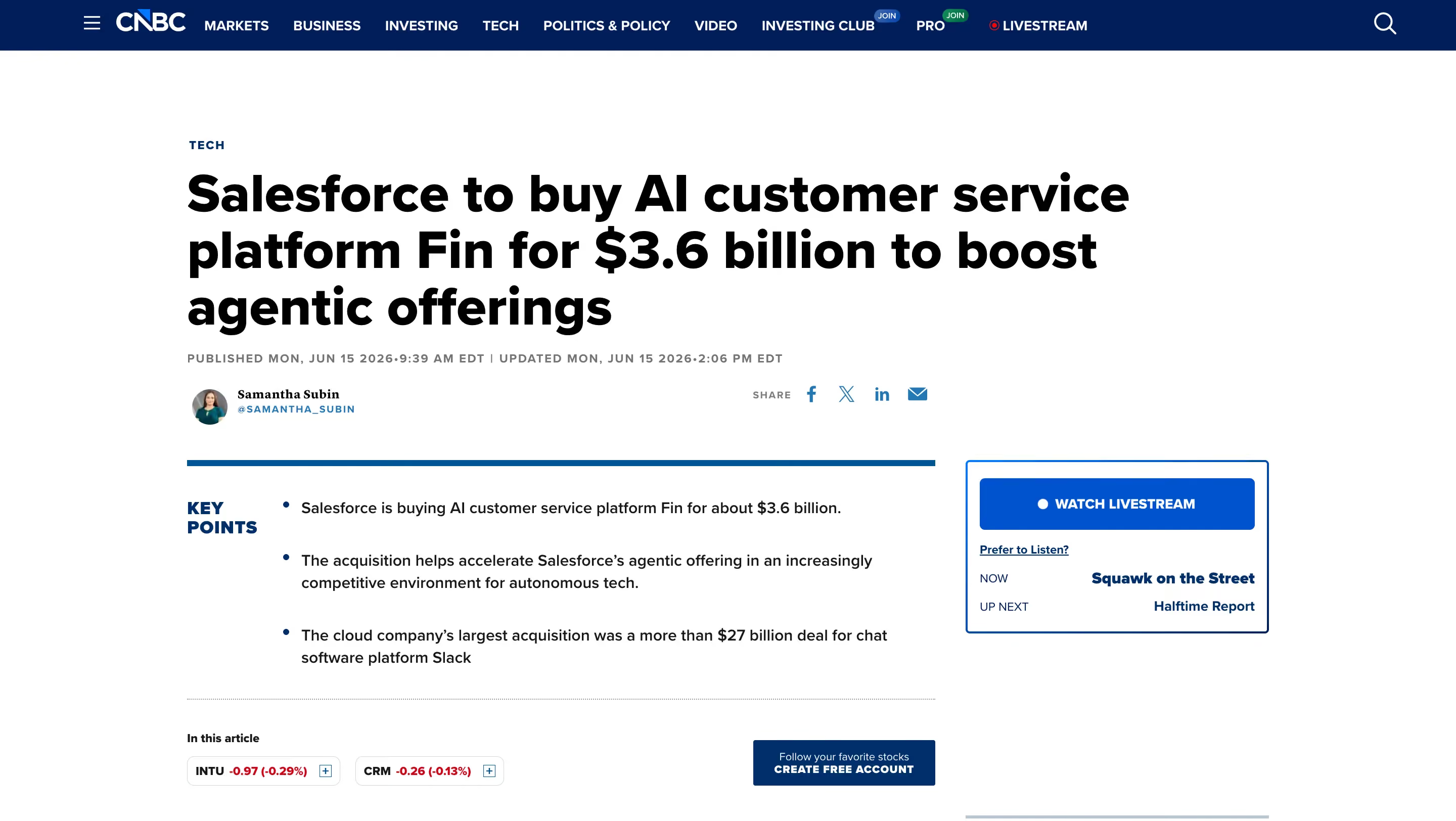
Nothing in that announcement confirms a price increase or a product disruption, and it would be dishonest to imply otherwise. Fin's leadership has told customers plainly that little changes operationally for them in the near term. Still, if you're about to commit to two years, one question is worth negotiating: what do packaging, integrations, product direction, and renewal terms look like once Fin sits inside Agentforce?
We’ve decided to dig into the depths of Reddit to see the actual sentiment about Intercom from its users now. What we’ve noticed across 4 r/SaaS threads is that many are talking about replacing Intercom. Mostly, the same couple of themes come up in all these scenarios.
The complaint isn't that Intercom is expensive. It's that the price can’t be forecasted, as it grows not with the number of seats, but rather with usage. One user pointed to his experience:

There are a few other Reddit stories that second that sentiment:

This Redditor also had to find out the hard way how expensive Intercom might get:
“The first time we moved to Intercom, we were a 12-person team with about 8 support agents. The initial sticker price looked reasonable. Six months later the bill had climbed because of seat additions, the AI resolution charges, and a couple of add-ons we didn't realize were optional at signing. Finance was not pleased.”
It sounds ironic, but too many loyal Intercom clients have come out to say that the platform doesn’t provide adequate care for its customers. It seems like with this software, you can forget about personalized customer service and instead enjoy the wait time. One customer even noted they had to wait to upgrade their plan:
“Turns out, Intercom sucks. Not only have we waited a week and a half now for an upgrade (yes, we have to wait to get the chance of giving them money), but a critical feature that we wanted, their WhatsApp integration, works only one-way…We're definitely thinking of dumping Intercom because, for their pricing, the whole experience is being very unsatisfactory.”
Another client recalled an unpleasant experience with his account handling:

As users switch to new tools, the inevitable comes: migrating all of the information you’ve collected for years (chat history, old tickets, documentation, etc.) to a new platform. And well, let’s just say, according to these Redditors, Intercom doesn’t make it any easier.
“Say goodbye to your ticket history. It's been a problem in prior migrations I've done.”
“Scaling support was messy, lots of fragmented channels and slow ticket handoffs.”
And nothing could have better summed up the general sentiment towards Intercom than this comment:

Sometimes, the software isn’t the issue. When we are talking about the digital customer service tools like CRMs and helpdesks, we often forget that the license is the smallest line in the commitment. Someone on your side still has to:
None of that work is listed on the invoice, and none of it disappears when you switch vendors. A new platform can lower your cost or give agents a cleaner interface. What it can't do is take the operating job away from your team.
Let’s move to a more trivial, yet nonetheless most crucial question about the software — how much does Intercom cost? Their billing model relies on 2 separate parts of the equation:
Monthly platform cost = (seats × plan price) + (billable Fin outcomes × $0.99) + add-ons and channel fees
As of the time of this article, Intercom’s pricing plans look the following way.
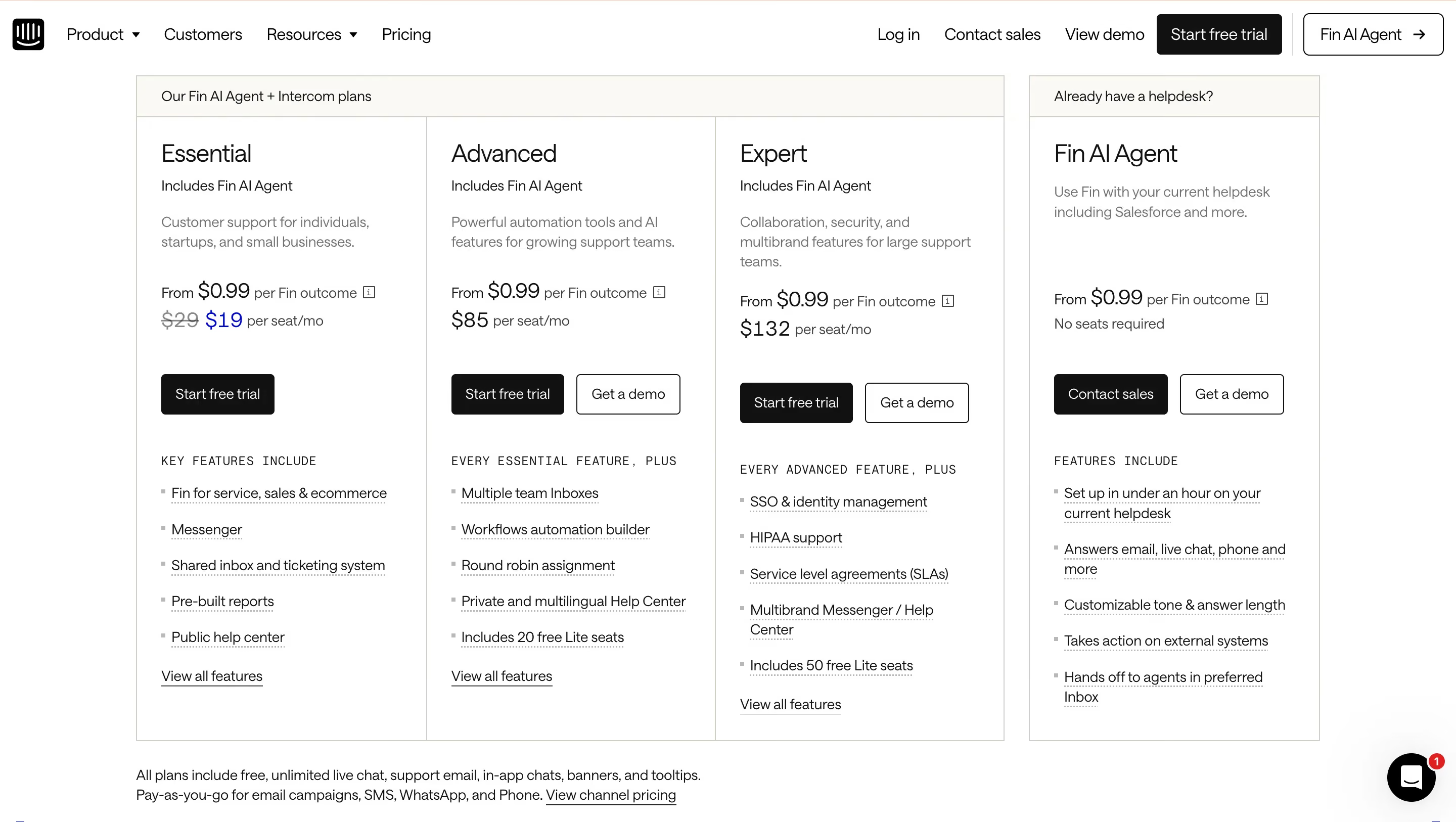
As you can see, there’s currently a slight discount on the Essential plan. Following the usual pricing, though, you would have the following choices in collaboration models (all with a Fin AI agent, but at different capacities):
They also offer a selection of add-ons, with Pro (from $99/month) and Copilot (from $29/agent/month) covering their more advanced AI features.
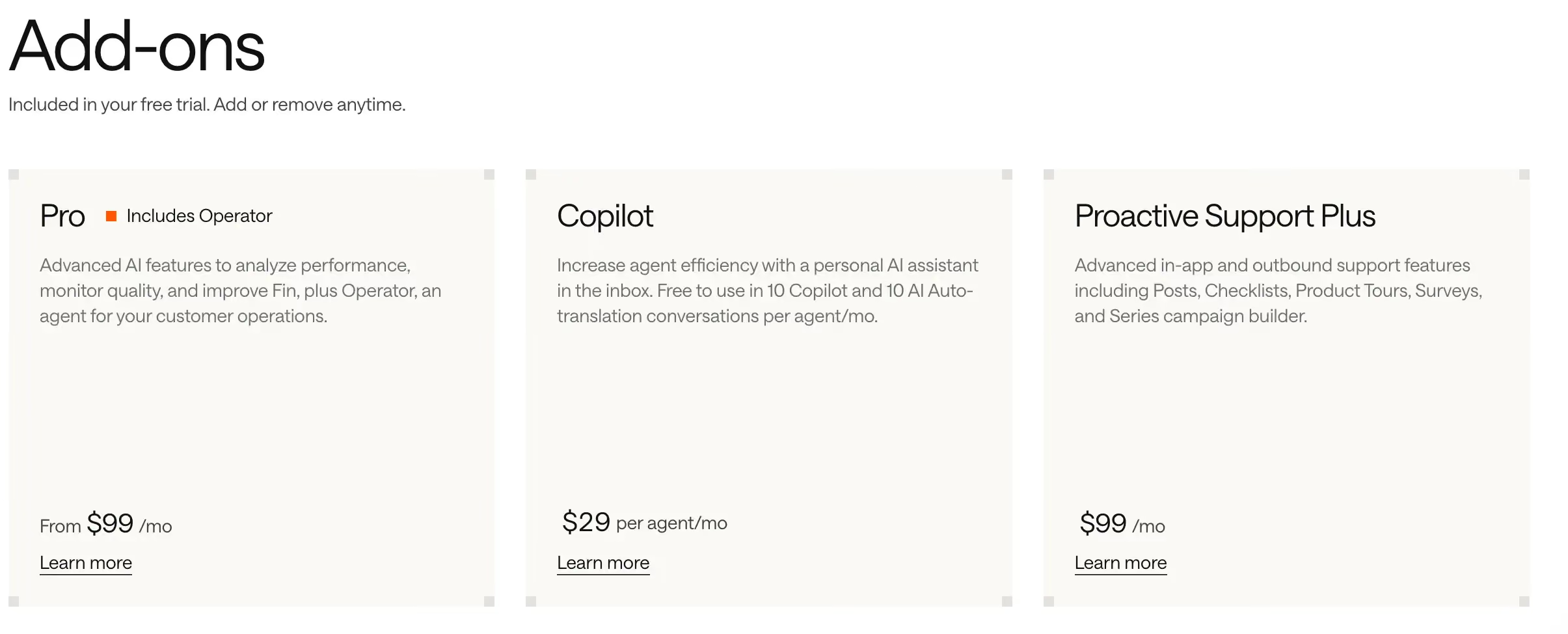
And if you already consider the pricing pretty steep, wait till you add the Fin AI resolutions. Though it’s priced the same at $0.99/resolution in each subscription model, it’s the single feature that can skyrocket your support budget through the roof.
Fin is Intercom's AI customer-service agent. It answers customer questions and can follow configured procedures, including some handoffs and routing actions, across chat, email, WhatsApp, SMS, phone, and Slack.
Intercom documents $0.99 pricing for several billable outcome types, not only an AI answer deemed resolved. Resolutions, configured procedure handoffs, and sales disqualifications are each billed at $0.99. Qualified sales outcomes are listed at $9.99.
As such, you're charged at most once per conversation, no matter how many questions the customer asks. Handoffs that Fin performs as part of a configured procedure count as billable outcomes, though a conversation passed to a human without an outcome isn't charged. Here’s a quick note on what counts as a resolution and what doesn’t from Intercom’s own explanation:
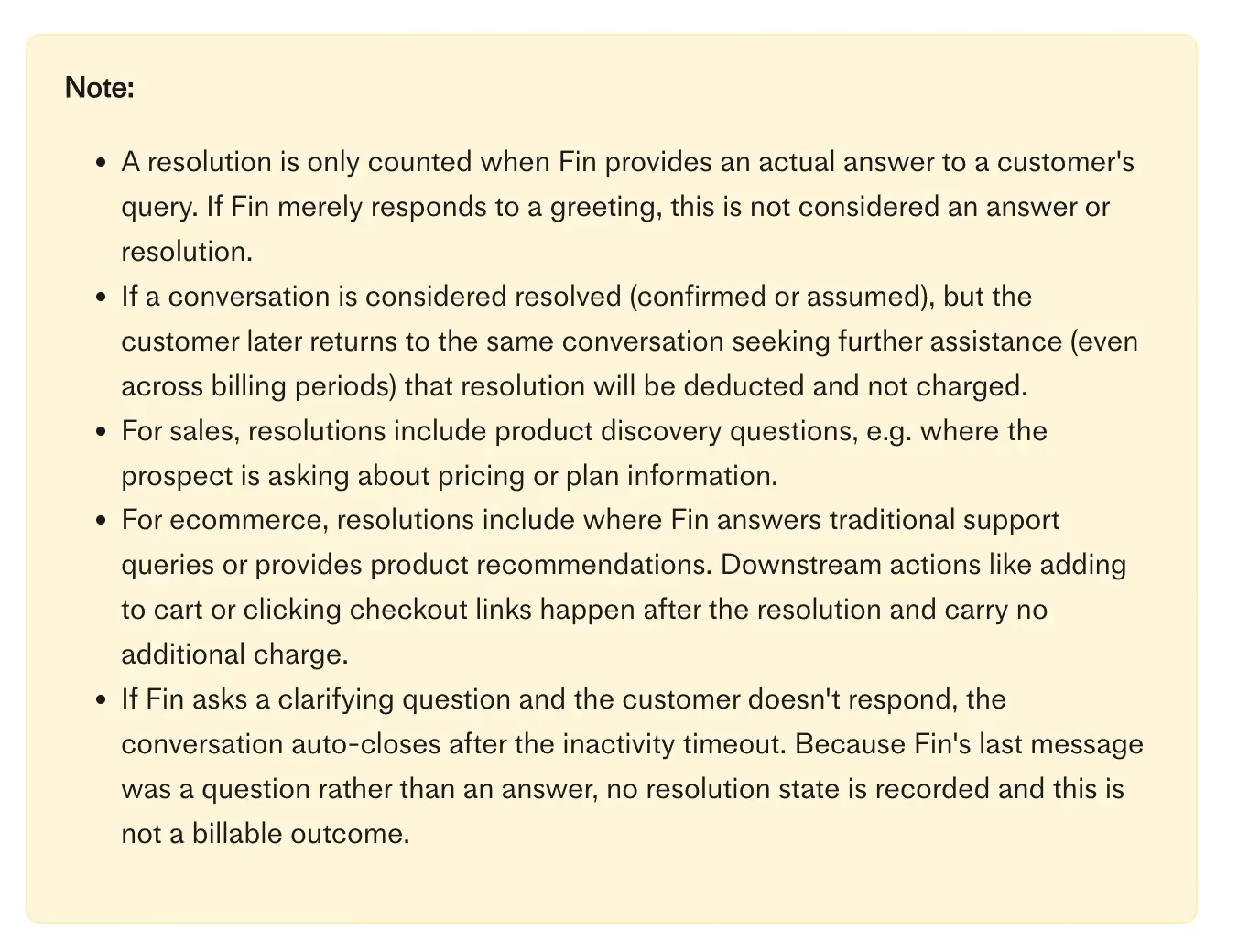
Your seat costs behave the way you'd expect. Hire someone, add a seat, add $85. Outcome charges work on a different logic, and that's where forecasting gets hard, because they climb whenever Fin does its job well. The better your AI performs, the more you owe.
Here's how that plays out, using published annual Advanced pricing.
*Examples only. Your figures depend on plan, billing cycle, add-ons, and actual outcome counts.
Same 10 people on both rows, and the bill still went up 4.3x, purely because more customers got helped. To be fair to Intercom, none of this is buried. Their documentation covers usage reminders and hard limits, and a 50-outcome monthly minimum applies.
{{cta}}
Having broken down the key reasons people switch from Intercom, let’s move on to discussing the Intercom alternatives. We can all probably agree that people switching from this helpdesk aren't looking for a clone. They're looking for specific things Intercom does differently:
Note: Together with Tidio, we held an educational AI for customer support webinar where we discussed 5 ways to build more effective AI support automation. You can check out our written breakdown of the topic via the link.
Everything a formal service desk needs is here: SLAs, multi-brand setups, custom objects, and reporting detailed enough for exec review. The catch is administration. Zendesk is better suited for teams with a dedicated support operations owner. We went deeper on this in our guide to choosing a Zendesk alternative.
Entry pricing for Freshdesk varies depending on a plan:
Despite undercutting Intercom's pricing by a wide margin, their core ticketing holds up. Just remember that Freddy AI is a separate add-on, so you need to analyze that spending line the same way you'd Fin's.
Email-led teams tend to love it. Onboarding takes hours rather than weeks, agents rarely need training, and the interface stays out of the way. It isn't built for heavy omnichannel customer support routing, which is a benefit when your volume is mostly email and a problem when it isn't.
Playbooks, meeting booking, and intent routing are genuinely strong, though pricing sits at the enterprise end. It was never going to replace a help desk anyway.
Note: On March 6, 2026, Clari + Salesloft announced the gradual sunset of Drift and named 1mind as the successor for existing customers. No end-of-life date has been published. Treat Drift as a benchmark, not a destination
If you want an alternative to Intercom chat specifically, rather than a full service platform, these are the options worth looking at.
What works well
What falls short
*Information presented was collected from Eesel AI, Brilo AI, Kayako.
What works well
What falls short
*Information presented was collected from Protooled, Brilo AI, Kayako.
What works well
What falls short
*Information presented was collected from Tidio, Helpyap.
What works well
What falls short
*Information presented was collected from Chatwoot.
For an early-stage team with owner-led support and predictable ticket volume, Crisp, Tidio, Freshdesk, and Help Scout all work. We advise picking based on billing model and time-to-value instead of feature count. You won't use most of the features, and the person configuring the tool is also the person shipping product.
Pro tip: Once support outgrows the founder, the real choice is between hiring a support lead plus agents, or bringing in a partner. And we, EverHelp, exist for the second case: teams that need a working support function and don't want to build a support-management layer internally. But that’s a totally different solution worth discussing.
So far we've been comparing tools with tools. Useful, but it assumes you want to run a support operation yourself. What if you are tired or don’t have the capacity to manage staffing, training, QA, and CRM platform calibrations?
In this case, your main option is to transfer your customer support team to a managed provider who, in addition to covering your support flow, can also help pick out and configure the help desk you need.
The answer is pretty clear at this point. While software gives your team a system, Everhelp can both set up that system and run your operations for you. We can hire you a Portuguese speaker to handle orders from Lisbon at 3 am and train them to match your customer service standards. Intercom or any other similar solution doesn’t do that.
Here’re just some numbers that prove what we bring to the table. And, if you are still skeptical, just check out our case studies to see how we actually handle support for our clients.
What we deliver:
We also offer our own AI agent solution, Evly, that can boost your customer support automation by covering up to 85% of routine queries end-to-end without human escalations.
{{cta}}
Neither option is a better choice, and that’s why you should make your decision based on 2 things:
Acquiring only the new software will work for your business if you can tick any of the following:
So, if all 4 apply to you, switch platforms and stop reading sales pages. You'll get more out of putting the saved budget into customer service analytics to later guide your support development.
You usually know when you're in this situation:
All of this may lead to lower customer loyalty and, eventually, higher churn. If that's where you are, what you need is people and structure, and you can either organize everything yourself or bring in a team that's already been doing this for years.
Now, if you’ve looked critically at your current situation, you can strip the shortlist down to 1 question: is your problem a feature gap or an operating gap? Everything else follows from the answer.
Let’s say you have already decided to migrate to another help desk. What are your next steps? Improvised migration is not an option, as you are risking losing data and breaking already established flows.
What we advise you (as all our clients) to do is to structure the switch from Intercom. You need to create an implementation plan, where you can specify critical information like which flows carry the most risk and which integrations everything else depends on.
To make this structuring process easier, we’ve created a checklist for you to follow.
Whatever you're moving to, don't move everything at once. Keep Intercom running, give the new setup a small slice of real traffic, and let the numbers decide. What you measure differs depending on which route you've picked.
Our list of customer satisfaction metrics covers how to measure your baseline and progress properly, and it's worth doing before you start rather than halfway through.
Most teams don't choose Intercom every year. They just don't cancel. And with the Salesforce deal closing sometime in fiscal Q4 2027, nobody knows how whatever you sign now will renew.
That's reason enough to consider your alternatives, including a managed one. Talk to our team and let’s break down what you actually need to finally deliver excellent customer service.
{{cta}}
Kayako.
What works well
What falls short
What works well
What falls short
For an early-stage team with owner-led support and predictable ticket volume, Crisp, Tidio, Freshdesk, and Help Scout all work. We advise picking based on billing model and time-to-value instead of feature count. You won't use most of the features, and the person configuring the tool is also the person shipping product.
Pro tip: Once support outgrows the founder, the real choice is between hiring a support lead plus agents, or bringing in a partner. And we, EverHelp, exist for the second case: teams that need a working support function and don't want to build a support-management layer internally. But that’s a totally different solution worth discussing.
So far we've been comparing tools with tools. Useful, but it assumes you want to run a support operation yourself. What if you are tired or don’t have the capacity to manage staffing, training, QA, and CRM platform calibrations?
In this case, your main option is to transfer your customer support team to a managed provider who, in addition to covering your support flow, can also help pick out and configure the help desk you need.
The answer is pretty clear at this point. While software gives your team a system, Everhelp can both set up that system and run your operations for you. We can hire you a Portuguese speaker to handle orders from Lisbon at 3 am and train them to match your customer service standards. Intercom or any other similar solution doesn’t do that.
Here’re just some numbers that prove what we bring to the table. And, if you are still skeptical, just check out our case studies to see how we actually handle support for our clients.
What we deliver:
We also offer our own AI agent solution, Evly, that can boost your customer support automation by covering up to 85% of routine queries end-to-end without human escalations.
{{cta}}
Neither option is a better choice, and that’s why you should make your decision based on 2 things:
Acquiring only the new software will work for your business if you can tick any of the following:
So, if all 4 apply to you, switch platforms and stop reading sales pages. You'll get more out of putting the saved budget into customer service analytics to later guide your support development.
You usually know when you're in this situation:
All of this may lead to lower customer loyalty and, eventually, higher churn. If that's where you are, what you need is people and structure, and you can either organize everything yourself or bring in a team that's already been doing this for years.
Now, if you’ve looked critically at your current situation, you can strip the shortlist down to 1 question: is your problem a feature gap or an operating gap? Everything else follows from the answer.
Let’s say you have already decided to migrate to another help desk. What are your next steps? Improvised migration is not an option, as you are risking losing data and breaking already established flows.
What we advise you (as all our clients) to do is to structure the switch from Intercom. You need to create an implementation plan, where you can specify critical information like which flows carry the most risk and which integrations everything else depends on.
To make this structuring process easier, we’ve created a checklist for you to follow.
Whatever you're moving to, don't move everything at once. Keep Intercom running, give the new setup a small slice of real traffic, and let the numbers decide. What you measure differs depending on which route you've picked.
Our list of customer satisfaction metrics covers how to measure your baseline and progress properly, and it's worth doing before you start rather than halfway through.
Most teams don't choose Intercom every year. They just don't cancel. And with the Salesforce deal closing sometime in fiscal Q4 2027, nobody knows how whatever you sign now will renew.
That's reason enough to consider your alternatives, including a managed one. Talk to our team and let’s break down what you actually need to finally deliver excellent customer service.
{{cta}}
Help someone else stay in the know. Hit that share button!
.webp)

.webp)

.avif)
.avif)
.webp)
.webp)