Technical Support
Customer Experience
Industry-specific
Published on
01.10.2026
Last updated on
01.10.2026
The best multilingual SaaS support providers that hold up at Tier 2
Daryna
Delivery Manager

Daryna
Delivery Manager
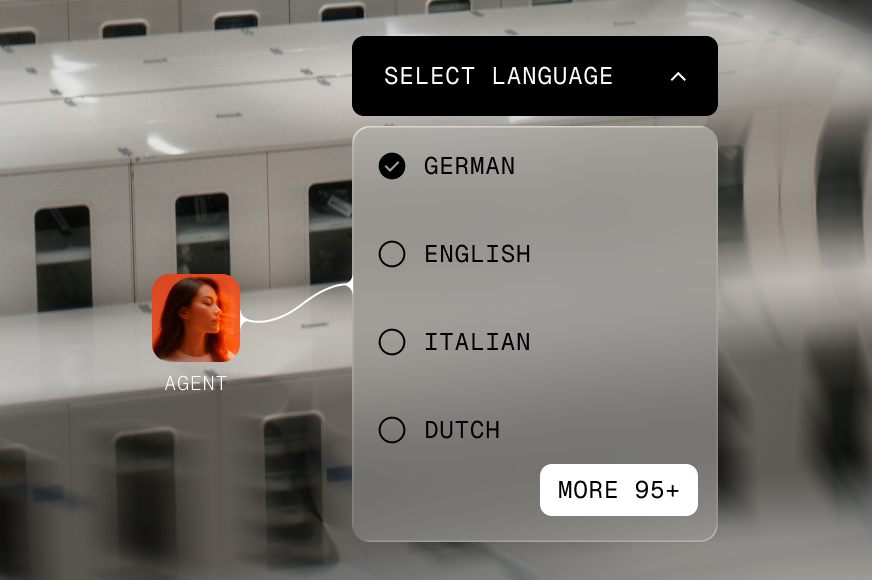
Multilingual customer support has shifted from a localization add-on to a core customer-experience capability. Yet, Capgemini’s 2025 report shows that 39% of customers still rank language barriers among the top 5 factors in frustrating support experiences (p. 21). This language friction erodes trust and becomes especially costly when customers need complex or emotionally sensitive help. As a result, only 45% of consumers report being satisfied with the support services provided (Capgemini, 2025, p. 19).
The question of multilingual assistance in SaaS support is even more prominent. SaaS businesses need agents who understand their products deeply enough to answer intricate technical questions. And their knowledge needs to come through in all the languages the business uses.
The most credible way to organize support of such depth is to outsource the function to multilingual support companies. However, many outsourced support providers can only provide multilingual assistance at the most basic levels (Tier 0/1 support).
In this guide, we will break down how you can find vendors whose multilingual capabilities extend to technical support. We will highlight key criteria for evaluating such partners and compare the best multilingual SaaS support companies on the market today.
Note: There’s no single “best” provider. The right choice depends on which languages you need, how technical your escalations get, who owns the ticket through engineering, and which data regulations you have to follow. The point of this piece is to help you ask better questions before you sign.
Before we dig into the criteria for finding the most fitting multilingual saas support providers, let’s first break down what different support tiers entail. Here's the model we use throughout this article and which is most widely applied in technical support outsourcing.
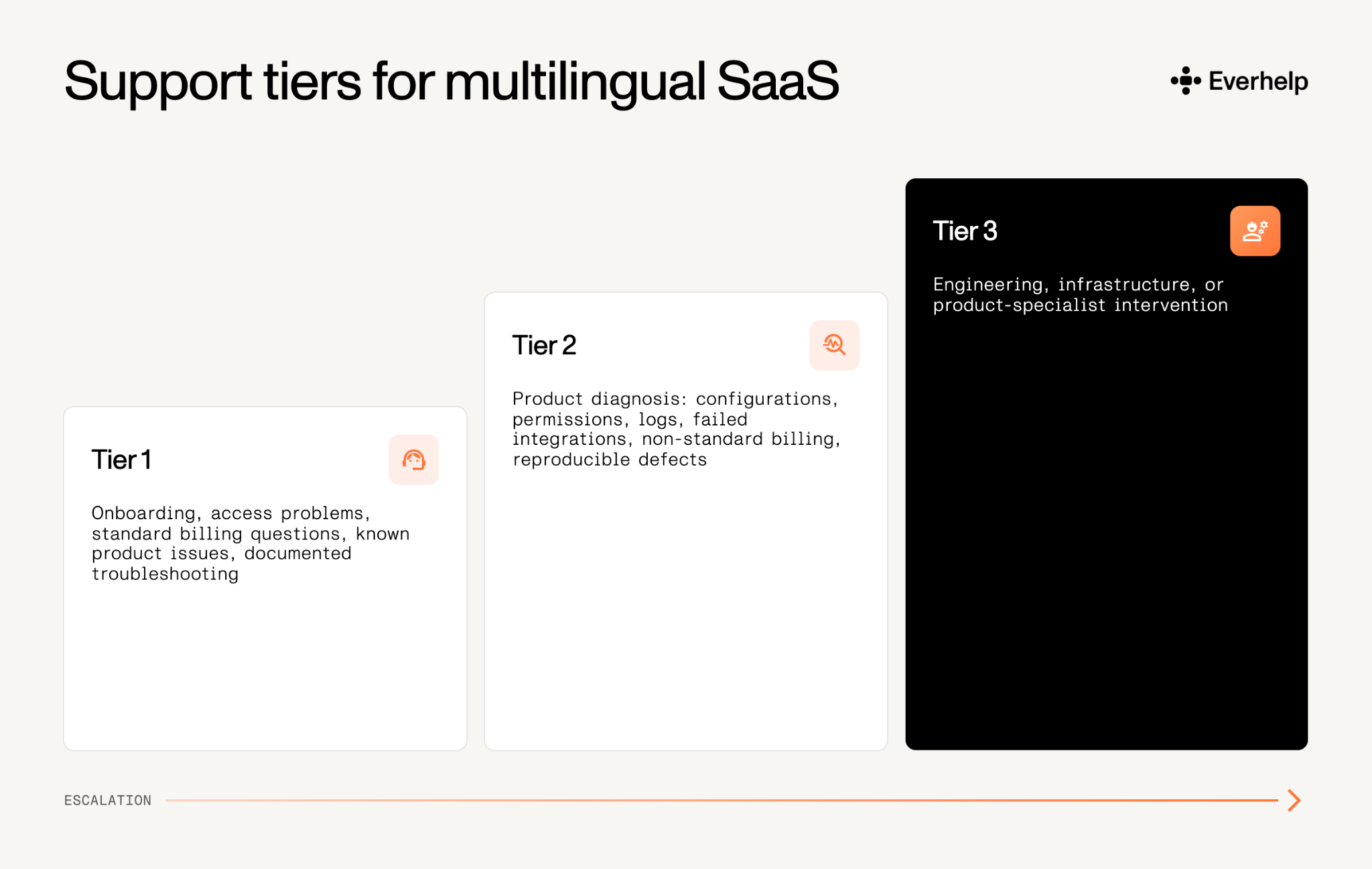
A provider doesn't need to own Tier 3 to count as credible. The real test is how they handle the escalation. A good provider keeps the customer's language, the case context, and the diagnostic evidence intact as the ticket moves up, so nobody has to restart the whole story in English for a specialist who joined halfway through.
For any of this to work, the best SaaS outsourcing companies need to provide agents with strong language skills, product expertise, and clear ownership of the escalation. Why do you need all three capabilities? The answer is simple:
For businesses operating worldwide, language coverage isn’t a nice-to-have feature. In CSA Research's survey of 8,709 consumers across 29 countries, 75% said they were more likely to buy from the same brand again when customer care came in their language. The preference held even among the people most comfortable reading English — 60% of them still wanted support in their own language.
And though this rather reflects consumer preference, it's a solid reason to offer your clients language coverage that would hold up past easy queries.
{{cta}}
SaaS is a technical industry, which means that customer service here will also have to cover more technical issues. To find SaaS technical support outsourcing companies that show enough expertise to handle even complex issues in languages other than English, we’ve outlined 3 primary evaluation criteria:
First, establish how many languages proficient human agents handle, not what software generates or translates. SaaS customer support fundamentals require agents to have specialized knowledge, so it’s best if the multilingual technical support on tiers 2/3 is provided by real humans who can read emotional cues as well as understand the technicalities of the issue.
For this reason, we recommend asking any potential vendor the following questions:
"Technical" is the word vendors stretch the most. Scripted troubleshooting and account configuration are not the same as reading logs, tracing integration behavior, or reproducing a defect.
Real multilingual technical support means the person doing that diagnosis can do it in the customer's language. If that’s not provided, there should be at least a quality-tested model for bridging complex customer cases to English-speaking staff.
Here, you can ask two key questions:
If possible, ask for a language-by-tier matrix showing headcount, hours, channels, proficiency, and backup coverage per language. If a provider can't offer one, assume their headline language-coverage number reflects Tier 0/1 support capabilities.
Working in a technical industry means strictly adhering to laws and regulations surrounding data storage, processing, and residency. So let’s establish one key distinction here:
Data residency — where the data physically lives and who touches it — is a different question that you need to discuss with each provider separately. They can be fully GDPR-compliant and still route your French customers' tickets to agents in Manila, run QA from another region, and pass transcripts through a US-based AI tool. So if your own contracts or regulators require UK or EEA residency, a compliance statement alone won't tell you whether you actually have it.
Multilingual support complicates the situation. Covering many languages usually means agents, reviewers, and tools spread across several countries. However, such a remote setup won’t be a threat to your own data compliance if the data is stored within the required area. We are talking:
Ask each vendor for the documents that let you confirm where all of this is stored:
To make your choice easier, we analyzed the most prominent multilingual support companies based on their publicly disclosed offerings.
We scored each provider on a scale from 1 to 5 on three axes:
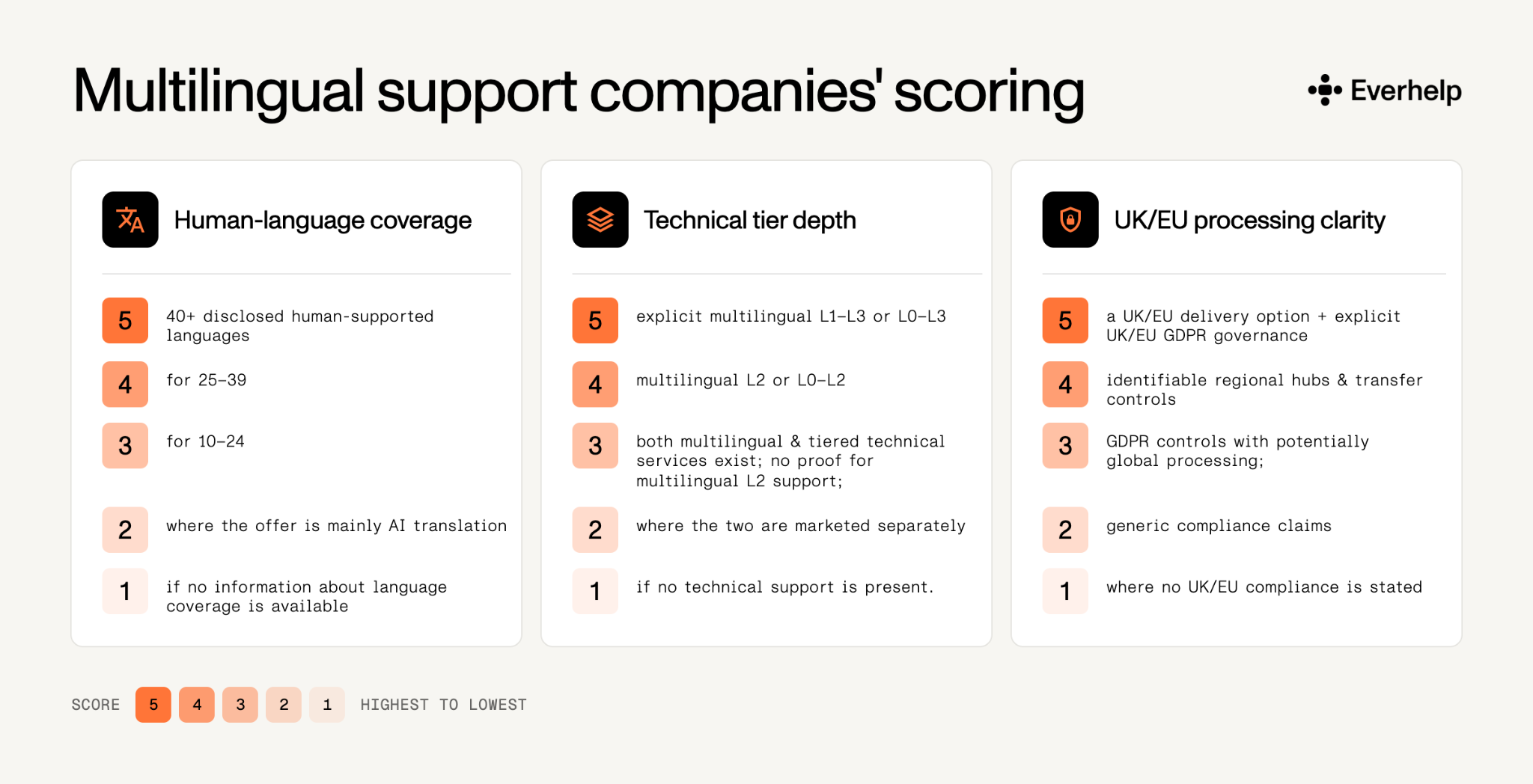
When analyzing providers, we left out retail-first call centers, answering services, and staffing firms whose public evidence stops at multilingual Tier 1.
We collected all information from providers’ own websites, technical service pages, privacy notices, trust centers, and location pages. Though we, Everhelp, are publishing this comparison, we scored our offering under the same rules as every other provider.
Disclaimer: All trademarks and brand names belong to their respective owners and are used for identification purposes only. No affiliation or endorsement is implied with any third-party company listed here unless explicitly stated. Competitor information is based on publicly available sources and is accurate as of October 1st, 2026. Providers may update their offerings at any time, so we recommend confirming current details directly with each company before making a decision.
Of course, these criteria don't cover every aspect of a good outsourced support provider. If you want a broader look, check out our general outsourcing company comparison.
Based on this evaluation, Conectys shows the clearest, most well-rounded evidence connecting language scale with multiple technical tiers. It has the widest language coverage in the table, advertises L1–L3 support, and scores well on data processing. The catch is UK delivery: Conectys doesn't offer it, so a UK-resident operation would need its approved delivery and remote-access countries fixed in the contract before signing.
Another thing to highlight is that Foundever, despite running large multilingual programs, doesn't publish how far its tiers reach by language. So, we advise treating the headline 60+ languages as a starting point for questions rather than proof of Tier 2 continuity.
The overall market-gap claim is simple to state and hard to argue with: many providers publish overall language totals, but comparatively few disclose how many languages remain available at Tier 2 or Tier 3.
Everhelp is another credible option for those looking for L0/1-L2/3 technical support. As an ecosystem for support outsourcing, we combine human talent, hand-picked to match each project, with AI scalability into a single human + AI multilingual support model.
It allows us to start with focused multilingual assistance first and scale languages and tiers as the business case proves out.
The best example of how we actually apply this approach with our clients is our work with Keiki. Their project is an edutainment app for toddlers and preschoolers with over 12 million installs worldwide, designed to gamify the learning process. The app gained decent popularity in the US and is available in both English and Spanish.
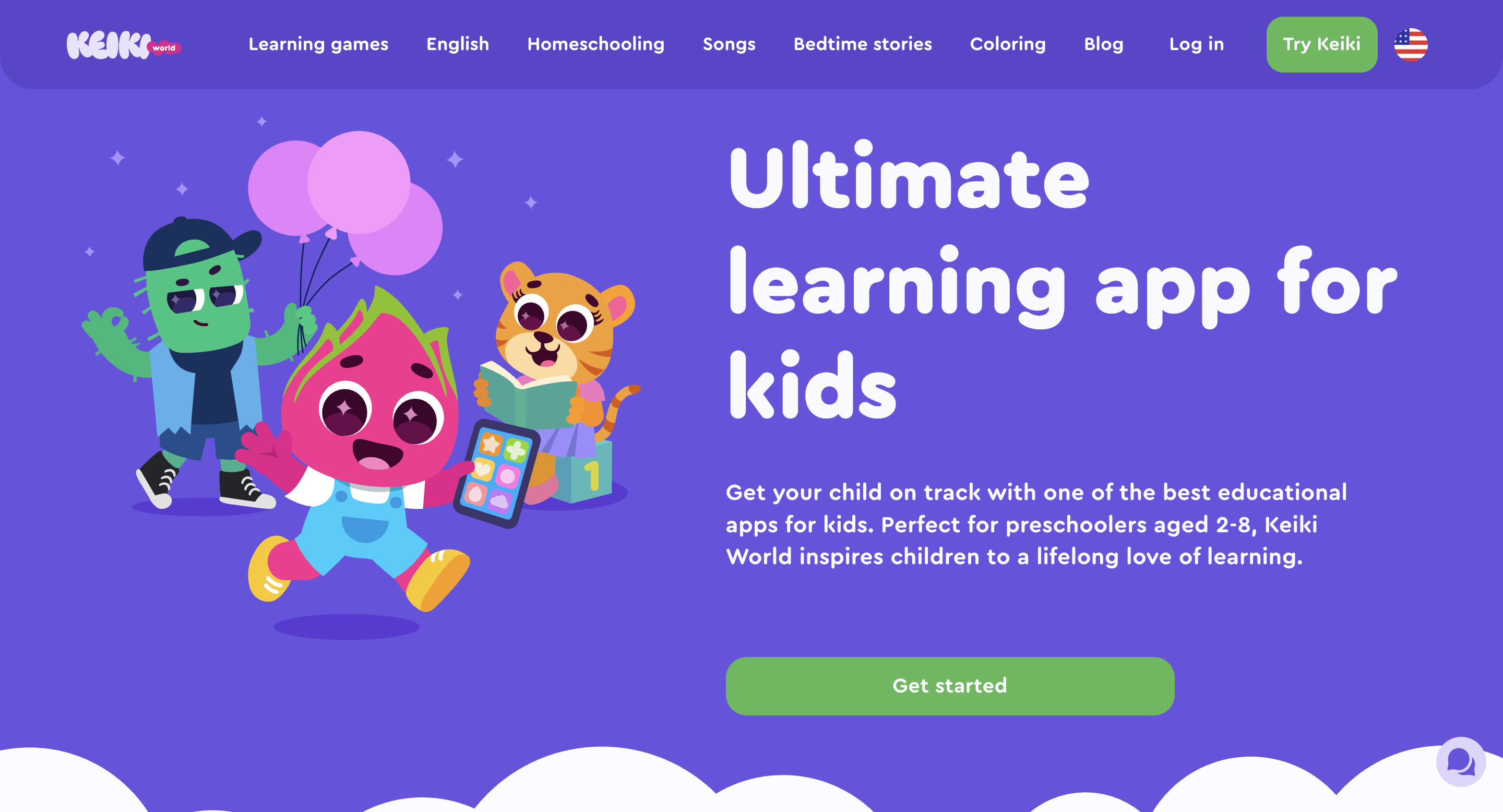
In their case, beyond refining their existing support workflows and adding training for human agents to align with the new CX focus, we also set up auto-translation via Zendesk. This has allowed the project to scale its operations and:
Now, we must admit that setting up a multilingual support system (even when it relies on human agents) isn't simple. Common operating patterns can help you identify exactly which scenarios to test with your chosen provider.
The most common one is the escalation. A customer opens a ticket in Spanish or German, a Tier 1 agent (or trained AI agent) handles the first exchange in that language, and if the case turns technical and moves to a Tier 2 specialist (often an in-house employee), it's handled only in English.
From there, the customer either waits on machine translation or is asked to explain the problem again in a second language. The diagnosis still gets done, but resolution takes longer, and the experience drops.
Several other failure points show up often enough to ask about directly:
Before choosing a partner, give each shortlisted provider the same three tickets to work on: a billing-entitlement mismatch, an integration failure with logs, and a reproducible product bug.
Alongside the results, ask each provider for:
When you review the numbers, break every metric down by language and tier. Our note on customer service analytics covers how to segment those metrics so a strong overall CSAT doesn't hide customers’ frustration from dealing with support in, say, Japanese or Italian.
{{lm-cta}}
Nowadays, AI plays a real and growing role in multilingual support. More providers lean on automated agents to expand language coverage and easily scale support operations into new markets. In 2025 alone, AI handled 30% of service cases, a number that’s expected to grow to 50% by 2027, according to Salesforce.
And as this shift is already happening, it’s best to adapt and use it to your advantage, rather than resist it. To do that, you should know which cases AI can handle alone and when it needs a human to fall back on.
For grounded, repetitive, low-risk contacts, AI is often the better tool:
These are among the most common service-AI use cases. The advantages of AI here are instant written-language expansion, 24/7 availability, and low marginal cost per repeat contact.
However, there’s a difference between answering and resolving. A fluent response that doesn't complete the required action isn't a resolution, and customers notice. In Qualtrics' 2026 study of 20,000+ consumers, nearly one in five who used AI for customer service reported no benefit, a reminder that generating an answer in ten languages doesn’t mean you are solving the problem.
Escalate ambiguous, technical, security-sensitive, or emotional cases to humans:
An effective hybrid workflow uses AI to detect language and intent, retrieve account context, collect diagnostics, and then translate or draft the response. Afterward, the AI agent should hand over the compiled case to a technically qualified human.
Two things to flag here:
These are exactly the reasons why we don’t want you to rush into AI-assisted language support. After all, any operation should be well-designed before going live. Our AI deployments handbook will walk you through designing a human+AI support workflow so that you are left with support that’s actually helpful for your business ROI.
Without data compliance, your multilingual operations will just breed unnecessary legal questions. That’s why it’s important to discuss how the multilingual technical support and support outsourcing companies are handling the data you are entrusting them with.
In the UK, customer support operations are now regulated by three key legal documents:
Transfers, at least, got clearer at the end of 2025. The European Commission renewed the UK's adequacy decisions in December 2025, running through December 2031, so EEA data can move to the UK without extra safeguards.
That only helps with one part of the picture, though. Adequacy covers data moving from the EEA to the UK. It doesn't, however, turn a provider whose staff and tools are scattered worldwide into a UK- or EEA-based operation. If you run a UK SaaS company with EEA users, you may still have to work through both UK and EU transfer rules, particularly once agents, reviewers, or AI services outside the region start handling the data.
Data residency isn't only about where tickets are stored. It also depends on everyone and everything that handles the data along the way:
A specialist in another country who opens a UK-hosted ticket is still reaching that data from abroad, and under UK rules that can count as a restricted transfer even though the help desk itself sits in the UK. The ICO's three-step test for restricted transfers is worth reading before you take any vendor's compliance claim at face value.
So before you accept that a provider is compliant, ask them for a few specific things:
Learn more about how to choose a data-ready support provider using our vendor checklist.
The most common mistake here is choosing languages by how many people speak them worldwide. Global speaker counts have little to do with where your tickets actually come from. The signals that matter are commercial and operational, and once you've picked a starting set, a short live pilot is what shows you whether the model holds.
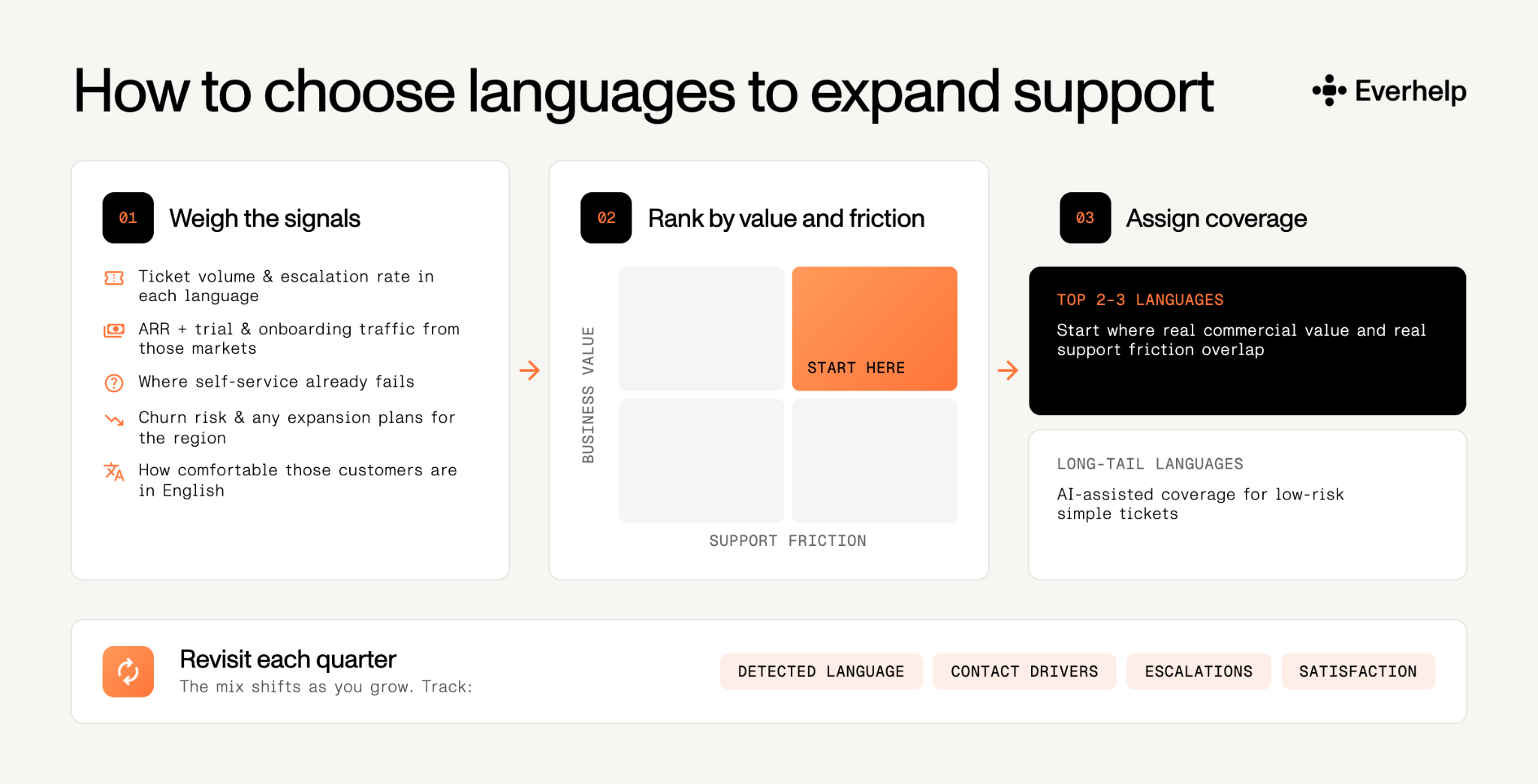
Rank your candidate languages by what they're worth to the business and how much support pressure they create. In practice, that means weighing:
Start with the two or three languages where real commercial value and real support friction overlap. For smaller, long-tail languages, AI-assisted coverage is usually the sensible call, provided the tickets there aren't high-risk or complex. Then revisit the list each quarter. The mix shifts as you grow, and your own data on detected language, contact drivers, escalations, and satisfaction will tell you where it's shifting.
English proficiency doesn't cancel the demand, either. In the CSA Research data, even the respondents most confident reading English still leaned toward their own language — 60% of them preferred it. So "our users speak English" is a weaker reason to skip local coverage than it first appears. For the strategic layer underneath all this, our multilingual support strategy guide covers how to sequence languages as you scale.
Run the first languages as a pilot before you commit to more. Keep it tight:
Then measure the numbers that tell you whether it's working, and analyze each of those per language and tier rather than as one blended figure:
The pilot is also your chance to check the things that don't show up in headline metrics:
When you're ready to add another language, get clear first on what "adding" actually involves. Does it mean recruiting native agents, turning on AI translation, or some of both? Settle the minimum volumes, recruitment lead times, proficiency standards, and QA capacity before you agree to anything.
The timelines are worth separating out, because human and AI expansion move at very different speeds. Our guide on how to choose an outsourcing partner walks through structuring the pilot and the contract so that adding languages later doesn't force you to switch providers.
Simply put, what matters when choosing the best multilingual saas supportis whether a vendor can show you who handles a complex ticket, in which language, at which tier, and from where.
So:
And it’s a great opportunity to start your experiment with Everhelp. Book a meeting with our team, and let’s see what we can do to help expand your multilingual support and do it right.
There's no reliable universal price list. The cost varies by language scarcity, operating hours, channel, tier depth, dedicated versus shared staffing, and volume. Compare language-level cost per resolved ticket rather than hourly rates, since a cheap hour in a thin language queue can cost more per resolution.
AI manages grounded, repeatable, low-risk requests, collects diagnostics, and translates conversations. Human specialists remain essential for ambiguous technical issues, security-sensitive actions, disputes, defects, and emotional escalations. Native status helps, but the critical combination is strong language quality plus real technical competence.
Prioritize the intersection of ticket volume, ARR, churn risk, expansion plans, escalation frequency, and customer English proficiency. Begin with two or three languages where demand and business risk are highest, then let actual contact and resolution data guide expansion rather than global speaker counts.
Potentially, but not automatically. Identify each destination and subprocessor, then document adequacy or the appropriate UK/EU transfer safeguard and assessment. Processing outside the region can be lawful, but it is not UK or EU data residency — the two claims are different and shouldn't be conflated.
Roughly two to eight weeks, depending on recruitment, language count, product complexity, integrations, and QA. Published examples range from seven days for a limited agent-plus-AI model to about 28 days or 4–8 weeks for a human-team deployment. Quote human and AI timelines separately.
Translation helps scale everything that's communicated via text. However, it's only proficient language speakers who can also add terminology control, context, cultural judgment, and ownership. Yet, for Tier 2, simply being a native isn't enough — the specialist must also understand the product, the diagnostic workflow, and the escalation criteria.
Usually you can't assume it. A few providers publish joined-up language and tier evidence, but many don't. Unless the vendor supplies a language-by-tier staffing matrix, treat the headline number as general or Tier 1 coverage and check how English-speaking specialists enter the workflow.
Use one core QA framework plus language-specific reviewers, translated terminology lists, and regular calibration. Track QA, CSAT, FCR, reopen rate, transfer rate, and resolution time by language, channel, and tier. Global averages can hide weak results in smaller language queues.
Yes, if the operating model and contract support modular expansion. Confirm per-language minimums, recruitment lead times, AI-versus-human coverage, QA availability, and whether each new language gets the same Tier 2 depth, SLAs, and residency controls before committing.
Help someone else stay in the know. Hit that share button!


.webp)

.avif)
.avif)
.webp)
.webp)