Customer Experience
Published on
10.09.2026
Last updated on
23.09.2026
Gen Z customer service expectations vs. every generation

Valentyna
VP of Customer Support

Valentyna
VP of Customer Support
.avif)
TL;DR: Picture one support team pleasing a customer who wants an instant chatbot reply, and another who won't hang up until a real person answers. Most companies build one experience and hope it fits both. It doesn't. Gen Z solves problems alone and fast, rarely touching the phone. Boomers call, willing to wait. Talkdesk puts that gap at 24% versus 56%. This isn't about generations liking different things. It's about patience, and what happens when it runs out.
What happens when a Gen Z customer wants a five-second chatbot reply, and a Boomer on the very same support line wants a real person on the phone? Most support teams give both customers a version of the same experience, and it fails one of them every time. Only 24% of Gen Z customers prefer the phone for customer service, compared with 40% of Gen X and 56% of Boomers, according to Talkdesk Research. That's not a minor style preference. It's a structural gap in what “fast, good service” even means, and it's exactly why Gen Z customer service needs its own playbook rather than a smaller version of the one built for everyone else.
Customer expectations have always moved with technology, but changing customer expectations today split cleanly by generation in a way one script can't satisfy. Every frictionless self-service interaction resets what the next generation expects from every brand, including yours. Most support leaders already sense the shift. Few have done anything structural about it beyond repeating the same two facts: Gen Z hates phone calls, Boomers want humans. That's true, but it's not useful on its own.
The real question is:
How do you staff, route, and measure a single support operation that has to satisfy all four generations at once, and that's what the rest of this piece is built to answer?
Generational marketing has shaped ad copy, product design, and social strategy for well over a decade. Support has lagged behind. Most companies still run one IVR script, one knowledge base, and one first-response-time target for every customer who reaches out, whether that customer is 19 or 65.
That gap becomes obvious the moment you look at customer service channel preferences by generation. Talkdesk's Winning Gen Z Through Exceptional Customer Service report found:
.avif)
Source: Talkdesk's Winning Gen Z Through Exceptional Customer Service report.
Gen X sits almost exactly between the two extremes, and that's the pattern running through most of the data in this piece: preferences don't split cleanly into “young” and “old.” They move on a gradient, generation by generation, and a support model built only for the ends of that gradient will always underserve the middle.
Talkdesk's research also found that Gen Z puts little premeditated thought into which channel they use to reach a brand, and expects to pick up a conversation exactly where they left it off. That single habit has real staffing implications for any support operation still routing by channel instead of by customer.
Picture the same "please hold, your call is important to us" message playing for two different customers. A Boomer stays on the line, reassured. A Gen Z customer hangs up to try the app instead, and never calls back to explain why. Neither reaction is negative, but a support operation measuring only the calls that connect will never see the second customer at all.
The mistake most businesses make isn't misjudging any one generation. It's assuming one support model can stretch across all four. It can't, and the cost rarely shows up as a single bad review. It shows up as:
It's the kind of nuance that should show up in how a business tracks customer service trends year over year, not just what's shifting industry-wide.
Check out our customer service trends 2026 guide for what else is shifting.
{{cta}}
Before breaking down what each generation actually wants, it helps to see the pattern side by side. Channel preference, patience for waiting, and reliance on self-service move together across generations, though not always in the direction you'd expect.
Sources: Talkdesk Research (channel preference, self-service adoption), Gartner (self-service abandonment).
Pro tip: Read the table by column rather than by row, and a pattern emerges: patience for waiting climbs with age, and dependence on reaching an actual person climbs right alongside it.
The customers who'll wait longest are also the ones most likely to want human support once they finally get through. The customers who won't wait at all are also the ones most likely to try solving it themselves before they ever reach for the phone.
Zoom in on any single generation, and Gen Z customer service draws most of the attention right now, but the story only makes sense set against the other three.
Gen Z's self-service instinct doesn't start with the support ticket. It's part of a wider pattern of Gen Z shopping habits. About three in four say they compare prices and read reviews before buying anything at all, according to Power Reviews. That same research-first habit carries into how they try to solve a problem after the purchase. By the time a Gen Z customer actually contacts support, they've usually already tried, and failed, to fix it themselves.
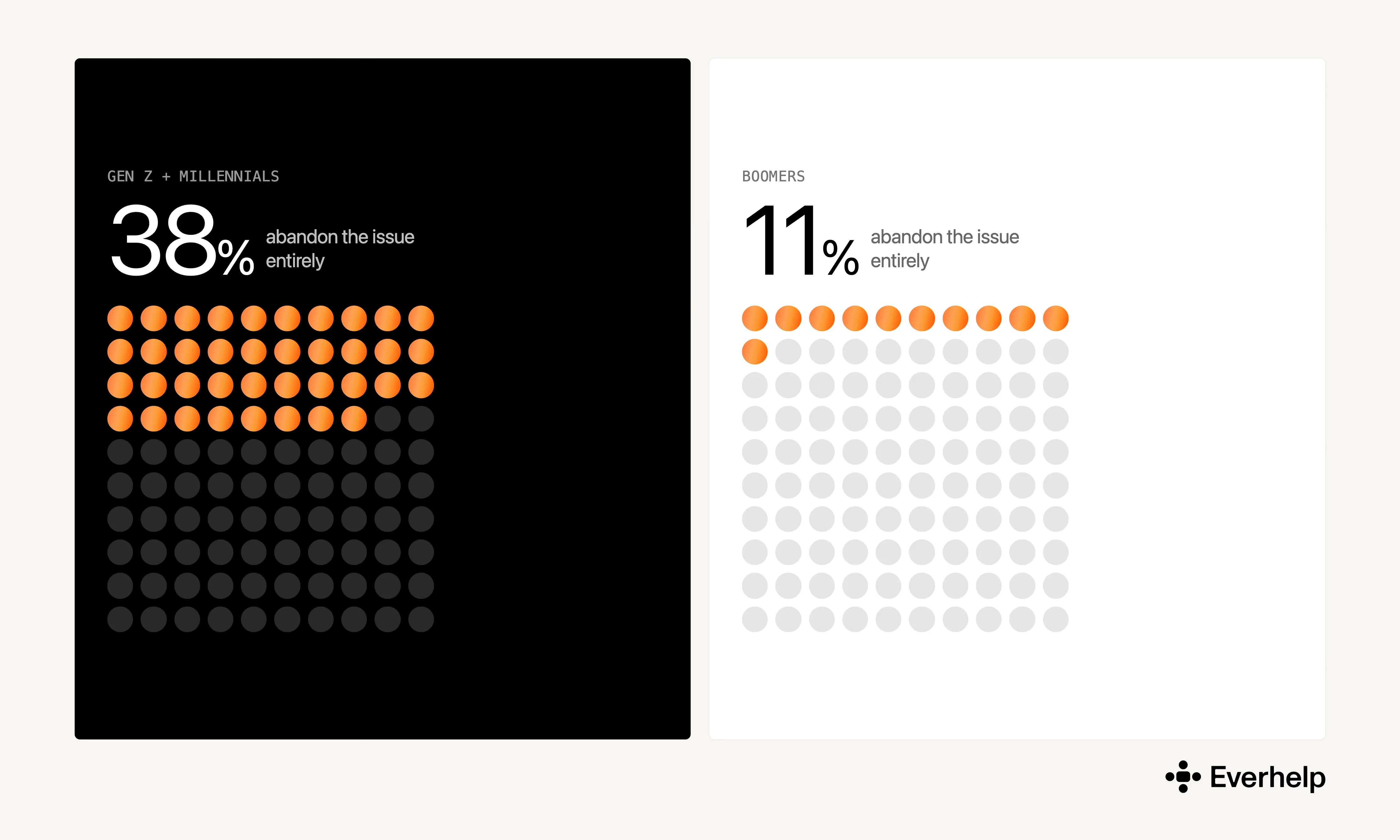
Millennials track closely behind. Gartner groups the two generations together for good reason: 38% of Gen Z and Millennial customers say they'd rather give up on an issue entirely than fight through broken self-service.
Only 11% of Boomers say the same.
That's not laziness. It reflects a different definition of what's worth their time. If solving it themselves takes longer than it should, many would rather walk away than pick up the phone. A business that reads that walk-away as a satisfied, silent customer is misreading its own churn.
Gen X sits in the middle of nearly every statistic in this piece. Channel preference is no exception: 40% prefer the phone, squarely between Gen Z's 24% and Boomers' 56%. This generation moves fluidly between email, chat, and phone calls. They pick whichever channel resolves the issue fastest, rather than defaulting to one out of habit.
For support specifically, Gen X often turns to WhatsApp and LinkedIn, according to Sprout Social's research. "In the middle" doesn't mean hard to reach. It means flexible, and worth routing accordingly.
That flexibility is a staffing advantage if you use it. Gen X customers rarely insist on one specific channel. Intelligent routing can steer them toward whichever queue has capacity at that moment, without hurting satisfaction. You can't safely do that with a Boomer who called specifically for a phone conversation
Boomers prefer the phone more than any other generation, at 56%, and that number shouldn't be read as a generation that's opted out of digital support entirely. Boomers remain active on channels like Facebook to reach brands for customer support, per Sprout Social, alongside more traditional channels. Phone-first doesn't mean phone-only for this generation. It means a live person is still the preferred outcome, whichever channel actually gets them there fastest.
{{cta}}
Nowhere is the generational gap wider than in self-service adoption. According to Talkdesk, 85% of Gen Z customers used a virtual or automated agent in the past year, and 78% used a chatbot to solve an issue on their own. This is where an AI voice agent fits naturally into the front line, handling the routine, high-volume interactions Gen Z already expects to resolve without waiting for a human. For this generation, self-service isn't a fallback offered after a long hold. It's the default first move, and businesses that treat it as a lesser channel are underinvesting in the one most of their youngest customers will actually try first.
That preference comes with an edge most support leaders underestimate. Gartner's research on what it calls the “self-service or no service” mindset found that 38% of Gen Z and Millennial customers will give up on an issue entirely if they can't resolve it through self-service, rather than escalating to an agent. Only 11% of Boomers do the same. A broken self-service flow doesn't just frustrate younger customers. It loses them quietly, with no phone call and no complaint to flag that anything went wrong.
AI adoption follows the same curve, and EverHelp's own customer service statistics research adds a data point most competing content on this topic doesn't have. Overall preference for AI support over a human agent sits at just 8% across the general population, but that share nearly doubles among Gen Z, to 14%. It's still a minority preference, but it's a real and growing differentiator, and one more reason a live chat vs. chatbot decision shouldn't default to the same answer for every segment of a customer base.
When customers do turn to AI, cost isn't the main driver. Availability tops the list, followed by speed and accuracy, per the same research. Gen Z's heavier AI usage lines up with all three: a chatbot is available at 2 a.m., replies faster than a queued phone call, and doesn't get tired at the end of a shift the way a human agent might.
None of this is a blank check for AI. The same research found that 23% of customers lose trust in a brand the moment they feel trapped in an AI loop with no way out, and that number doesn't disappear just because a customer skews younger. The businesses getting Gen Z customer service right are the ones treating self-service quality as seriously as they'd treat a call quality score, with a visible escalation path for the moment self-service isn't enough — because for a growing share of their customers, self-service is the only interaction that ever happens at all. That's also the strongest argument for weighing the pros and cons of AI in customer service by segment rather than for the customer base as a whole.
Gen Z puts little premeditated thought into which channel they use to reach a brand, and expects to pick up a conversation exactly where they left it off, per Talkdesk's research. Start on chat, switch to email a day later, mention it again on social when nobody's replied — to a Gen Z customer, that's one conversation. To most support stacks, it's three disconnected tickets and an agent who has to ask them to explain the whole thing again from the start.
That expectation makes delivering true omnichannel customer experience a requirement for this generation specifically, not a nice-to-have upgrade for everyone. A digital customer experience strategy that treats each channel as a separate silo will keep losing exactly the context Gen Z customers expect to carry with them, and every dropped thread costs a little more patience from a generation that didn't have much to begin with. The same principle shows up across omnichannel support trends more broadly, but it's sharpest here.
The same logic extends directly to personalized customer service: a customer who's already told a chatbot what's wrong shouldn't have to repeat it to a phone agent twenty minutes later. Omnichannel continuity and personalization aren't two separate initiatives here. They're the same fix, described from two different angles, and skipping one undermines the other.
It's tempting to read everything so far as a straightforward generational divide and stop there. That would overstate it. Genesys' global research across four generations found real common ground:
Gen Z and Boomers may reach for different channels, but they're not chasing different outcomes. The generational split shows up more in channel and pace than in what a good experience actually requires. Older generations trust reviews less, not because reputation matters less to them, but because they've built other habits for judging it, like calling and asking a real person before they decide.
That matters for how you read every other stat in this piece. A Boomer who prefers the phone isn't asking for a slower experience. They're asking for the channel that, for them, most reliably delivers a fast and accurate one. A Gen Z customer avoiding the phone isn't asking for lower-quality service. They're asking to get the same outcome without waiting on hold.
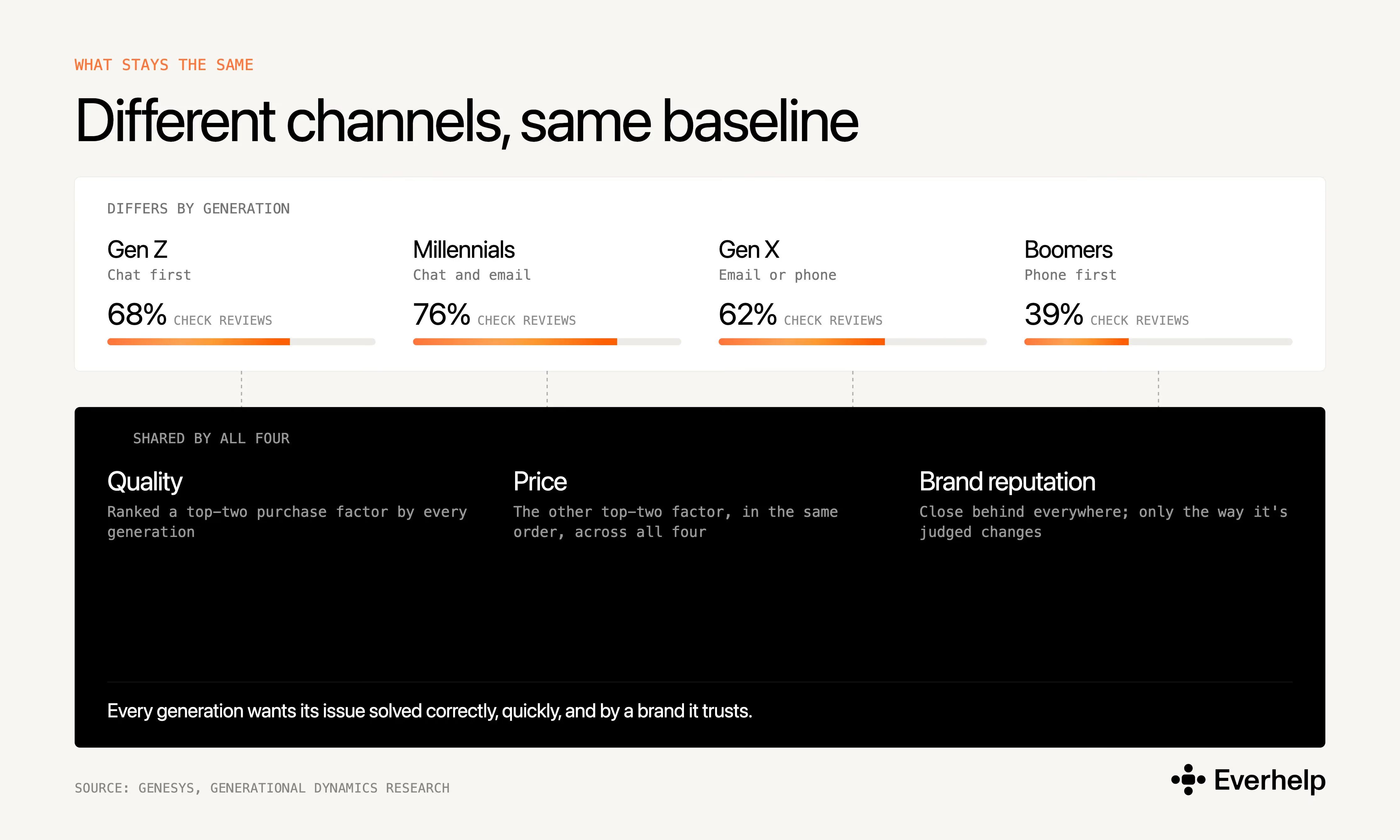
The differences documented throughout this piece are real, but they sit on top of a shared baseline: every generation wants its issue solved correctly, quickly, and by a brand it trusts. Most competing content on this topic skips that baseline entirely, treating the youngest generation as the future and everyone else as legacy. That framing costs credibility with the majority of a support team's callers, and it simply isn't what the data shows.
Here's the part most Gen Z customer service guides skip entirely: how do you actually staff and route for four generations with different expectations, at the same time, without running four separate support operations?
The answer isn't picking one generation, or one channel, to prioritize. It's building a human + AI support model where each part of the operation does the job it's actually good at:
A client example makes this concrete. When EverHelp built a blended human + AI setup for Relatio using Evly, the AI agent automated 50% of tickets while the team still reached 86% CSAT — proof that automating the routine, high-volume requests doesn't have to come at the expense of customers who need, or simply prefer, a person. Blending Evly with human agents this way typically lets EverHelp teams hit an 83% average CSAT with a 45-second first response time, regardless of which generation is on the other end of that first message.

Getting that balance right isn't a one-time setup decision. It means tracking outcomes by segment through customer service analytics, not only in aggregate, because a CSAT score that looks healthy overall can still be quietly failing one generation while over-serving another. If a Gen Z self-service deflection rate is climbing while Boomer phone CSAT is sliding, averaging those two numbers together will hide the exact problem worth fixing.
Most content on Gen Z customer service stops at describing the differences. The businesses actually solving for it treat "which generation is this?" as a routing question, not a trivia fact. Self-service and AI absorb the volume younger customers already want to handle themselves, while human agents stay ready for the phone-first and the complicated. Nobody has to start over when they move between the two.
That's not a compromise. It's what real customer service standards look like when one customer base spans four generations. Not one channel for everyone, but one standard of speed and quality, delivered however each person wants to reach you.
Wondering if your own setup quietly favors one generation over another? Check your CSAT, self-service deflection rate, and handle time by age band before assuming it already works for everyone.
At EverHelp, that's the model behind every support operation we build: people, technology, and process, structured around outcomes, not one script for every caller.
{{cta}}
Help someone else stay in the know. Hit that share button!


.webp)

.avif)