Growth & Metrics
Published on
22.01.2026
Last updated on
12.10.2026
How to Increase Customer Loyalty: 10+ Tips That Work in 2026

Nataliia
Chief Executive Officer

Nataliia
Chief Executive Officer

Let’s face it, basics like quality service, fair pricing, and a responsive customer support team cover only a small part of customer expectations in today’s competitive market.
Research shows 65% of customers now expect companies to adapt to their changing needs and preferences. Which, for modern businesses, means that a single sale doesn’t equate to a won-over customer. And even though this does require them to put in more effort, such a strategy pays off. After all, let’s not forget that acquiring a new customer costs five times more than retaining an existing one (that's right, five times!).
So, it's no surprise that a loyal customer base is the secret sauce to a thriving business. They not only provide consistent revenue but are also less price-sensitive, more helpful in spreading the word about your brand, and greatly reduce marketing costs by shortening the customer acquisition process. As such, knowing how to build customer loyalty program and strategy can be your lifeline, even in uncertain economic times.
Before we get into specific tactics, it helps to take a step back and think about why customers stay loyal in the first place. When you understand what’s going on in their minds and what really motivates them to keep coming back, you’re in a much stronger position to build a strategy that actually works.
Remember Maslow's hierarchy of needs? This iconic framework offers straightforward parallels to customer behavior.
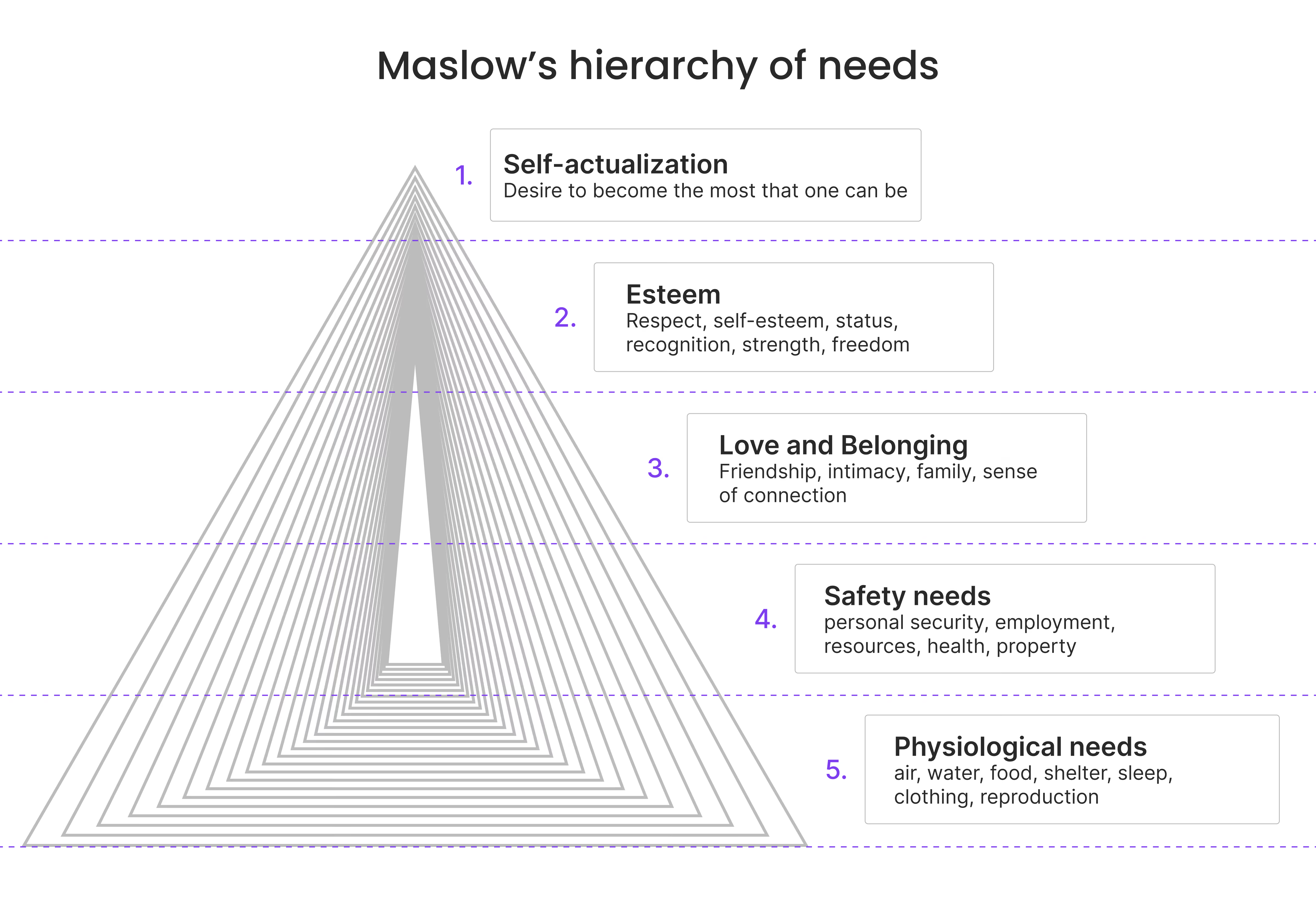
Example: Imagine your brand sells wool sweaters. At a basic level, buying one fulfills a physiological need – staying warm on cold days. While this essential need is met, it doesn’t automatically turn the customer into a loyal fan.
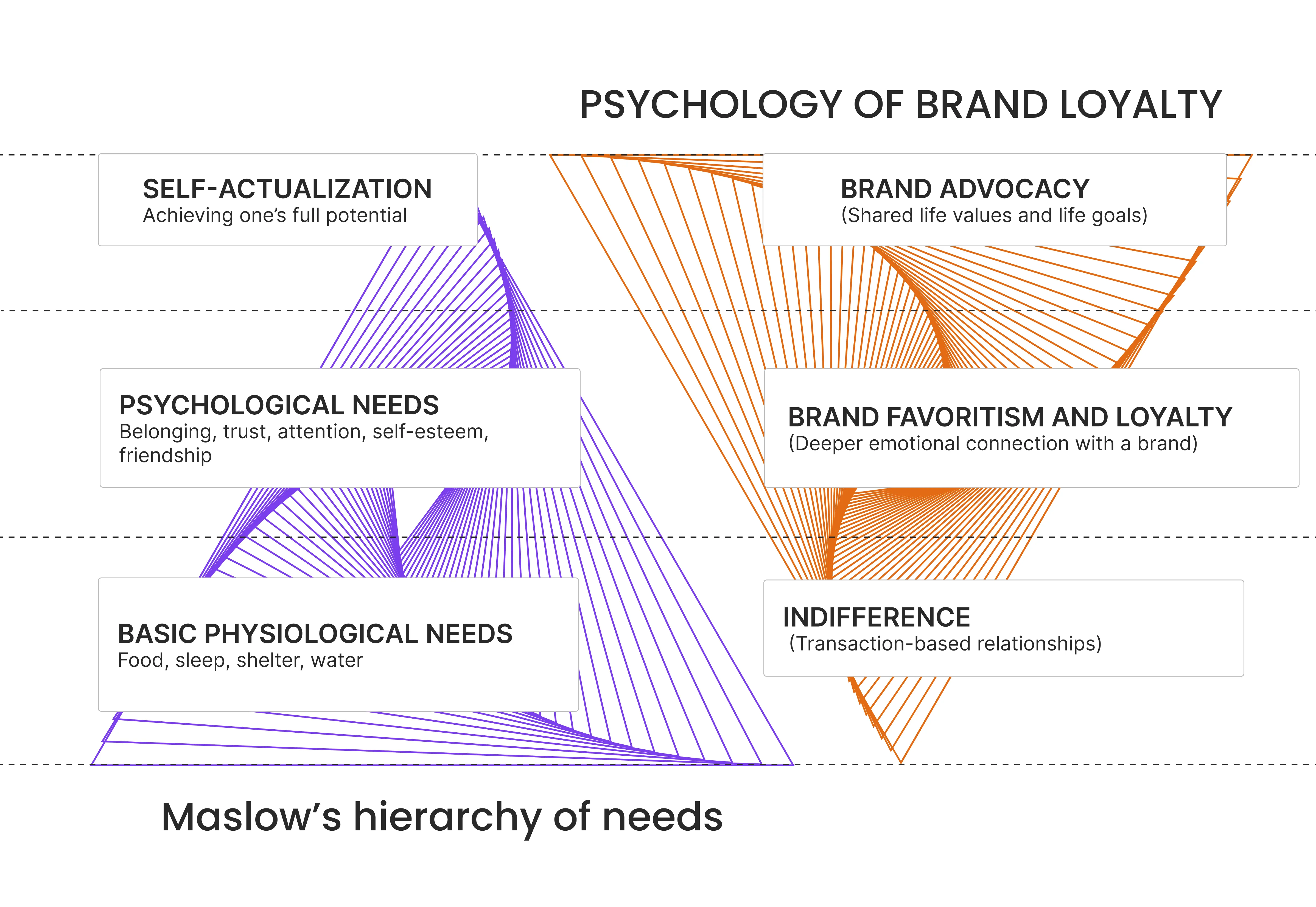
Following that example and Maslow’s concept, we can say that brand loyalty begins to form only when the brand delivers something more than warmth, for example, comfort, reliability, emotional connection, or a sense of identity.
Your ultimate goal, thus, is to move beyond satisfying basic functional cravings and consistently fulfill higher-level psychological and emotional needs. For that, you shouldn’t just sell a product – you should become meaningful in the customer’s life. In practical terms, a highly loyal customer doesn’t just buy from you because they need to. They buy because:
{{cta}}
Ask ten experts what drives customer loyalty, and you'll get ten different answers, with each probably backed by compelling data. The truth is, they'll all be partially right, because loyalty isn't built on a single pillar.
Data collected from customer feedback systems proves that trust forms the foundation. When brands consistently deliver on promises, safeguard data, and maintain transparent policies, customers return. And recent studies show that 26% of consumers intentionally stay loyal to favorite brands (even during economic uncertainty) because they value consistency and trust. General business experience shows this translates directly into higher retention rates and increased order values. But trust alone isn’t enough for customers to become advocates who enthusiastically recommend your brand.
That's where emotional connection enters the equation. Nowadays, it’s hard to deny that personalized communication and empathetic support create emotional bonds that transform satisfied customers into loyal ones. Price and well-designed features might bring customers through the door, but emotional resonance keeps them there.
Meanwhile, tangible value delivery across every touchpoint remains a major driver, too. Frictionless experiences, relevant offers, and consistent rewards through digital platforms make customers stay longer. The importance of the overall customer experience is supported by the fact that businesses investing in CX achieve 16+ points higher revenue growth and 13+ points higher EBITDA margin than peers.
Basically, this means a customer retention strategy can only be effective when it account do all of these elements. Trust without emotional connection feels transactional. Emotional bonds without reliable value delivery won't survive. Smart companies recognize that loyalty emerges from the intersection of consistent quality, genuine empathy, and seamless experiences – not from choosing one over the others.
By connecting with your customers on a deeper level and helping them become the best versions of themselves, you're well on your way to building a loyal following that's both fun and rewarding. So, now let's dive into the major ways to increase customer loyalty in 2026.
In today's market, personalization has become the new black. And it goes far beyond crafting personalized emails or ad targeting. In 2026, more companies are expected to scale their efforts using AI and machine learning for personalization, and the global revenue of customer experience personalization is forecasted to reach around 11.6 billion U.S. dollars this year. This growth reflects organizations investing in more innovative, AI‑enabled ways to give customers greater control over their online engagement.
Additionally, to meet individual customer needs and preferences, more companies started to adopt a "one-to-one" approach, which involves deeper data collection and analysis to provide clients with more customized product features, personalized customer service and product recommendations, and even personal voice assistants and chatbots.
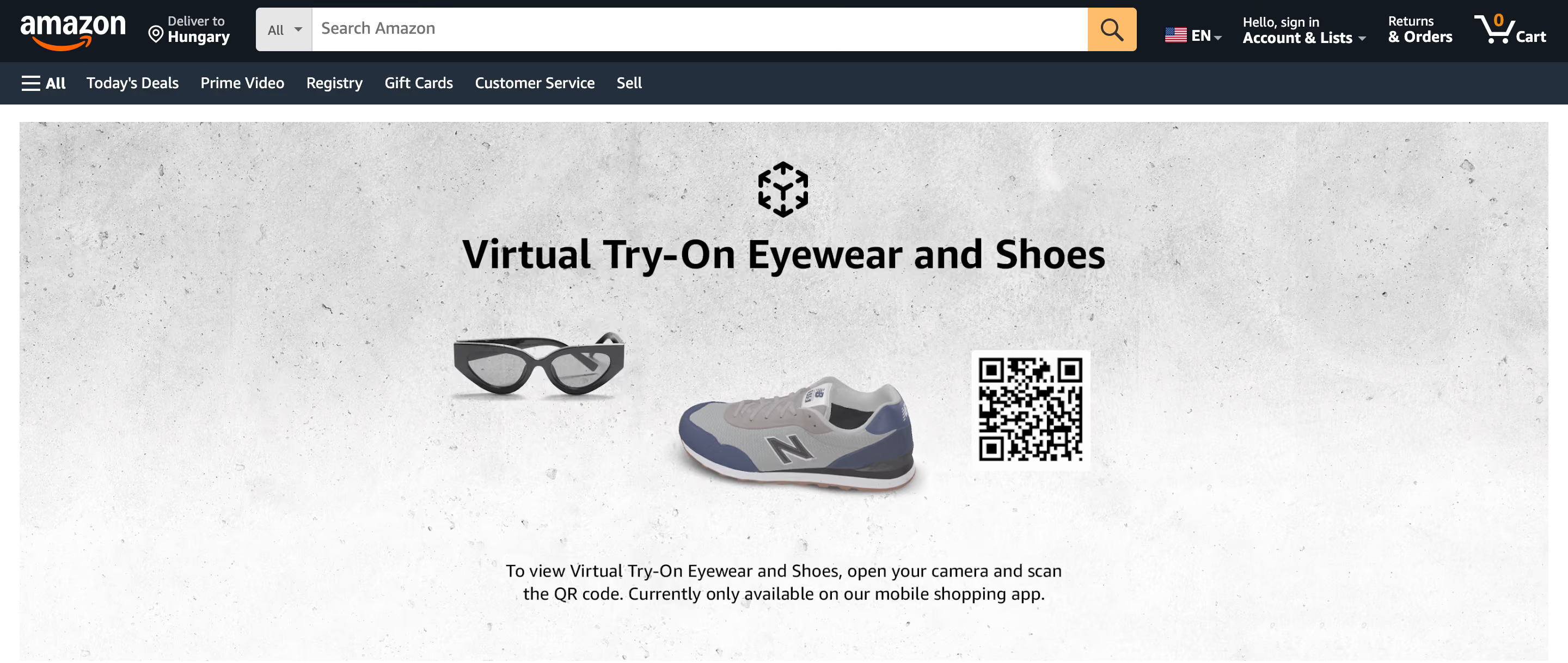
A prime example of advanced personalization is Amazon, which extensively employs personalization through product recommendations, tailored emails, customized search results, and reward and loyalty programs. This strategy has helped Amazon build a loyal customer base, making it one of the most successful e-commerce companies globally.
Today's consumers don't stick to just one platform, and brands can't afford to either. Relying solely on a website or mobile app is no longer enough. Customers move fluidly between devices and channels (often using several at once) to research, ask questions, and make purchases. In fact, people commonly switch between multiple devices and interact with brands through a wide range of touchpoints, such as on-site chat, email, and even social media. Following this, communicating only through one channel has already become a clear sign of poor customer service.
By implementing omnichannel customer support and unifying the customer journey, businesses can create a smooth, consistent experience wherever individuals choose to engage. Whether someone starts a conversation on social media and finishes it via email, or moves from mobile to desktop, the process should feel effortless. When brands make interactions easy, responsive, and connected, customers stay for the convenience, which plays a key role in building long-term loyalty.
According to Okendo's 2024 Loyalty Consumer Research Report, 77% of consumers are more likely to remain loyal long term if a brand offers a compelling loyalty program, and 72% say they purchase more often from brands whose program they belong to. And that checks out because, really, who doesn't like a freebie?
These types of programs work because incentive systems that recognize and reward loyal customers appeal to customers' psychological needs. They emphasize gratitude, recognition, and love that a brand has for its clients. And if you don't have an idea what type of program to implement, here are a few that were proven to work for other businesses:
Delivering excellent customer service, quick, caring, and reliable, is the most important way for any business to build trust and keep customers coming back.
But today, it's much better if you level it up a bit:
With all these trends, it's evident that this will be a year of substantial brand-building. Studies show that customers exposed to a brand repeatedly develop positive attitudes and behaviors toward it. Thus, establishing a consistent and original brand identity that resonates with clients is a must.
A strong brand identity creates positive first impressions, fosters trust and loyalty, encourages repeat purchases, and inspires customers to recommend the brand to others. If your goal is to reach that point, you need to cover the following 3 components:
{{cta-lm}}
"Don't create content that tries to sell. Create content that people want to consume."
– Michael Brenner, CMO Influencer
By providing creative and valuable content, companies can establish themselves as reliable sources of information, ultimately increasing customer retention and loyalty.
According to Adobe, two-thirds of people would rather read something well designed than something plain when given 15 minutes to consume content. Thus, incorporating creative elements into your UX, as well as self-service materials, is a reliable way to increase engagement and make people want to stay with our business.
Here are a few things you might want to consider:
{{cta}}
Loyal customers don’t become such by chance. It takes accurately curated customer loyalty program strategies that connect deeply with their needs and values to keep them interested and locked in. Below you will find what can help you build a loyalty-first approach that turns buyers into long-term advocates.
Given that a staggering 88% of consumers place greater trust in recommendations from friends and family than in any other advertising method, it's clear that word-of-mouth marketing is an efficient way to build long-term customers.
Here are just a couple of practical strategies that can help encourage it and turn happy customers into genuine brand advocates:
When done right, word-of-mouth marketing helps you grow organically by attracting new clients who already trust the recommendation and rewarding customer loyalty.
Another powerful way to turn customers into true brand ambassadors is by standing for values that genuinely matter to them. When people see their own beliefs reflected in a brand, they want to stick with it.
Here are four essential values your brand can embrace:
When these values are clearly defined and consistently expressed, your brand turns from just being another business into something people believe in, trust, and proudly support.
Your “brand promise” is a customer-centric statement that highlights how you help your customers overcome specific challenges and deliver a meaningful impact. It should reflect the unique obstacles your customers face and showcase how your brand is committed to helping them triumph over these difficulties.
Question: What is "the big promise" that you're making to your customer?
To identify your brand's "big promise:"
Example: If you're a fitness brand, your "big promise" could be empowering individuals to achieve their health goals and live their most vibrant, energetic lives. This promise goes beyond just offering workout programs or nutrition plans and instead taps into the clients’ desires to make a lasting, positive change in their lives.
By figuring out and consistently delivering on your "big promise," your brand can cultivate trust, loyalty, and a strong emotional connection with your customers.
One of the most popular customer service tips for ensuring the effectiveness of your customer loyalty strategies is to track key performance indicators (KPIs) that measure your efforts' success. Tracking these KPIs will help you identify areas for improvement and fine-tuning and adjust your strategies to maximize customer loyalty.
Some essential KPIs to track include:
By regularly tracking these customer satisfaction metrics, you can gain valuable insights into the success of your loyalty initiatives and make data-driven decisions to enhance customer retention, loyalty, and lifetime value.
We live in the technological age, so it would be quite impractical to refuse to use the advancements it offers. And believe it or not, there are specific software solutions that might help you upgrade your loyalty program game once and for all.
Of course, the right loyalty platform isn't the one that just tracks points. So, here are five solutions that stand out in 2026, with each having the potential to become a true powerhouse for your customer success.
Overview: Yotpo is a comprehensive customer retention platform designed to help brands build loyalty through reviews, SMS marketing, user-generated content, and rewards, all from a single dashboard.
Pros:
Cons:
Best for: Mid-size to large businesses looking for a comprehensive, integrated retention solution.
Overview: LoyaltyLion is built specifically for brands that want full control over how their loyalty programs work, from points and tiers to referrals and rewards.
Pros:
Cons:
Best For: eCommerce brands focused on online growth and detailed customer insights.
Overview: Smile.io offers an accessible way for businesses to launch and manage loyalty programs without technical complexity.
Pros:
Cons:
Best For: Small to medium-sized businesses looking for a simple, affordable loyalty solution.
Overview: Salesforce Loyalty Management is an enterprise-grade solution designed for organizations already operating within the Salesforce ecosystem.
Pros:
Cons:
Best For: Large enterprises already using Salesforce that need advanced loyalty management.
Overview: Open Loyalty is a headless, API-first platform that gives brands full flexibility to build custom loyalty programs across any channel or technology stack.
Pros:
Cons:
Best For: Businesses with technical resources that want fully tailored loyalty programs across multiple channels.
Overview: Reteno is an AI messaging platform purpose-built for Web2App, trial, freemium, and direct-install funnels, with specialized expertise in the Health & Fitness and Education verticals. Ideal for teams prioritizing retention, loyalty, speed, and automated optimization.
Pros:
Cons:
Best For: Businesses with technical resources that want fully tailored loyalty programs across multiple channels.
You might like: Zendesk's Service Culture: The Customer Service Books Behind Success
While it's clear that the strategies we've discussed for improving brand loyalty and customer retention are essential, one of the ways to increase customer loyalty and the success of your CX efforts is by embracing vulnerability and authenticity.
In today's world, customers crave genuine connections and transparent relationships with the brands they choose to support. You can forge stronger emotional connections with your customers by fostering openness, honesty, and vulnerability as your brand and customer service qualities.
This may involve sharing your brand's journey, including your struggles and challenges, or openly discussing your company's values and purpose. Taking this unexpected approach to customer loyalty can create a sense of shared experience and mutual trust between your brand and its customers.
And, if you need some extra help in fostering customer loyalty, EverHelp’s support experts are ready to help. Book a meeting today, and we will discuss ho to optimize your support processes to make sure your customers stick with you.
Help someone else stay in the know. Hit that share button!






.webp)

.avif)